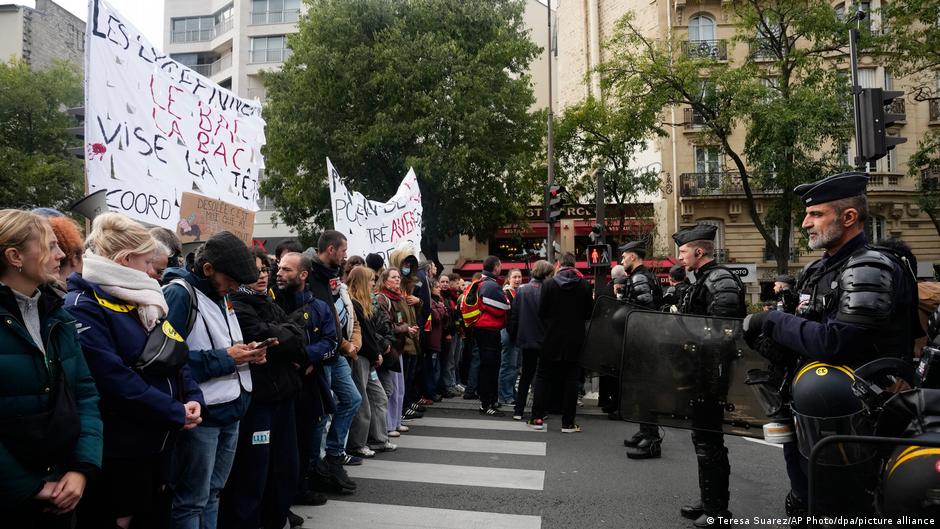
The rhythm of a weekend in modern France is usually set by labor disputes, student grievances, and political maneuvering. But the days leading up to the recent crisis carried a different weight. What began as protests over the education system and the soaring cost of living quickly spun out of control. By the end of that chaotic stretch, the mood in the streets had shifted from policy debate to physical confrontation. For the first time in years, the question for the French government was no longer how to manage a march, but how to protect the state from collapsing under the weight of its own public square.

As the sun went down, the situation had deteriorated into what officials would later describe as widespread disorder. This was not just a crowd pushing back; it was a fragmented ecosystem of actors where grievances about inflation mixed with more radical impulses. The result was a scene of looting and violence that would trigger the most severe domestic security response in a decade.
The decision-making process in Paris moved with the speed of a chess match. Following the weekend rioting, security leaders convened at the Élysée Palace. The room was filled with intelligence chiefs and senior ministers, faces grim as they reviewed the damage reports from the provinces. The strategy was not to suppress all speech, but to surgically remove what the state viewed as the threat of 'illegitimacy.' The distinction is subtle in public discourse but sharp in legal terms: the difference between a union-led protest with an alternative route, and a march that intends to break windows in a city center.
While acknowledging that many were driven by economic anxiety, Macron argued that the core of the violence was manufactured.
From those closed doors came a sweeping set of directives. The ban was not uniform across the country but targeted at the heart of the unrest. In Lyon, there was a blanket ban on all protests. In Marseille, Nice, and Toulon, specific demonstrations were prohibited to protect the urban cores. Even in the capital, a major march through Paris was shut down. The logic was defensive: by moving recognized groups to different routes or cancelling them entirely, the government aimed to keep businesses open and public buildings secure.
The sheer scale of the crackdown is staggering. Within days of the initial unrest, 2,700 people had been arrested across France. The judicial system, usually a slow machine, was pushed into overdrive. More than 1,000 of those individuals appeared in court, a rapid funnel designed to clear the streets before the next Saturday. Of that total, 217 people were convicted in fast-track trials and jailed for their role in the previous weekend's disorder. It is a rare logistical feat: moving thousands of accused individuals through the French legal system in a matter of days, suggesting a state of emergency where speed is prioritized over the typical pace of due process.
Presidents rarely assign blame so specifically. But Emmanuel Macron did. In his assessment of the week's events, he drew a sharp line between the average protester and the architect of chaos. While acknowledging that many were driven by economic anxiety, Macron argued that the core of the violence was manufactured. He placed the burden on 'rioters who came expressly to loot,' but then went further, pointing the finger at 'political and seditious acts by ultra far-left groups.'
The language was deliberate. By using the word 'seditious,' Macron invoked a legal framework that treats opposition not just as a political stance, but as an attempt to undermine the very foundations of the state. He asserted that these groups 'aim to bring down the Republic.' This is a high-stakes claim. It suggests that in the dark of the streets, the issue was no longer about tuition fees or housing costs, but a fundamental challenge to the existence of the French state itself. It is a narrative that justifies the heavy hand of the police: you are not arresting citizens because they disagree; you are arresting them because they are trying to break the system.
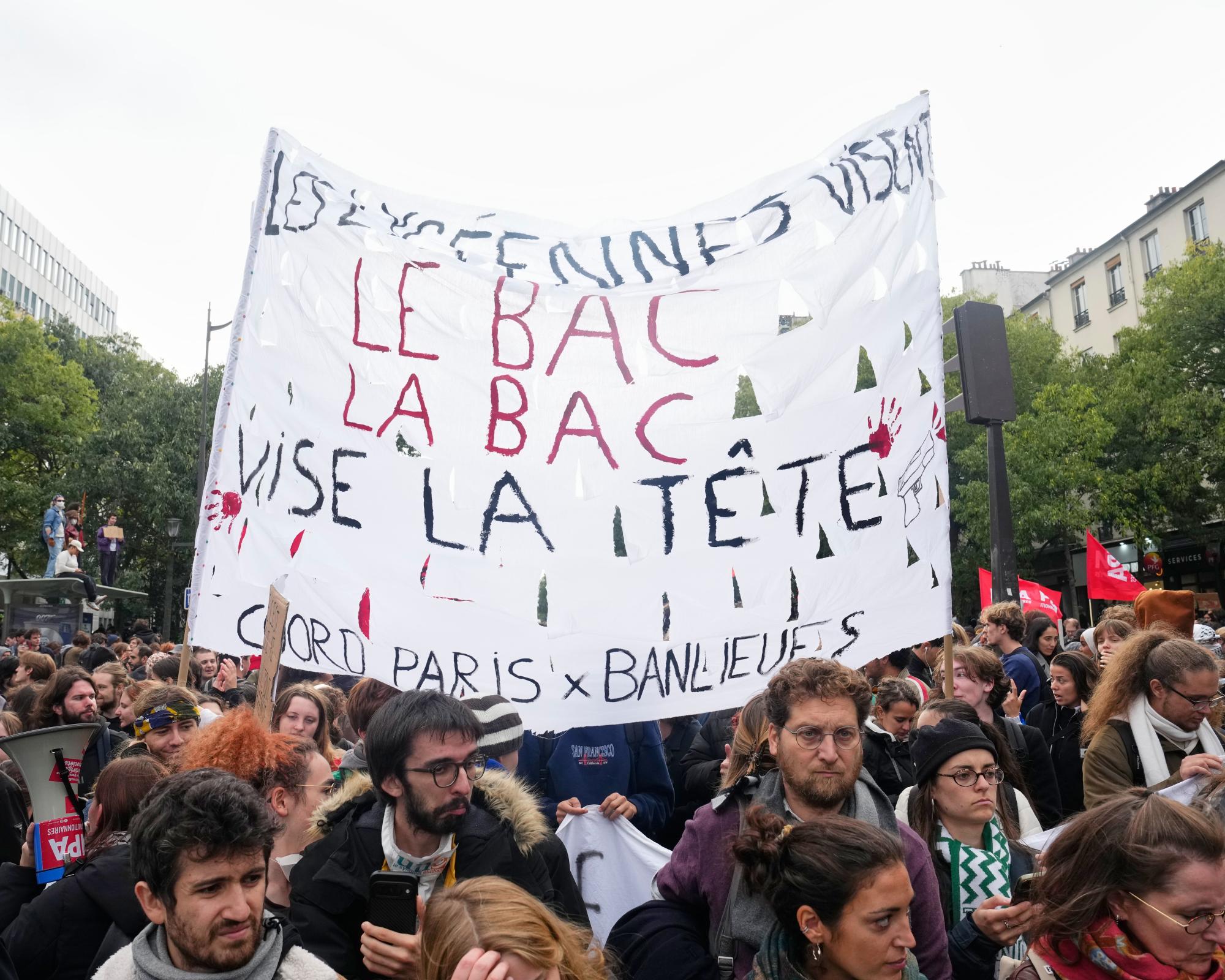

French President Emmanuel Macron said on Thursday that "illegitimate" protests would be banned in the coming days and blamed "seditious" ultra-left groups and vandals for last weekend's riots and looting. https://t.co/ZayXiV9Tk1
The state's response to this accusation was not just verbal; it was kinetic. Ahead of the next scheduled protest day, Jean-Didier Berger announced that police deployments would be increased by 20 percent compared to the previous weekend. This is a massive logistical shift for the French police, who already operate under strained conditions. The increase was intended to create a visual and physical barrier between the city center and the protesters. The message to the public was one of reassurance: the state was watching, and the state was prepared to hold the line, even if it meant the streets would be far more crowded with officers than with marchers.
To back up the police presence, local authorities in several cities imposed curfews in the immediate aftermath of the rioting. This is an instrument rarely used in France, where the open night has long been a symbol of freedom. With these curfews in place, the movement of people was physically restricted, not just by police barricades but by law. The effect was to freeze the city, forcing a separation between the public and the private that normally blurs during a crisis. The curfews provided a necessary window for city managers to clean up, secure businesses, and stabilize the situation before the next wave of public opinion could form.

Emmanuel Macron warned that the government will ban protests that are not organised by legitimate groups such as unions to prevent a repeat of the rioting and looting that erupted across France last weekend. https://t.co/t8XIGveGQn https://t.co/yO8qg6BkUD
As the immediate storm settles, the country is left with a new status quo. The 'general recommendation' from the administration is that there should be no demonstrations in the coming days. It is a temporary silence imposed by the state, a breathing space for the republic to recover its composure. Recognized unions have been offered alternative routes, a concession that acknowledges their right to be heard, but only on terms that ensure their march does not disrupt the lives of those who did not ask for the conflict.
The balance of power has shifted. The government has successfully identified a small subset of agitators and contained them within the legal boundaries of jail and ban. But the underlying tensions—about the cost of living and the fairness of the education system—remain. They have not been solved by police tape. They have simply been pushed into the shadows, waiting for a moment when the 'illegitimate' have been cleared, and the question of who is allowed to speak can be answered once more.