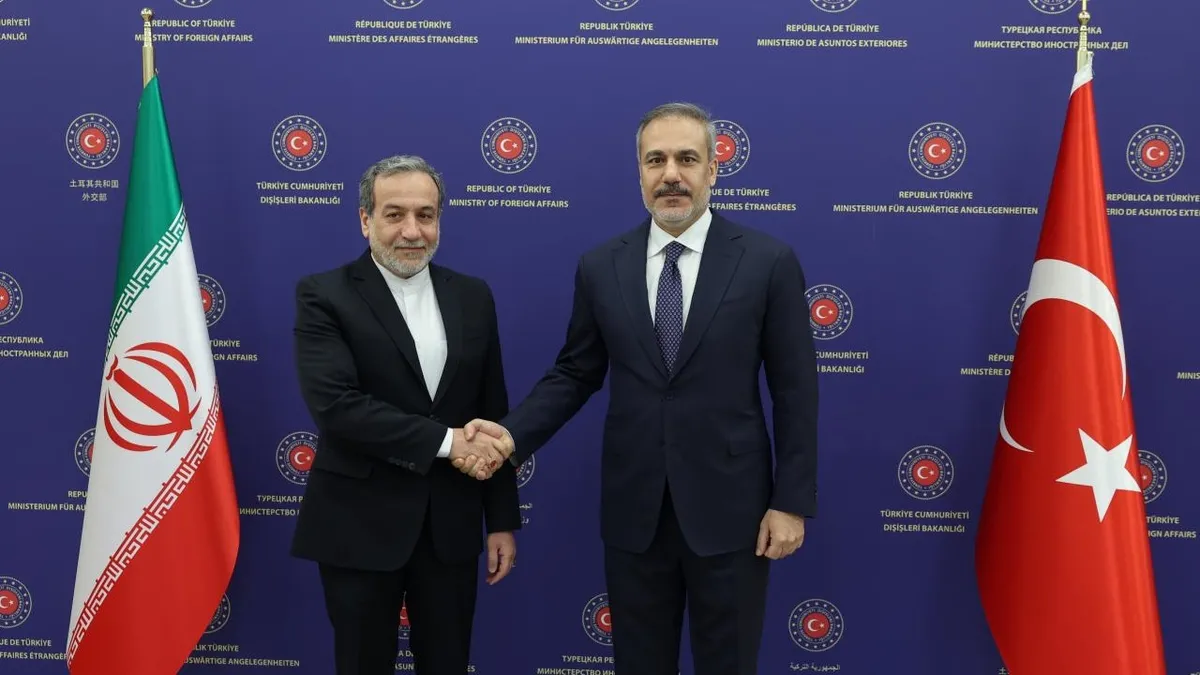
In the high-stakes theater of international relations, the most consequential work is often conducted not in grand summits or before the glare of television cameras, but through the quiet, measured cadence of a telephone call. On November 5, 2026, this reality played out once again when Turkish Foreign Minister Hakan Fidan reached out to his Iranian counterpart, Abbas Arakchi. The conversation, while brief in its public disclosure, served as a vital touchpoint between two nations whose geopolitical interests are inextricably linked by geography and the shifting tides of regional security.

For the casual observer, such a call might appear routine—a standard administrative check-in between neighbors. Yet, in the context of the current Middle Eastern landscape, these dialogues are the essential scaffolding of diplomacy. By maintaining an open line of communication, Fidan and Arakchi are not merely exchanging pleasantries; they are actively managing the friction that inevitably arises when regional powers navigate a complex, often volatile, environment.
Central to the discussion between the two ministers was the state of ongoing negotiations between Iran and the United States. These talks, which represent one of the most delicate and protracted diplomatic efforts in the modern era, cast a long shadow over the entire region. For Turkey, which often finds itself in the position of a strategic bridge, understanding the nuances of the Iran-US dialogue is paramount to its own foreign policy objectives.
By coordinating their perspectives, the two ministers sought to ensure that both Ankara and Tehran remain aligned on the broader trajectory of these talks.
Fidan and Arakchi utilized the November 5 call to review the progress of these negotiations. By coordinating their perspectives, the two ministers sought to ensure that both Ankara and Tehran remain aligned on the broader trajectory of these talks. This is not to suggest a total convergence of interests, but rather a functional alignment—a shared recognition that the outcome of these negotiations will fundamentally alter the regional balance of power. For Turkey, staying informed and involved is a matter of national interest; for Iran, maintaining a dialogue with a regional heavyweight like Turkey provides a necessary sounding board as it navigates its complex relationship with Washington.

Türkiye’s Foreign Minister Hakan Fidan and Iranian counterpart Abbas Araghchi discuss ongoing negotiation process between Iran and US, and other regional developments – Foreign Ministry sources https://t.co/PBP3HOxCNB
Beyond the specific, headline-grabbing negotiations, the conversation between Fidan and Arakchi touched upon the broader, more amorphous category of regional developments. In a region defined by shifting alliances and sudden crises, the ability to interpret regional signals in real-time is a critical asset. The two ministers used the opportunity to exchange assessments, ensuring that neither side is caught off guard by the rapid pace of change that characterizes the current geopolitical climate.
This focus on regional stability underscores the pragmatic nature of the Turkey-Iran relationship. Despite the inherent complexities and occasional tensions that define their interactions, both nations recognize the value of a predictable, communicative framework. By keeping the lines open, Fidan and Arakchi are working to prevent miscalculations that could spiral into larger, more uncontrollable conflicts. As the world watches the unfolding drama of international diplomacy, it is these quiet, persistent efforts—the phone calls, the coordination, the steady exchange of information—that provide the necessary ballast in an increasingly turbulent sea.