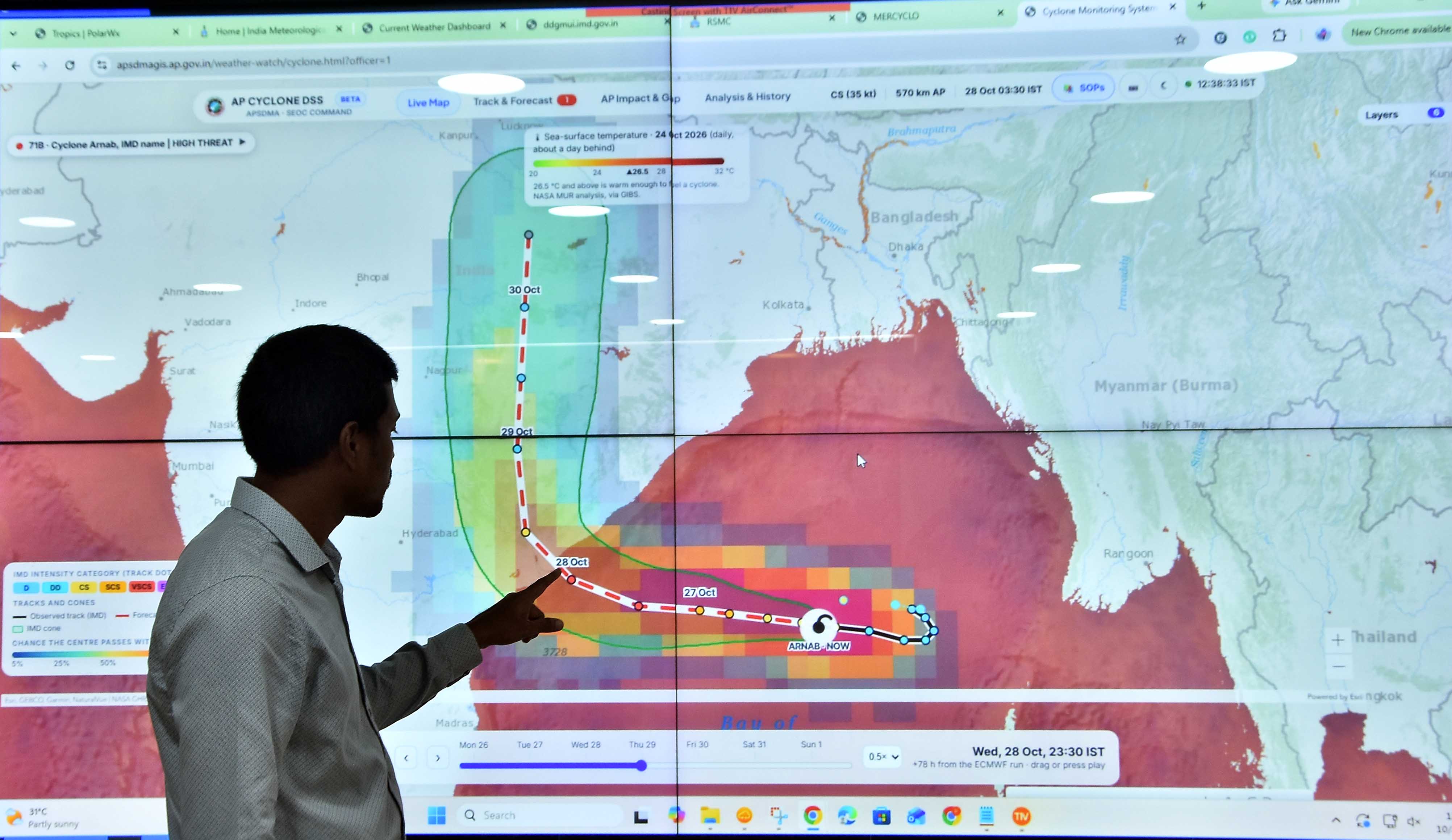
Nature has a way of signaling its intent long before the first gust of wind rattles a windowpane. For the coastal stretches of Andhra Pradesh, that signal is currently manifesting as Cyclone Arnab, a very severe cyclonic storm that is rapidly intensifying as it marches toward the shoreline. The storm is not merely a weather event; it is a massive atmospheric engine, gathering strength and momentum as it steers toward a projected landfall near Yanam. This specific geographic point, situated between Bapatla and Visakhapatnam, serves as the epicenter of an unfolding meteorological crisis.

The scale of the threat is etched into the geography of the region. The path of Arnab is broad and heavy, casting a shadow over 16 districts that now sit under an official Orange Alert. This is not a localized disturbance but a wide-reaching phenomenon that threatens to reshape the landscape of daily life for a vast number of people. The storm's trajectory encompasses 2,460 revenue villages—the fundamental administrative units of rural life—and 92 urban areas, creating a complex web of risk that spans from dense city streets to the most remote agricultural outposts.

Breaking || Cyclone Arnab strengthens over the Bay of Bengal. ➤ Andhra Pradesh braces for widespread rains ➤ Heavy rains likely in Andhra today & tomorrow ➤ Cyclone Arnab intensifies into severe storm
To understand the danger is to understand the physics of the wind. Meteorologists and disaster management officials are tracking a system capable of producing wind gusts reaching 140 kmph. At these speeds, the wind ceases to be a breeze and becomes a physical force, capable of uprooting trees, damaging infrastructure, and complicating any attempt at movement. This intensity, coupled with the projection of heavy rainfall, creates a dual threat: the immediate violence of the wind and the lingering, transformative power of flooding.
To manage the chaos that a landfall brings, a vast network of 2,907 control rooms has been established.
In the face of such a storm, the response must be as organized as the weather is chaotic. The India Meteorological Department (IMD) and the Andhra Pradesh State Disaster Management Authority (APSDMA) have moved into a state of high readiness, coordinating a massive logistical operation. The strategy is one of containment and protection, built upon a foundation of physical structures and administrative oversight. To ensure that the most vulnerable populations have a place of refuge, 1,763 cyclone shelters have been readied across the affected regions, standing as prepared bastions against the rising waters and howling winds.

Andhra Pradesh | Cyclone Arnab intensifies into a severe cyclonic storm over the west-central Bay of Bengal. It is centred approximately 300 km from Visakhapatnam. Widespread rainfall is expected across Andhra Pradesh today and tomorrow: Prakhar Jain, Managing Director of the Disaster Management Authority.
Protection, however, requires more than just empty buildings; it requires a nervous system of communication and command. To manage the chaos that a landfall brings, a vast network of 2,907 control rooms has been established. These rooms operate at both the district and mandal levels, serving as the vital links between high-level decision-making and the immediate needs of local communities. This granular approach ensures that information flows from the coast to the command centers and back again, allowing for a coordinated reaction to the storm's evolving behavior.
While the control rooms manage the data, the actual work of relief and rescue falls to the people on the front lines. To oversee these operations, 3,185 nodal officers have been deployed. These individuals serve as the eyes and ears of the state, tasked with overseeing relief operations on the ground and ensuring that the directives issued from the control rooms translate into meaningful action in the villages and urban centers. They are the bridge between the theoretical preparations of the APSDMA and the lived reality of those in the path of the cyclone.

Cyclone 'Arnab' intensifies: Severe storm headed for Andhra coast; 16 districts on high alert ahead of landfall Read @ANI Story | https://t.co/mPSmcwvB2n #CycloneArnab #AndhraPardesh #IMD https://t.co/coQprKJ3wm
Time is the most critical variable in the current equation. The storm is expected to make landfall near Yanam by Wednesday morning, a deadline that dictates the pace of every evacuation and every reinforcement of local defenses. As the clock moves toward that morning landfall, the atmosphere in the 16 alerted districts is one of focused urgency. The window for proactive preparation is closing, and the focus has shifted from monitoring the storm's intensification to the immediate execution of disaster response measures.

As Cyclone Arnab continues its intensification, the region remains in a state of high alert. The convergence of 140 kmph gusts, heavy rainfall, and a direct path toward Yanam has set the stage for a significant test of the state's disaster preparedness. With thousands of officers deployed and hundreds of shelters waiting, the machinery of the state is fully engaged, waiting for the moment the storm makes its final, decisive contact with the coast.