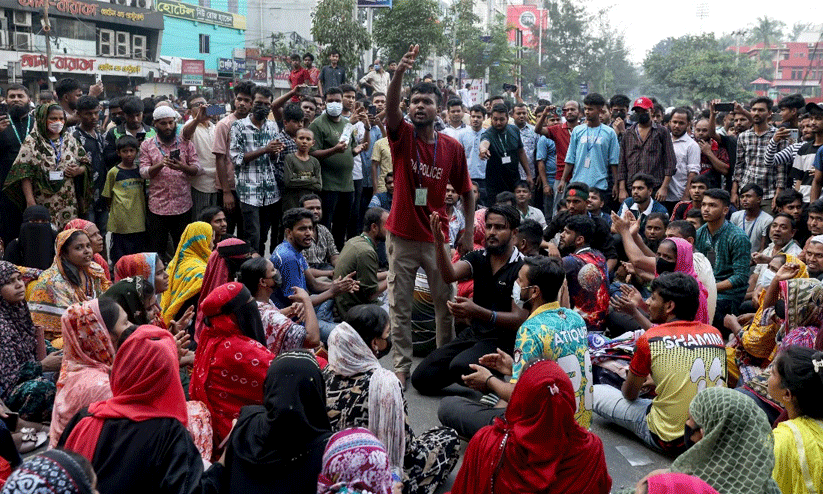
For anyone watching from the outside, the global fashion supply chain often looks like a seamless marvel of logistics, shipping containers, and fast-moving trends. But on the ground, that system rests on human labor that is increasingly pushed to the breaking point by the rising cost of living. On 2026-11-03, this tension erupted into the open across Bangladesh, transforming industrial zones into sites of immense friction. Mass protests by garment workers suddenly paralyzed production, bringing daily operations to a sudden, grinding halt. This was not a subtle negotiation or a polite petition; it was a loud, disruptive demand for survival, echoing through the major industrial belts and signaling that the status quo had become completely unsustainable for the people behind the sewing machines.

The geography of these demonstrations reveals just how vital and fragile this economic ecosystem truly is. The unrest tore through critical manufacturing hubs, with protesters blocking major roads, clashing directly with police, and attacking factories in Dhaka, Ashulia, and Gazipur. The physical toll on the industrial infrastructure quickly mounted. By the time the disruption peaked, textile factories were halted due to protests, sweeping through an astonishing 679 factories across the region. The sheer scale of these shutdowns demonstrated the collective power of the workforce, turning quiet manufacturing zones into battlegrounds of economic discontent.

🚨MASSIVE: Bangladesh’s 500 Textiles Factories and Mills Face Shutdown in Just 2 Days While India’s Textile Exports Surge 17% Bangladesh’s textile industry is facing a major disruption. In just two days, around 500 garment and textile factories are reportedly facing shutdowns amid escalating wage protests by workers across major industrial hubs. From Ashulia and Gazipur to Savar and Mirpur, factories have been forced to suspend operations as demonstrations intensify. Production has been disrupted, roads blocked and clashes reported, putting further pressure on an industry that accounts for more than 80% of Bangladesh’s exports. At the heart of the crisis is a bitter wage dispute. Workers are demanding a substantial increase in minimum wages, arguing that the existing pay structure has failed to keep pace with the rising cost of living. The government’s wage negotiations have so far failed to end the standoff. For Bangladesh, this is far more than a labour dispute. Garments are the backbone of its export economy. Prolonged factory shutdowns could mean delayed orders, disrupted supply chains and growing concerns among international buyers. And this is where the story takes an interesting turn. While Bangladesh’s garment sector is battling factory closures and labour unrest, India’s textile exports have been moving in the opposite direction. India recorded approximately 17% growth in textile exports, with strong momentum across textiles and apparel. Textile exports alone reportedly rose around 20%, while apparel exports grew by approximately 13%. India is also removing long-standing bottlenecks for manufacturers, including working-capital problems created by the inverted GST structure, while expanding manufacturing capacity through PM MITRA textile parks, PLI incentives and other policy measures. The global apparel supply chain is constantly searching for reliable, competitive manufacturing destinations. Bangladesh is currently struggling to keep its factories running. India is positioning itself to capture the opportunity. If Bangladesh’s labour crisis continues while India maintains its export momentum, the competition for global textile orders could begin to shift decisively in India’s favour.
At the heart of this sweeping unrest lies a stark and uncompromising arithmetic of survival. For years, the baseline compensation for workers has been anchored at a minimum monthly wage of 12,500 taka. Consequently, protesters are demanding a doubling of the minimum monthly wage to 30,000 taka. It is a massive leap, but from the perspective of the workers, it reflects the true cost of living in an economy that has left them behind.
It is a massive leap, but from the perspective of the workers, it reflects the true cost of living in an economy that has left them behind.
To understand why these protests carry such immense weight, one must look at the sheer scale of the industry involved. Bangladesh stands as the world's second-largest exporter of clothing by volume, occupying a foundational role in international retail. This massive enterprise is powered by nearly 4 million people employed in Bangladesh’s garment sector, a workforce where women workers are disproportionately affected by the crisis, bearing the brunt of low wages and high living costs. When this workforce stops, the entire machinery of the nation's primary economic driver stutters to a halt, affecting millions of households that depend on these wages to live.

To understand how disruptions to LNG shipments through Hormuz are reverberating across the emerging world, look no further than Bangladesh 🇧🇩 ⚠️ Once-bustling textile and ceramics plants in the South Asian nation are running well below normal capacity due to gas shortages and high prices. Some factories were forced to halt production altogether in August and September, when an outage at an LNG import terminal compounded the crunch These types of industrial facilities in Bangladesh have been operating at a loss for months. Textile manufacturing, in particular, is energy-intensive, with gas-fired boilers producing steam that’s used in dyeing and finishing the fabrics Bangladesh relied on Qatar for about 60% of its LNG imports last year. That dependence had been a boon following Russia’s invasion of Ukraine in 2022, since long-term agreements helped shield it from the surge in spot prices This time around, the arrangement has been a crippling vulnerability for the world’s second-largest garment exporter. Qatar has been unable to deliver gas, forcing Bangladesh into the pricey spot market to avoid worsening blackouts A single shipment of the super-chilled fuel now costs the country more than $100 million, according to Bloomberg calculations, about four times as much as a contracted cargo would have. That’s resulted in about $2 billion in additional costs so far Bangladeshi manufacturers supplying global brands like H&M and Ralph Lauren are dealing with spiraling energy costs and the possibility of more power cuts. Factory owners are worried that orders could be shifted to competitors in China or India, they told me on a visit to Dhaka last week There’s little relief in sight. While Bangladesh has scaled back purchase tenders, opting for bilateral deals instead, those shipments are still linked to spot prices. The prospect of a revival in LNG flows through Hormuz was dealt another blow last week after a Qatari tanker was attacked despite Pakistan’s arrangementswith Iran for safe passage As gas prices continue to climb in Europe and Asia, the pain won’t be confined to Bangladesh. The longer the crisis drags on, the more industries across the emerging world risk confronting the same pressures now playing out on the factory floors of Dhaka https://t.co/fTr5PgwLs6
As the unrest intensified, the physical security of the manufacturing facilities began to buckle under the pressure. The clashes and blockades soon gave way to more chaotic scenes of destruction as the chaos breached factory gates. Describing the severity of the breakdown, Mahmud Hasan Khan noted, "From 20 to 25 factories were looted," capturing a moment where peaceful demands for better pay collided with volatile, destructive outbursts that terrified factory owners and deepened the crisis.
While workers surveyed their empty plates and shrinking paychecks, the business establishment looked at the ledger and saw an existential threat to the nation's competitive edge. The Bangladesh Garment Manufacturers and Exporters Association adopted a critical stance against the sweeping demands, pointing to the macroeconomic dangers of such a sharp increase. Authorities warn that a significant wage increase could lead to higher production costs, potentially pricing Bangladeshi goods out of the global market and threatening the very export engine that drives the country forward. The sector drives 80% of Bangladesh’s exports, meaning that any shock to production sends shivers through the entire national economy.

Bangladesh’s Garment Industry at a Crossroads --- The backbone of Bangladesh’s economy is under growing pressure. The country’s ready-made garment (RMG) sector is facing rising production costs, energy shortages, declining orders, and factory closures. Thousands of workers have reportedly lost their jobs as manufacturers struggle to stay afloat. Industry leaders warn that without urgent policy support and a stable business environment, one of Bangladesh’s largest export sectors could face even greater challenges. (Business and Human Rights Centre) A strong garment industry is not just about exports. It is about the livelihoods of millions of workers, the country’s foreign exchange earnings, and Bangladesh’s economic future. Protecting this sector should be a national priority. Read ➡️ https://t.co/NrbSCecm82 #Bangladesh #RMG
Faced with paralyzed production lines and escalating street battles, the state was forced to intervene directly in the dispute. On 2026-11-03, the government forms a wage council, stepping into a neutral posture to try and untangle the competing demands of impoverished workers and anxious industrialists. This council now represents the primary institutional vehicle for resolving a crisis that pits human survival against global market economics, leaving millions waiting to see whether compromise is even possible in a system stretched to its absolute limits.