On October 7, 2026 the Cockroach Janta Party submitted a formal application to the New Delhi district authorities seeking permission to hold a demonstration on Saturday, October 10, 2026. The notice outlined the party’s intention to gather at Jantar Mantar to question the Election Commissioner’s conduct.

The planned rally was directed at Chief Election Commissioner Gyanesh Kumar, with demonstrators alleging voter‑list tampering and claims that he had bypassed colleagues to alter Form 6. These allegations formed the core of the Cockroach Janta Party’s grievance.

Central Delhi to face a 24-hour internet suspension | Mobile internet services will remain suspended within a 4-km radius of the Janpath-Kartavya Path crossing in New Delhi from 10 pm on October 9 to 10 pm on October 10, a day on which the Cockroach Janta Party (CJP) has called a protest at Jantar Mantar. The Ministry of Home Affairs (MHA) has approved the temporary suspension of internet services, according to ANI. Instructions have been issued to suspend all forms of mobile internet technology in the area. Full Report Here 👇 https://t.co/IQXT9icp4a #Delhi #Internet #India #Protest #JantarMantar
Delhi Police refused the request, stating that the application arrived only three days before the proposed event, falling short of the mandatory ten‑day notice period required for public assemblies.
Over 120 companies of the Central Armed Police Forces were earmarked for deployment, supplementing the local police strength.
Officials pointed to Section 163 of the Bharatiya Nagarik Suraksha Sanhita, 2023, which is currently in force in the New Delhi District and bars any protest or assembly without prior approval.

Statement : The blocking of BitChat's code on GitHub is unconstitutional and authoritarian. New Delhi, 24 July 2026 The Internet Freedom Foundation (IFF) condemns the order issued by the Indian Cyber Crime Coordination Centre (I4C), Ministry of Home Affairs, directing GitHub to remove the code repositories of BitChat. The order, Notice No. 11072601011432, was issued at 11:16 pm on 23 July 2026 under Section 79(3)(b) of the Information Technology Act, 2000 read with Rule 3(1)(d) of the IT Rules, 2021. The order directs GitHub to disable access to three repositories, including the Android application and its release files, within three hours. It threatens the platform with loss of safe harbour and criminal prosecution. No copy was published by the Government of India. The public learnt of it from a post by @jack, whose team develops BitChat. Censorship in India now comes to light through disclosure by the censored. Since 17 July 2026, the Ministry of Home Affairs has suspended mobile internet around Jantar Mantar as per public reports about five times, most recently within a 1.5 kilometre radius from 4 pm until midnight on 23 July. That radius takes in Janpath and parts of Connaught Place. Reports describe signal jammers at the protest site and people walking two kilometres before their phones work. Inside that zone a student separated from her group during a detention drive cannot send a message to say where she is. Thousands of students and young people have camped at Jantar Mantar since June, seeking accountability for examination irregularities. Permission for their march to Parliament was refused. Metro stations were shut and also internet connectivity has been blocked. BitChat is an open source application built for exactly this situation. It passes messages from phone to phone over Bluetooth, without mobile networks or a central server. It is striking that the order does not identify a single unlawful message. It objects to what BitChat is. In its own words, the application is dangerous because it enables communication "even during network restrictions" and can "circumvent lawful restrictions" during "internet shutdowns". Hence, the government's objection is that citizens can speak to one another while it has switched the internet off. The order is illegal on at least four grounds. 1. Section 79(3)(b) is not a blocking power. In Shreya Singhal v. Union of India (2015) 5 SCC 1, the Supreme Court read down the provision. Intermediaries may be required to act only on a court order, or a government notification confined to the grounds under Article 19(2) of the Constitution. Blocking is governed exclusively by Section 69A and the Blocking Rules, 2009, which require a hearing and reasons recorded in writing, subject to review. Directions issued under Section 79(3)(b), Rule 3(1)(d) and the Sahyog Portal evade these safeguards, and constitutional challenges to this parallel regime are pending before High Courts. 2. The reasons in the order are circular. The order asserts that the repositories contain "information which is prohibited under any law" without naming any such information, and rests on what the application is "capable of" enabling. Anticipated misuse of a communications tool is not a lawful basis to prohibit the tool. By this logic a telephone exchange could be sealed. 3. The order cites Section 43 of the IT Act, a civil compensation provision, alongside conspiracy and abetment offences under the Bharatiya Nyaya Sanhita, 2023, against a platform that hosts code. 4. A three hour deadline issued close to midnight forecloses legal assessment and recourse, and fails the proportionality standard in Anuradha Bhasin v. Union of India (2020) 3 SCC 637. The order also fails on its own terms as deleting a repository does not delete the application from any phone that carries it, and the mesh keeps functioning without servers. What the takedown actually prevents is scrutiny of the underlying code. IFF demands
Joint Commissioner of Police Nupur Prasad said, “Permission has not been granted for relevant reasons.”
She added, “Section 163 of the BNSS is in‑force in the New Delhi District at the moment, and this clearly prohibits any form of protest or assembly.”

48-Hour Mobile Internet Ban In #Tripura As Northeast Opposes #CitizenshipBill; Protests In Assam, Delhi Details: https://t.co/ywzVuyOyts https://t.co/d6Fxr3HhJ1
Prasad further explained, “permission for the proposed demonstration had been denied because the application was submitted on October 7, only three days before the event, whereas rules require at least 10 days’ notice.”
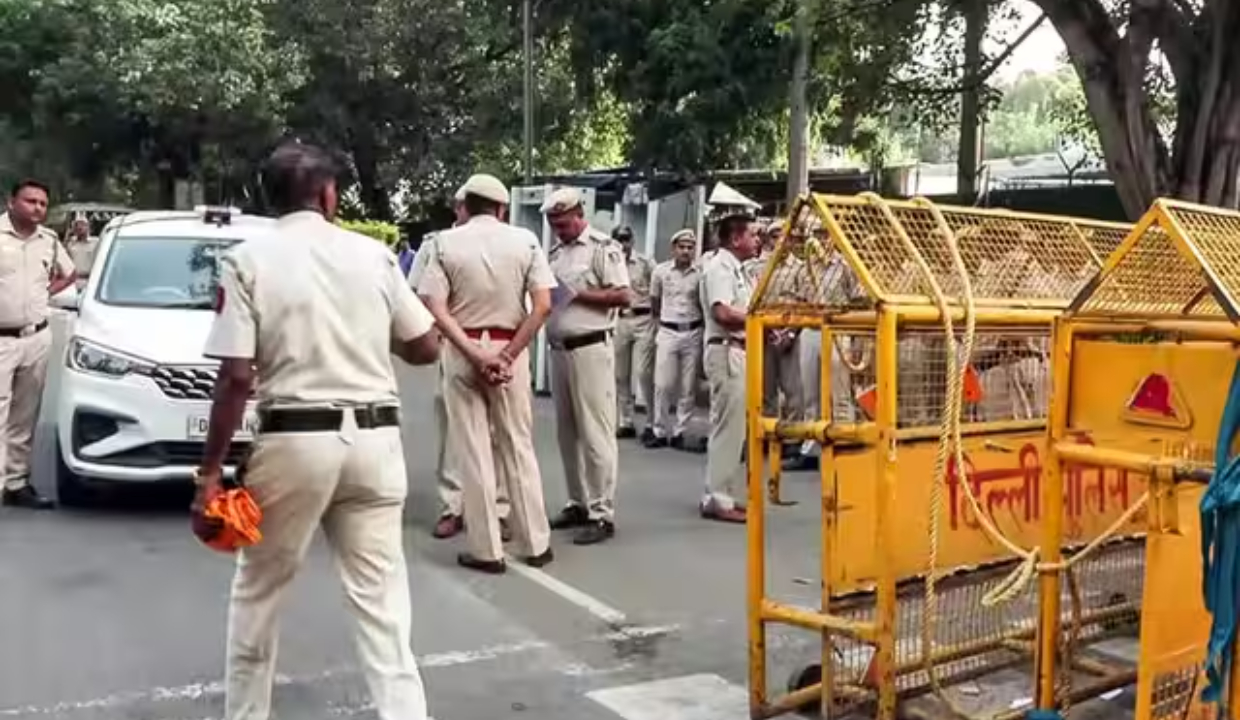
In anticipation of the gathering, Delhi authorities deployed approximately 25,000 police and paramilitary personnel to the city.
As part of the security plan, the entry and exit gates of 57 metro stations across Delhi were shut down to control crowd movement.
New Delhi was divided into twenty distinct zones for real‑time monitoring, allowing commanders to track developments sector by sector.
Over 120 companies of the Central Armed Police Forces were earmarked for deployment, supplementing the local police strength.
The Union Home Ministry gave its approval for a temporary suspension of mobile internet services in a four‑kilometre radius around the protest site.
The blackout was set to begin at 10 p.m. on October 9, 2026 and to end at 10 p.m. on October 10, 2026, covering a full twenty‑four‑hour period.
The restricted zone extends four kilometres from the Janpath–Kartavya Path crossing, effectively encompassing the area surrounding Jantar Mantar.
Concurrently, the excise department ordered all liquor shops in Delhi to remain closed on October 9 and October 10, 2026.
Police reiterated that, under the prevailing Section 163, any form of protest or assembly is prohibited unless expressly authorised.
The Cockroach Janta Party, the group that filed the application, is the organisation behind the planned demonstration at Jantar Mantar.
The sequence unfolded as follows: application filed on October 7, internet services suspended from 10 p.m. October 9 to 10 p.m. October 10, and the protest slated for October 10.
As of the evening of October 9, security forces are in place, metro gates are closed, and the city prepares for the impending communications blackout ahead of the scheduled rally.