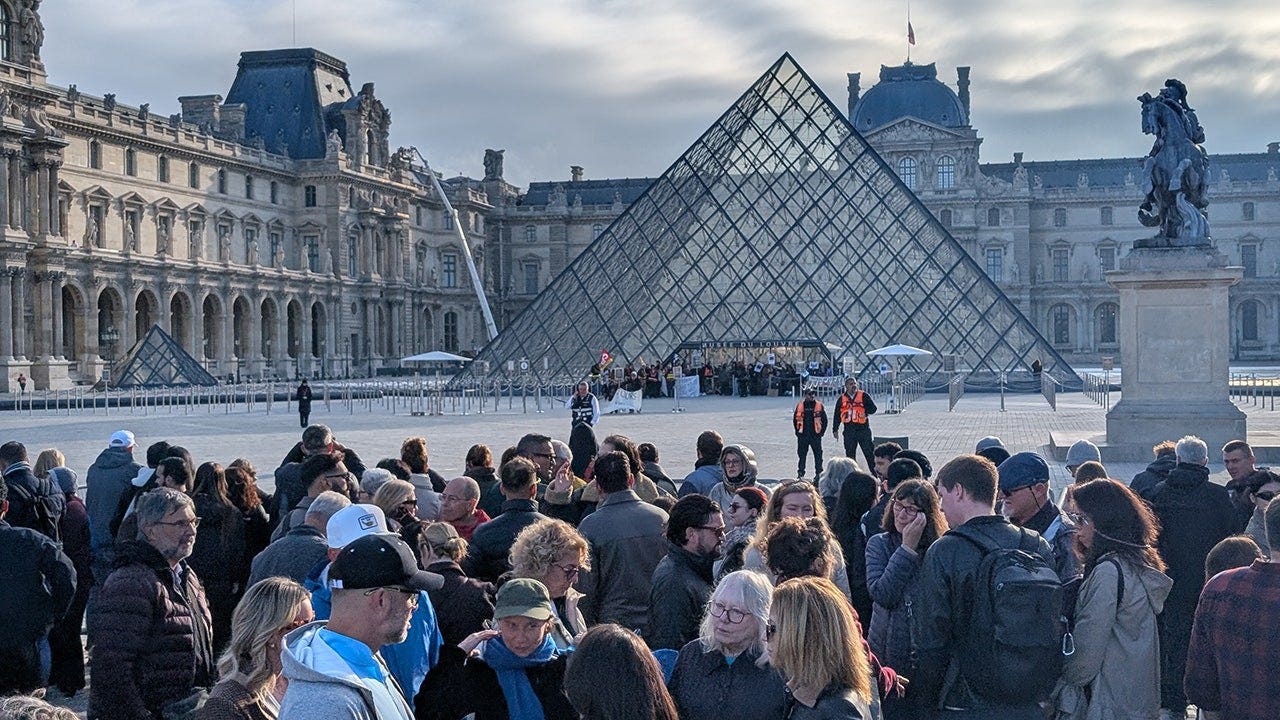
On October 19, 2026, the Louvre, Paris’s crown jewel of art and history, became a fortress under siege. Protesters, their voices echoing through the glass pyramids, barricaded the museum’s entrances, forcing its doors to close. Inside, the Mona Lisa and other masterpieces stood silent, their admirers locked out. Outside, the city’s pulse quickened as demonstrations spread, paralyzing not just the Louvre but other landmarks like the Eiffel Tower and the Château de Versailles. For a city that thrives on tourism, the shutdown was more than an inconvenience—it was a shockwave.
The Louvre’s closure wasn’t an isolated incident. It was the latest flashpoint in a wave of protests sweeping France, fueled by economic discontent and rising prices. What began as a cry against financial strain had escalated into a standoff between demonstrators and the government, with cultural institutions caught in the crossfire. The museum’s iconic façade, usually a backdrop for selfies, now symbolized a nation’s turmoil.
By midday, the government responded with a curfew, an attempt to quell the unrest. Tourists, many of whom had traveled thousands of miles to stand before masterpieces, found themselves stranded. Local tour guides, whose livelihoods depend on the museum’s steady stream of visitors, faced sudden uncertainty. The conflict between protesters and tourists became palpable—a clash of priorities in a city where culture and commerce are intertwined.
The Louvre’s closure became a metaphor for the impasse—a cultural treasure inaccessible, a dialogue broken.
The Louvre’s closure extended beyond the weekend, its reopening date uncertain. For Paris, this wasn’t just a loss of revenue; it was a blow to its identity. The museum, which draws millions annually, is more than an attraction—it’s a symbol of France’s cultural legacy. Now, it stood as a silent witness to the country’s divisions.
The protests were rooted in broader discontent. Rising prices had strained households, and the government’s response—or lack thereof—had ignited frustration. What started as economic grievances had morphed into a movement, with students and workers taking to the streets. The Louvre, a global icon, became a strategic target, its closure a powerful statement against the status quo.
Yet, the choice of the museum as a protest site wasn’t without irony. The Louvre, a repository of history, now found itself at the center of a struggle over France’s future. Its barricaded gates mirrored the barricades of revolutions past, a reminder that the streets of Paris have long been a stage for upheaval.
As the protests continued, France found itself at a crossroads. The government blamed violent protesters for the chaos, while demonstrators accused authorities of ignoring their plight. The Louvre’s closure became a metaphor for the impasse—a cultural treasure inaccessible, a dialogue broken. For visitors, it was a missed opportunity; for Parisians, it was a daily reality.
The economic impact was immediate. Tourism, a lifeline for the city, suffered as cancellations piled up. Hotels, restaurants, and shops felt the ripple effects. Yet, for the protesters, the disruption was necessary, a means to force change. The Louvre, in their eyes, was more than a museum—it was a platform, a way to amplify their voices on a global stage.
Amid the chaos, individual stories emerged. Tourists, their itineraries upended, stood outside the Louvre’s gates, their disappointment palpable. A local guide, who had spent years studying the museum’s treasures, now faced an empty calendar. For them, the protests were personal, a collision of their dreams with the nation’s struggles.
The conflict also highlighted the tension between preservation and progress. The Louvre, a guardian of art, was now a battleground. Its walls, which had withstood centuries of history, now bore the marks of a new era. The question lingered: Could France protect its past while addressing its present?
As of now, the Louvre remains closed, its reopening contingent on the protests’ resolution. The demonstrations, though localized, have sent ripples across France, sparking debates about economic policy and social justice. The museum, once a symbol of unity, now reflects a nation’s fractures.
For Paris, the closure is a temporary wound, but for France, it’s a reckoning. The Louvre’s gates, once open to all, are now a reminder of the challenges ahead. As the protests continue, the world watches, waiting to see if France can heal its divisions—and if its cultural heart will beat once more.