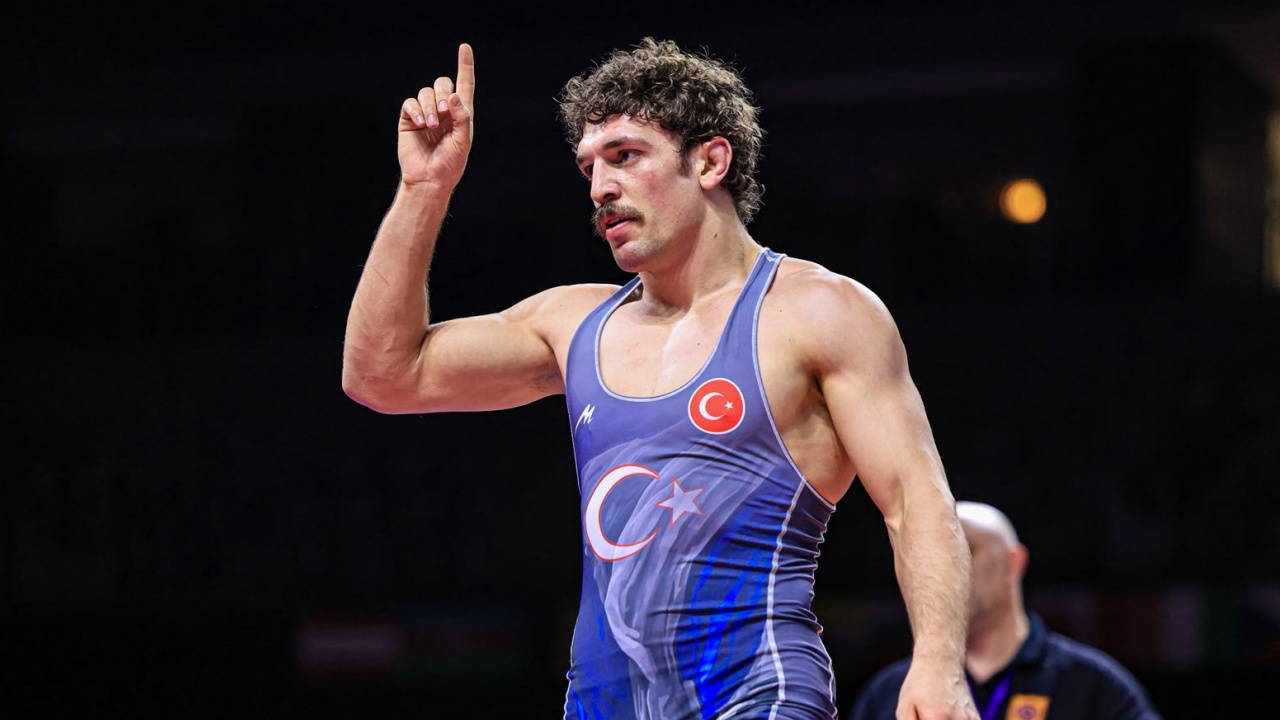
Sarıçiçek competed in the 82-kilogram Greco-Roman style, a discipline where two men grapple in a closed room, relying on strength, throws, and the refusal to fall. By the end of the week in Astana, he had done enough to claim the runner-up spot, but not enough to take the top prize.
The road to the final was not simple. Sarıçiçek had to beat his way through a gauntlet of high-level opponents. In the second round, he faced Halishan Bahejiang, and the contest was tight, finishing 7-5 in Sarıçiçek’s favor. That was a warning shot: no match in this weight class is a formality. He continued his ascent, dispatching opponents to reach the quarter-finals, where he secured a 10-2 victory. The momentum built through the semi-final, where he dominated his opponent 6-0. By the time the final whistle blew, the Turkish wrestler had proven he could handle the pressure of the world’s best.
The opponent in the final was Gholamreza Javad Farokhisenjani, a name that carries significant weight in the wrestling world. The match ended 7-1 in favor of the Iranian champion. That scoreline might look like a comfortable win for Farokhisenjani, but Sarıçiçek’s own account of the match tells a different story. He described the early stages as going exactly according to plan. "For the last two minutes, everything was going as we hoped and planned," he said. "There is no way beyond fate. We all know that."
To lose the final so convincingly, yet feel that he had the game in hand until the end, created a complex emotion of pride and regret.
What happened in those final moments of the match was the difference between gold and silver. Sarıçiçek admitted he made a mistake, a lapse of experience that cost him dearly. "I made a junior-like mistake," he explained. "I couldn’t perform the last phase. While I was going for a point while in the lead, I gave it away myself." In wrestling, when you are in control and your opponent is tired, you can sometimes get caught under the pressure of finishing the job. Sarıçiçek’s attempt to score more points backfired, and Farokhisenjani capitalized to secure the 7-1 result.
Sarıçiçek did not hide his frustration. To a wrestling fan, losing a match you were supposed to win is a specific kind of sting. It is not just about the medal color; it is about the narrative of the match. He had outscored opponents earlier in the tournament, including a 10-2 win in the quarter-finals and a dominant 6-0 semi-final. To lose the final so convincingly, yet feel that he had the game in hand until the end, created a complex emotion of pride and regret.
But Sarıçiçek is not a one-year wonder. He is a long-term player looking at the bigger picture. The 2027 World Championships are not just another title fight; they are the crucial stepping stone for Olympic selection. "Nothing is over yet. I will bring the belt to my country," he stated. "In the 2027 World Championship, the Olympic selection begins. Of course, everyone has an Olympic dream, and I do too. I believe I will represent my country in the best possible way at next year's World Championship."
The 2027 World Championships will be the defining moment for many athletes competing in the 82-kilogram category. Olympic qualification is brutal, and a silver medal in 2026 is a strong foundation, but it is not a guarantee. Sarıçiçek’s goal is clear: to win the gold in 2027 to secure his place on the Olympic team. He is not content with being a consistent finalist; he wants to be the champion.
The wrestling community in Türkiye is watching. Sarıçiçek has shown he can beat anyone on his day, as evidenced by his victory over Halishan Bahejiang and his dominant runs through the bracket. The question is whether he can maintain that consistency when the stakes are highest. His admission of a "junior-like mistake" is a sign of maturity. He knows what went wrong, and he is fixing it.
The 2026 World Championships in Astana are already a memory, replaced by the grind of preparation for the next cycle. Sarıçiçek is now one of the top contenders in the 82-kilogram Greco-Roman style. The silver medal is a testament to his skill, but the 7-1 loss in the final is a reminder of the margins in elite sport. He has the talent, the experience, and the determination. Now, he just needs to execute.
As he leaves the mat in Astana, Sarıçiçek is not looking back at the last two minutes of that final. He is looking forward to the 2027 World Championships, where he plans to defend his position and, ultimately, his dream. The path to the Olympics is narrow, but for Yüksel Sarıçiçek, it is one he is determined to walk to the end.