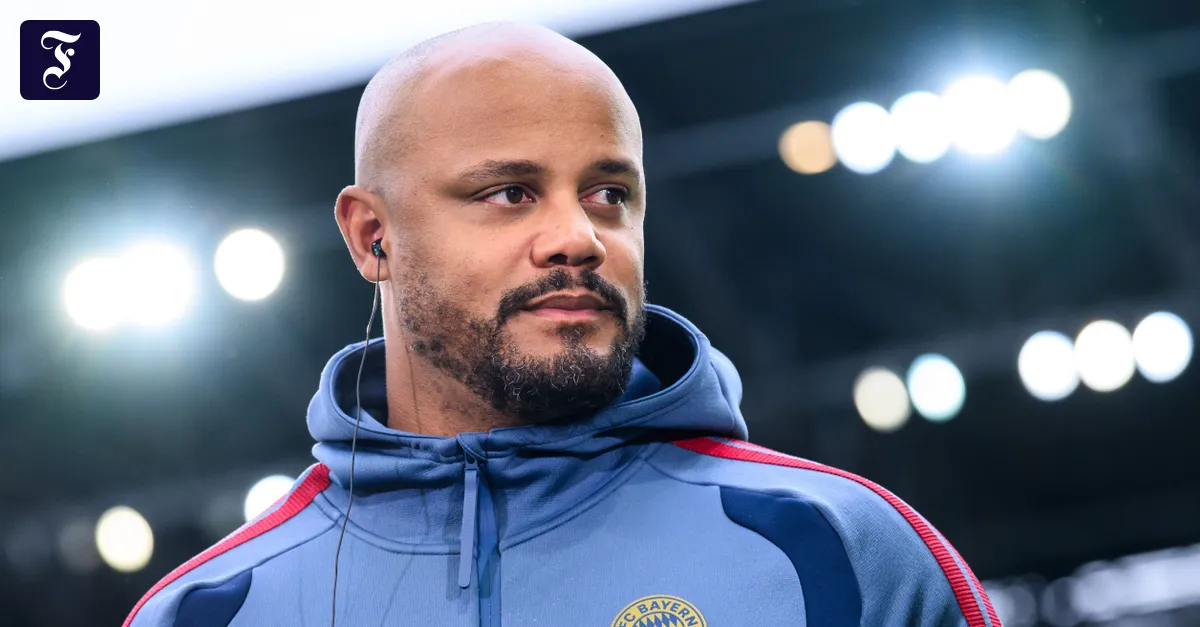
There is a specific kind of stillness that falls over a professional football team when its leader suddenly disappears from the training pitch. For FC Bayern Munich, that stillness was broken last week, not by a dramatic injury, but by a medical mystery that left the staff and fans wondering what exactly had happened to their new head coach. Vincent Kompany, the Belgian striker turned manager who took the reins in Munich, collapsed during a routine session. The incident sent him directly to the hospital, marking a stark and unsettling beginning to a week that would test the resilience of the entire club.

For days, the diagnosis remained a closely guarded secret. While speculation ran wild among those who watch the team’s every move, the club maintained a tight lip, allowing only facts to surface. That changed with the confirmation from Max Eberl, the sports director who leads the football department. Eberl clarified the medical situation with a precision that cut through the noise: Kompany was suffering from an irritation of the brain membrane. It is a specific, inflammatory condition that can cause severe headaches, sensitivity to light, and disorientation. It is not a tumor, it is not a stroke, and it is not a failure of heart or lung, but a distinct irritation that can incapacitate a healthy adult athlete without warning. By naming it, Eberl transformed an abstract fear into a manageable reality.
The immediate outcome of that Friday’s collapse was hospitalization, but the trajectory of Kompany’s recovery has been surprisingly swift. Eberl noted that Kompany was released from the hospital shortly after arrival, a sign that the clinical team saw no need for extended inpatient care. The plan was clear: rehabilitation would continue at home. For a man of Kompany’s constitution and will, going home was not a step back; it was the start of the next phase. The transition from the sterile white walls of a medical facility to the sanctuary of his own home allowed for a recovery that is as much about mental space as it is about physical healing. The hospital stay served its purpose: to diagnose, to treat, and to clear the path for the final stretch of the cure.
The rehabilitation protocol for Kompany is deceptively simple, which is perhaps its most challenging aspect.
In a press conference that felt less like a routine update and more like a message of solidarity, Eberl framed the discharge as a moment of profound relief. "I believe that is the biggest and the most beautiful news for all of us," he said. The phrasing was deliberate, stripping away the corporate detachment that often surrounds sports administration. He spoke not just as a director, but as a colleague and a friend. This public declaration of joy was not just a diplomatic maneuver; it was a signal to the fanbase and the squad that the fear of the worst-case scenario had passed. The “most beautiful news” was not the win on the pitch, but the health of the man leading them there. It was a rare admission of vulnerability from a man who rarely shows emotion, and it landed with a weight that resonated far beyond the walls of the training ground.
The rehabilitation protocol for Kompany is deceptively simple, which is perhaps its most challenging aspect. Eberl explained that the recovery consists of rest and medication. "Reha means for him rest, medication," Eberl stated. There are no complex surgeries, no immediate physical therapy regimens that require a gym. It is a battle of patience and pharmacology. This simplicity requires a discipline that many athletes struggle to maintain. The temptation to push, to prove fitness, to return to the sidelines too soon, is a constant companion. By defining the rehab as “rest,” the club has set a firm boundary. It is a directive to stay off the field, to let the brain membrane heal, and to resist the urge to perform. It is a mental shift as much as a physical one, asking a competitive beast like Kompany to be still.
Despite the quiet nature of the recovery, the expectation at FC Bayern is unshakable. Eberl expressed his confidence in Kompany’s return with a certainty that mirrors the club’s own historical resilience. "Then I am very, very sure that he will soon be back on the sideline with one hundred percent," he said. The phrase “with one hundred percent” is crucial. It does not merely mean returning to work; it means returning to full capacity. In the high-stakes environment of German football, a manager at less than full strength is a liability. The club is banking on Kompany’s return being complete, not partial. This assurance is a lifeline for the players, who need their leader at full voice, at full intensity, and at full presence to navigate the remainder of the season.
The club’s approach to Kompany’s timeline is as careful as its medical handling. Eberl emphasized that Kompany will be given “all the time” he needs. This statement carries the weight of a commitment. “We have always said that, which is why we have spoken of weeks from the beginning,” Eberl added. This reference to weeks sets a realistic expectation for the public. It is not a matter of days; it is a measured, cautious window. Meanwhile, the club must keep its machinery running. For the upcoming DFB-Pokal match against 1. FC Magdeburg, Kompany’s assistant, Aaron Danks, will take over the duties. This transition ensures that the football continues without compromising the coach’s recovery. It is a seamless handover, a t}