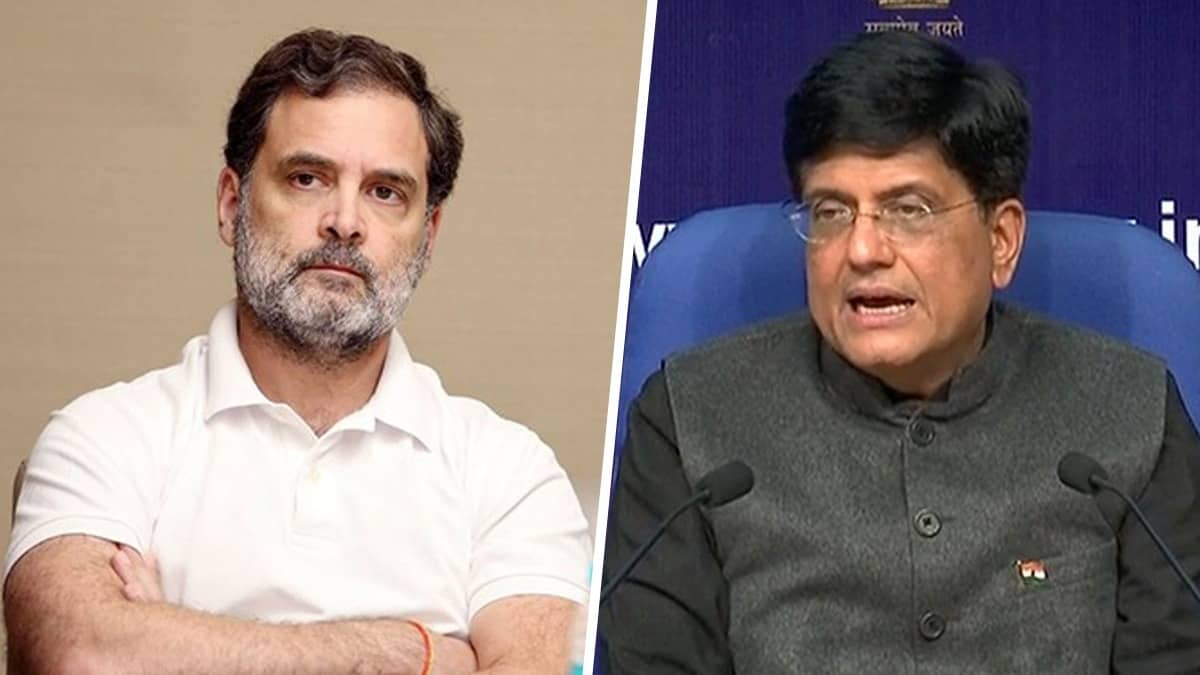
In the high-stakes arena of Indian politics, few institutions carry as much weight as the Election Commission. It is the arbiter of the democratic process, the body tasked with ensuring that the will of the electorate is translated into governance without interference. Recently, the debate over the independence of this institution has intensified, with Rahul Gandhi leading a chorus of criticism regarding its perceived impartiality. However, the response from the current administration has been swift and pointed. Union Minister Piyush Goyal has countered these allegations by shifting the focus from the present to the past, arguing that the accusations of political manipulation are not only unfounded but deeply hypocritical given the historical record of the Congress party.

For Goyal, the current discourse is a matter of selective memory. He contends that the Congress party, which now questions the integrity of the Election Commission, has a long-standing history of blurring the lines between the regulator and the political class. According to the Union Minister, the party has frequently utilized former Chief Election Commissioners (CECs) to serve its own political ends, appointing them to roles as ministers, members of parliament, or governors after their tenures concluded. By framing these past appointments as political rewards, Goyal seeks to undermine the credibility of the current critique, suggesting that the party is projecting its own historical practices onto the current government.
To illustrate his point, Goyal points to a specific, high-profile instance from the turn of the millennium. In 1999, the political landscape was marked by a notable development: T.N. Seshan, a former Chief Election Commissioner, was fielded by the Congress party as a candidate in an election against L.K. Advani. For the current administration, this event serves as a definitive example of the very political entanglement that the Congress party now claims to oppose. By placing a former top election official directly into the electoral fray under their own banner, the Congress, in Goyal’s view, demonstrated a willingness to leverage the prestige and influence of the commission for partisan gain.
Beyond the historical accusations, Goyal’s defense of the Modi government is rooted in a claim of institutional reform.
Beyond the historical accusations, Goyal’s defense of the Modi government is rooted in a claim of institutional reform. He asserts that under the current leadership, the Election Commission has been granted a level of autonomy that stands in stark contrast to the practices of the past. The Minister maintains that the Modi government has deliberately refrained from offering political rewards or positions to election officials, thereby preserving the sanctity of the office. This stance is central to the administration's narrative: that they are not merely following the rules, but are actively fostering a culture of independence that prevents the kind of political co-option they allege was common during previous administrations.

You got it wrong. It’s not Piyush Goyal (BJP Minister), it’s Piyoosh Goyal ( businessman). Different people https://t.co/LEGaTqJuHK
As the debate continues, the fundamental disagreement remains one of interpretation. The Congress party’s criticism of the Election Commission is framed as a defense of democratic values, a warning against the potential for executive overreach. Conversely, the government’s rebuttal is framed as a defense of institutional integrity against what it characterizes as partisan hypocrisy. As Goyal noted, "Congress raises questions on the impartiality of the Election Commission, but completely ignores its own work, its own track record..." This clash highlights the enduring difficulty of maintaining a neutral arbiter in a system where the stakes of every election are absolute. Whether the current autonomy of the commission is as robust as claimed, or whether the historical precedents cited by Goyal are indicative of a deeper, systemic issue, remains a point of intense contention in the national dialogue.