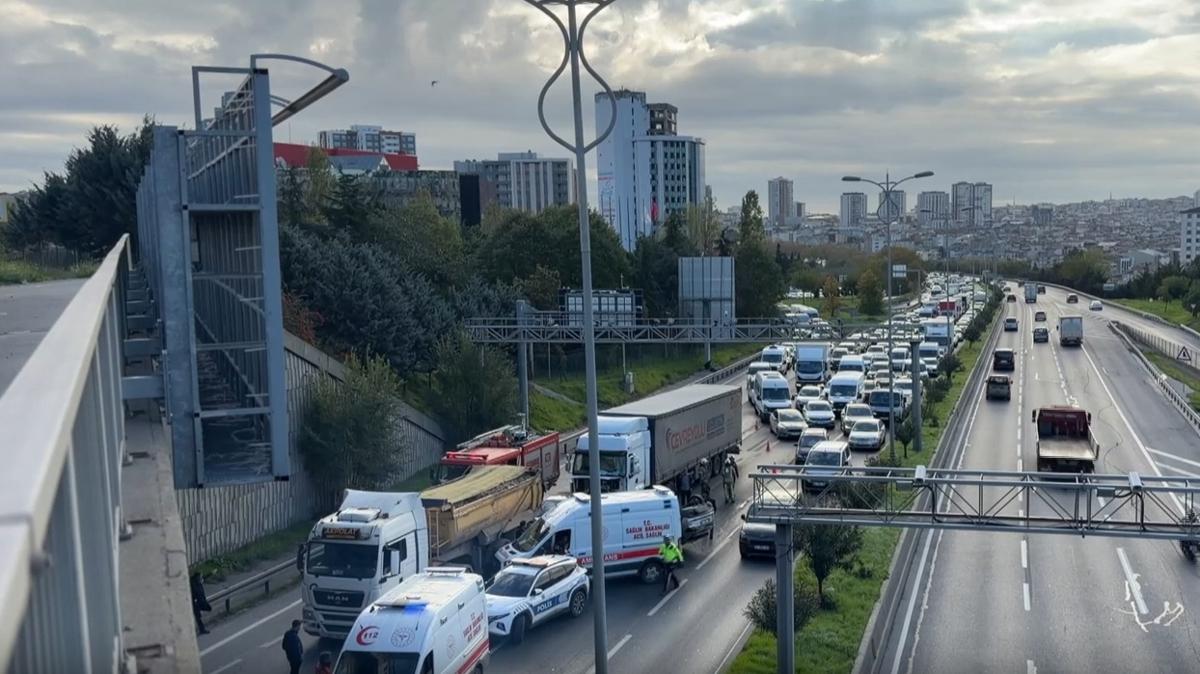
For anyone who relies on the arteries that keep Istanbul moving, a routine commute can change in a fraction of a second. On a recent day, that reality struck the city's vast transit network when a sudden disruption turned a major thoroughfare into a scene of urgent response. It is the kind of modern urban shock that momentarily freezes the daily rhythm of millions, shifting the focus from the ordinary business of the day to the flashing lights of emergency responders.

The incident itself was not a simple fender-bender, but a complex chain traffic accident that ultimately drew in a total of five distinct vehicles. Among them were heavy commercial transports—specifically a dump truck and a TIR, the large semi-trucks that form the backbone of regional freight hauling—alongside three standard passenger cars. The sheer physical scale of these heavy vehicles means that when momentum is abruptly halted on a busy highway, the resulting forces are immense. At least one of the passenger vehicles involved flipped over entirely during the chaotic sequence of impacts, illustrating the violence of the crash.
The location of the accident amplified its immediate impact on the city. The collision occurred on the TEM Highway, heading towards Edirne in the Bağcጚr district of Istanbul. The TEM Highway serves as a vital corridor for both local and international transit, making any disruption here an immediate regional crisis. As the vehicles collided and came to rest across the asphalt, the physical footprint of the wreckage instantly demanded a major spatial response from traffic authorities and highway management systems.
The collision occurred on the TEM Highway, heading towards Edirne in the Bağcጚr district of Istanbul.
Almost as quickly as the dust settled, the machinery of urban crisis management swung into action. Following urgent reports called in by witnesses who bore witness to the sudden violence on the highway, emergency medical personnel, police officers, and fire rescue teams were rapidly dispatched to the scene. For the injured individuals, the arrival of medical teams marked the beginning of urgent roadside care, as emergency workers scrambled to stabilize those hurt in the wreckage while navigating the hazards of an active highway.
Managing a multi-vehicle crash involving heavy trucks requires aggressive intervention to prevent secondary collisions, and that intervention came at a cost to the flow of traffic. Initially, authorities moved to close two lanes of the highway to accommodate the heavy rescue and clearance operations. As the scale of the emergency operation became fully apparent, the closure expanded to encompass three lanes of traffic, leading to significant traffic congestion in the area.
When a major highway loses multiple lanes of capacity in a densely populated district like Bağcጚr, the consequences ripple outward with mathematical inevitability. The lane closures immediately triggered significant traffic congestion across the surrounding area, trapping countless commuters and commercial drivers in sprawling gridlock. This sudden bottleneck served as a stark reminder of how deeply interdependent a modern metropolis is with its transit infrastructure—when one key segment falters, the entire system feels the strain.
As emergency operations continued at the site, the focus shifted from immediate rescue to the painstaking work of clearing the heavy wreckage and restoring order to the asphalt. The overturned vehicles, the scattered debris, and the sheer physical presence of the dump truck and semi-truck required specialized equipment and sustained coordination among police, fire, and medical crews. It is a grinding, unglamorous process that unfolds under the watchful eyes of delayed motorists, highlighting the invisible labor required to keep a massive urban center safe and functional when disaster strikes on the open road.
