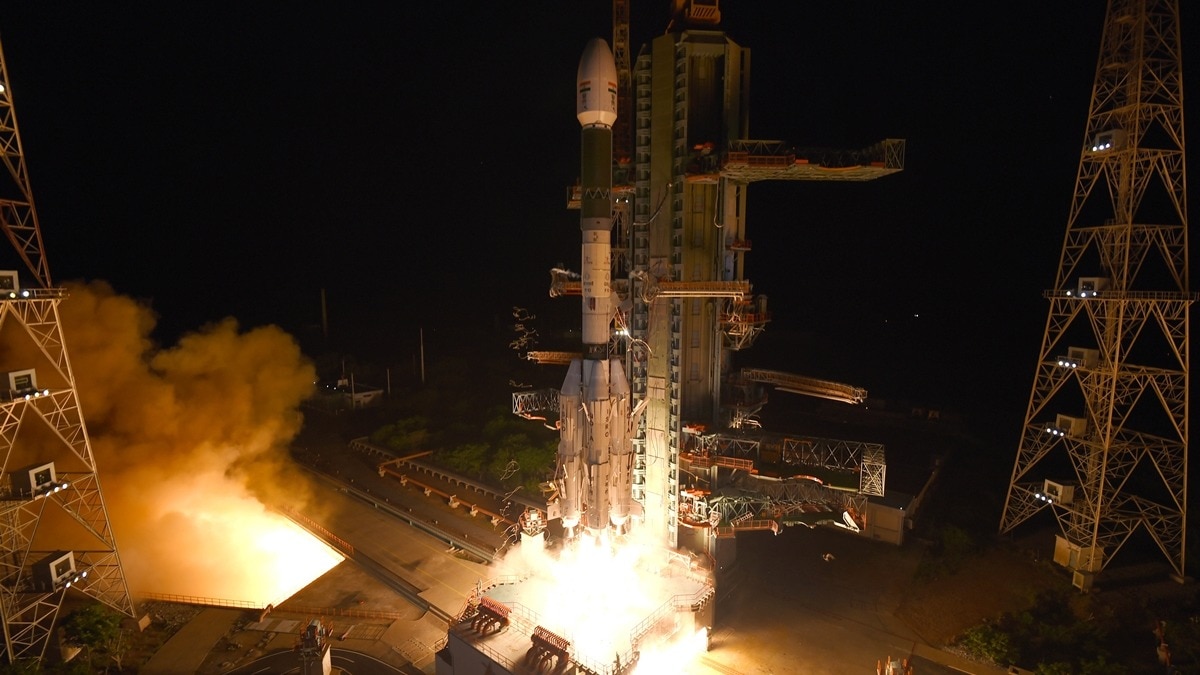
On a crisp October morning in 2026, the Geosynchronous Satellite Launch Vehicle lifted off from the Satish Dhawan Space Centre in Sriharikota, carrying with it a technological advancement that would reshape India's navigation capabilities. The NVS-03 satellite, weighing 2,250 kg, represents a significant leap forward for the country's indigenous navigation system, NavIC. This launch marked the 20th flight of India's Geosynchronous Satellite Launch Vehicle (GSLV), a testament to the nation's growing prowess in space technology.

The NVS-03 satellite is designed to provide positioning and timing services across the Indian mainland and a region extending approximately 1,500 km beyond the country's geopolitical boundaries. This expanded coverage is crucial for both civilian and strategic applications, ensuring that India's navigation capabilities are not limited to its own territory but extend well into neighboring regions. The satellite's ability to operate in this extended range makes it a vital component of India's strategic infrastructure.

#WATCH | GSLV-F18 rocket successfully injected the NVS-03 satellite in orbit. GSLV-F18/NVS-03 Mission accomplished. ISRO scientists congratulate each other at Satish Dhawan Space Centre in Sriharikota, Andhra Pradesh. (Video: ISRO) https://t.co/3haufngqcn
What sets NVS-03 apart from its predecessors is its advanced payload, which includes an indigenous atomic clock. This highly precise timekeeping device is essential for accurate positioning, as even the slightest timing errors can lead to significant navigation inaccuracies. The satellite also introduces the L1 frequency signal, which improves compatibility with navigation receivers and consumer devices. This enhancement means that the NavIC system will be more accessible to a wider range of users, from commercial aviation to everyday smartphone applications.
The launch of NVS-03 comes at a time when independent navigation systems are increasingly viewed as critical for national security and preparedness.
The launch of NVS-03 comes at a time when independent navigation systems are increasingly viewed as critical for national security and preparedness. By developing its own navigation constellation, India reduces its dependence on foreign systems like GPS, which could be vulnerable to disruptions during conflicts. The NavIC system, enhanced by NVS-03, provides India with a resilient, indigenous solution that supports everything from military operations to disaster management and commercial transportation.

Mission Success! GSLV-F18 has successfully placed NVS-03 in the intended orbit. Congratulations! Watch live: https://t.co/6X42ANRnTC Mission details: https://t.co/wtZ6TmjUhc #GSLVF18 #NVS03 #ISRO #NavIC
The NVS-03 launch continues India's steady progress in space technology and navigation systems. The NavIC system, which stands for Navigation with Indian Constellation, was first established to serve India's specific needs, particularly for applications that require high accuracy in the region. With NVS-03, the system becomes more robust and versatile, capable of supporting a broader range of applications with greater precision and reliability.
As the NVS-03 satellite settles into its orbit and begins transmitting signals, it will gradually enhance the capabilities of the NavIC system. The expanded coverage and improved signal compatibility will make India's navigation system more valuable to users across the region. For India, this launch represents not just a technological achievement but a strategic investment in its future security, preparedness, and technological independence in an increasingly complex global landscape.

India launched the NVS-03 navigation satellite to orbit today (Oct. 30) atop a GSLV rocket. It was the fourth orbital launch from Indian soil so far this year. https://t.co/9FleNwwMAU