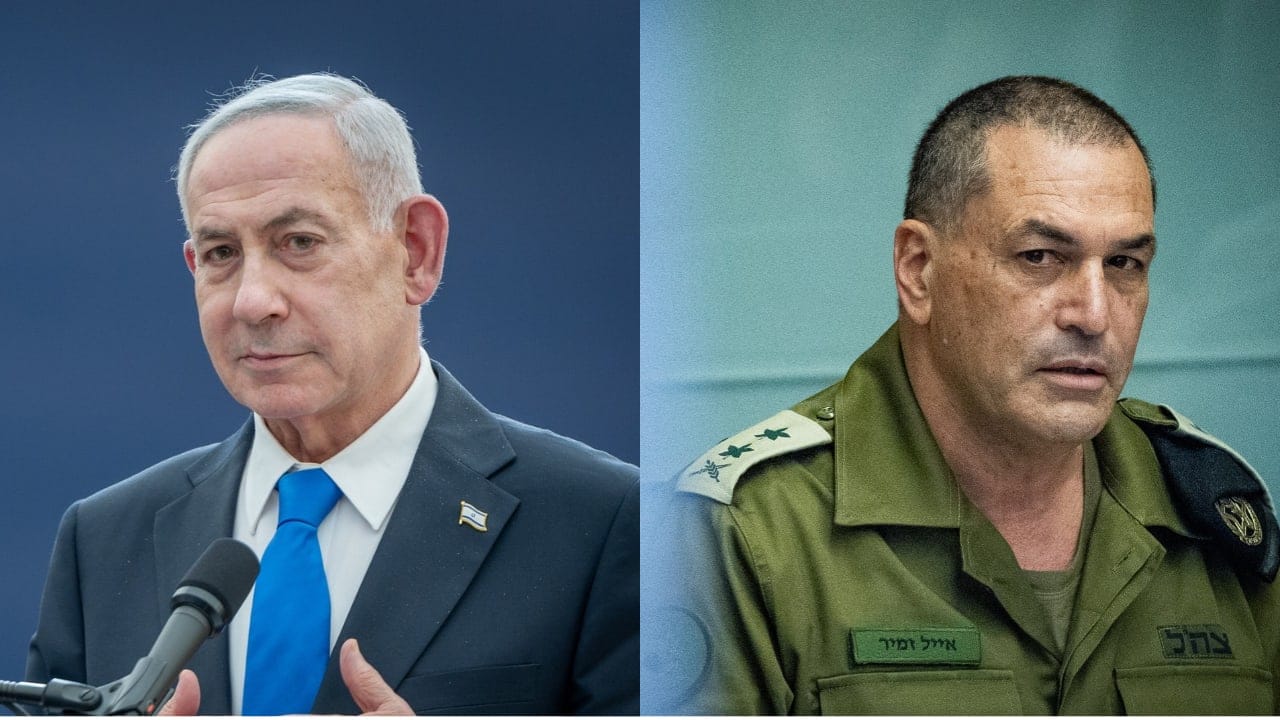
On October 25, 2026, the tension between Israel’s political leadership and its military high command reached a breaking point. Near the Palmachim airbase, a site synonymous with the nation’s strategic capabilities, Prime Minister Benjamin Netanyahu and Chief of General Staff Eyal Zamir engaged in a heated dispute that would reverberate through the halls of government. The subject was Iran—a nation that occupies a central, often volatile, position in Israeli security doctrine. But as the two men stood at the intersection of military strategy and political survival, the conversation shifted from the mechanics of defense to the motivations of governance.

At the heart of the confrontation was a direct order issued by Netanyahu for potential military action against Iran. For the military, such an order is usually the culmination of intelligence assessments and strategic planning. However, in this instance, the directive was met with unprecedented resistance. Chief of Staff Zamir, tasked with the operational health of the Israel Defense Forces (IDF), pushed back. His hesitation was not born of an inability to act, but of a profound concern regarding the timing and the underlying intent of the Prime Minister’s directive.

JUST IN - U.S. not involved in strikes against Iran: Rubio https://t.co/HmMJQB5rJq
With parliamentary elections scheduled for October 27, 2026, the atmosphere in Israel was already thick with political maneuvering. Security sources expressed growing alarm that the Iran file, historically a matter of existential security, was being repurposed as a campaign tool. The military leadership, wary of being drawn into the political fray, voiced fears that a new military engagement could be used for election manipulation. The concern was clear: if the IDF were to initiate a conflict, it must be for the sake of the state, not for the sake of a candidate’s electoral prospects.
As the debate intensified, the professional security establishment began to demand more than just verbal instructions.
As the debate intensified, the professional security establishment began to demand more than just verbal instructions. Sources close to the discussions have called for deeper deliberations and, crucially, formal legal documentation of the orders being issued. This push for a paper trail suggests a lack of trust between the civilian leadership and the military brass. By requesting that decisions be codified, the security establishment is attempting to create a safeguard against the potential exploitation of the military for political gain.

🇮🇱ZAMIR NAMED NEW IDF CHIEF AS ISRAEL BRACES FOR MORE CONFLICT Herzi Halevi is out, and Major General Eyal Zamir is in. Israel’s new IDF chief takes over at a critical moment, with tensions flaring in the West Bank and the military on high alert after a major prisoner release. Zamir, a former deputy chief of staff and close Netanyahu ally, steps into the role as Israel faces ongoing threats from Hamas, Hezbollah, and Iran. Meanwhile, IDF forces just engaged an armed group in the Syrian Golan. Source: The Jerusalem Post
Netanyahu, for his part, has characterized the situation as one where others are attempting to stoke conflict. Yet, the military remains in a state of readiness, prepared to act should the security of the nation truly demand it. The challenge, as articulated by those within the security apparatus, is the distinction between a necessary defensive strike and a politically motivated escalation. Security sources and the military emphasized that the Iran conflict must serve national security, warning against its exploitation for political gain.
As the election date looms, the standoff at Palmachim serves as a microcosm of a broader national crisis. The disagreement over Iran is not merely a tactical dispute; it is a fundamental clash over the norms of governance and the role of the military in a democracy. While the IDF remains prepared to defend the country, the internal friction suggests that the most significant threat to the state’s stability may currently be the lack of alignment between those who hold the power to order a war and those who must carry it out.

The IDF confirms launching airstrikes against the Houthis in Yemen, in response to the Iran-backed terror group's repeated ballistic missile and drone attacks on Israel in recent weeks. In a statement, the military says Israeli Air Force fighter jets struck Houthi targets along Yemen's western coast and deeper within the country. The targets included "infrastructure used by the Houthi terror regime for its military activities" at Sanaa International Airport in the capital; the Hezyaz and Ras Kanatib power plants; and infrastructure at the Hodeidah, Salif, and Ras Kanatib ports on the coast. "These infrastructures were used by the Houthi terror regime to transfer Iranian weapons to the region and for the entry of senior Iranian officials," the IDF says. The airstrikes were approved by IDF Chief of Staff Lt. Gen. Herzi Halevi, Defense Minister Israel Katz, and Prime Minister Benjamin Netanyahu, the military adds.