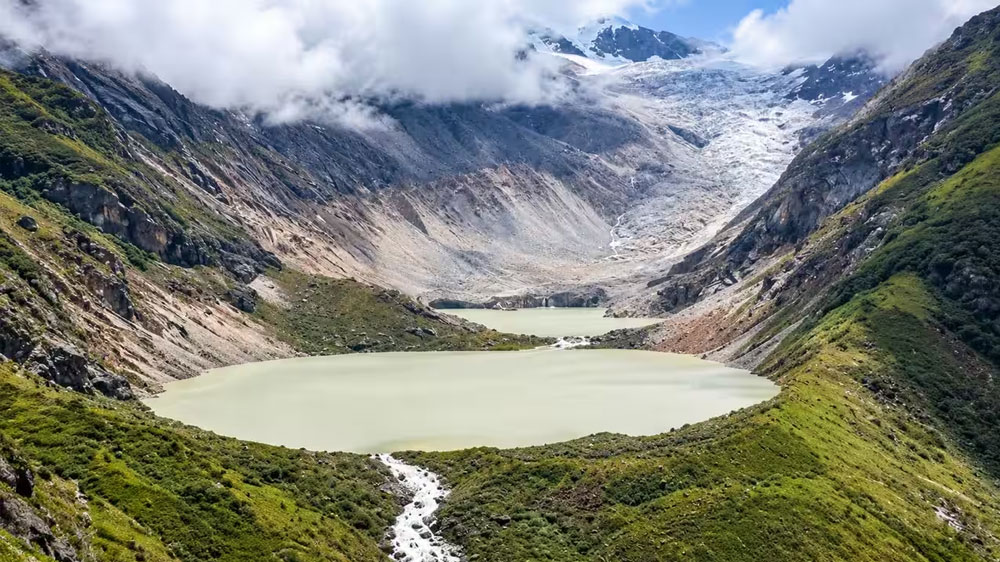
On the morning of October 30, 2026, the tranquil surface of Bhutan’s Shintaphu Glacier Lake shattered. The lake, perched high in the Himalayas, released a torrent of meltwater that cascaded down valleys, carving a path of destruction before disappearing into the rugged terrain. The event was not merely a local landslide; it was a stark reminder that the region’s frozen reservoirs are increasingly volatile.

Within hours, Bhutan’s disaster management agencies sounded a warning that rippled across the border into India. Officials in the Indian states of West Bengal and Assam, already accustomed to monsoon swells, were told to brace for flash floods that could follow the glacial surge. The warning was not a speculative alert—it was a direct response to a measurable outflow that, if it reached the Brahmaputra’s tributaries, could overwhelm low‑lying communities.
Glacial lakes form when meltwater accumulates behind natural dams of ice and moraines. As global temperatures climb, glaciers retreat faster than they can replenish these barriers, enlarging the lakes and weakening their containment. Experts monitoring the Himalayas have long warned that such conditions raise the probability of glacial lake outburst floods, or GLOFs. The Shintaphu event fits that pattern: accelerated melting, a larger water body, and a sudden breach that turned a serene alpine lake into a rushing hazard.
While Bhutan’s neutral stance emphasized the factual nature of the warning, India’s neutral response reflected a pragmatic focus on preparedness rather than blame.
Bhutan and India share more than a border; they share a watershed that feeds some of the world’s most populous river basins. The outburst highlighted the interdependence of the two nations when it comes to climate‑driven hazards. While Bhutan’s neutral stance emphasized the factual nature of the warning, India’s neutral response reflected a pragmatic focus on preparedness rather than blame. Both governments recognized that a disaster in the high Himalayas does not respect political lines—it flows downstream, affecting lives and livelihoods far beyond its point of origin.
In West Bengal and Assam, disaster response teams activated early‑warning protocols. River gauges were calibrated, evacuation routes reviewed, and community leaders briefed on the potential for rapid water level rises. The alert underscored a broader shift in emergency planning: traditional monsoon forecasts now have to incorporate high‑altitude melt events, a reality that climate models have been projecting for years.
The Shintaphu burst adds urgency to ongoing discussions about glacier monitoring and lake management in the Himalayas. Satellite imagery, on‑the‑ground sensors, and cross‑border data sharing are being touted as essential tools to predict future outbursts. Yet the episode also serves as a sobering illustration that technology alone cannot halt the underlying driver—global warming. As glaciers continue to recede, the frequency and scale of such floods are likely to rise, demanding coordinated adaptation strategies between Bhutan, India, and the broader South Asian region.
As of the latest reports, the immediate flood threat has subsided, but the water that surged from Shintaphu continues to feed downstream rivers. Communities remain vigilant, and both nations are reviewing the incident to refine their early‑warning systems. The episode stands as a vivid case study of how a single glacial lake can ripple through geopolitics, ecology, and daily life, reminding us that the high Himalayas are no longer a distant, static backdrop but an active front in the climate narrative.
