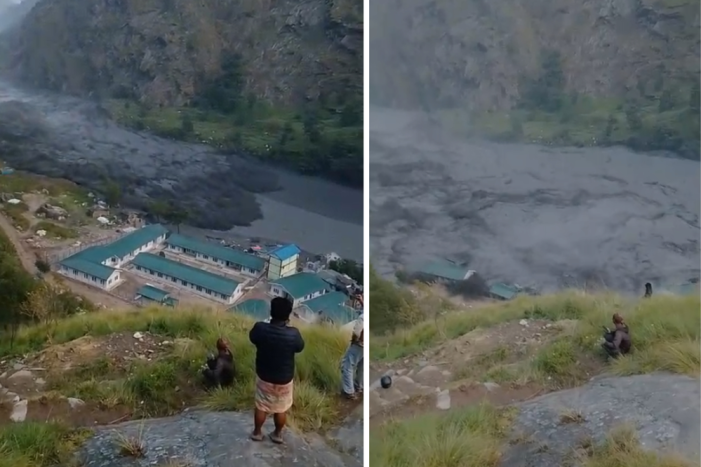
On Sunday morning, the Budhigandaki River flowed through the valleys of Gorkha district as it had for generations. Residents of the nearby settlements went about their routines, unaware that the calm would soon be shattered by a sudden surge of water. The day was marked only by the ordinary rhythms of life in the rural municipalities of Chumanubri and Dharche, where homes clung to the hillsides and footpaths linked villages across the river.

High upstream, between the villages of Lokpa and Chumling in Chumanubri Rural Municipality-6, a landslide broke loose and tumbled into the Budhigandaki. The debris piled against the current, forming a natural dam that held back the river’s flow. Water began to pool behind the obstruction, building pressure as the morning wore on. The blockage was situated in a narrow stretch of the river valley, a spot where the surrounding steep slopes made the channel especially vulnerable to sudden releases.
When the accumulated water finally overcame the landslide dam, it rushed downstream with tremendous force. The resulting flash flood surged through the river channel, carrying with it the sediment, rocks, and timber that had been trapped behind the barrier. The wave moved quickly, gaining strength as it descended the steep gradient of the Budhigandaki, and it reached the lower settlements with little warning.
One spanned the gap between Nyakchet in Chumanubri Rural Municipality-3 and Sirdibas, a vital footpath for traders and families.
The first structures to feel the full impact were the two suspension bridges that linked communities across the river. One spanned the gap between Nyakchet in Chumanubri Rural Municipality-3 and Sirdibas, a vital footpath for traders and families. The other connected Kerauja to Machhakhola, serving the lower reaches of the valley. Both bridges, built of cables and wooden decking, were swept away entirely by the torrent, leaving only the remnants of their anchors on the riverbanks.
Further downstream, the flood reached the iron‑and‑concrete bridge at Soti, which joined wards 2 and 3 of Arughat Rural Municipality. Unlike the suspension spans, this bridge was constructed with metal girders set in concrete foundations, designed to withstand heavier loads. Yet the sheer volume and velocity of the water overwhelmed its supports, and the bridge collapsed into the river, severing the road link between the two wards.
In the wake of the deluge, the river left a trail of destruction beyond the crossed‑over spans. A mud house belonging to Ram Bahadur Gurung in Chumanubri-3 was completely washed away, its walls and roof reduced to debris carried downstream. In the lower settlement of Machhakhola in Dharche-5, the floodwaters inundated five to seven houses and huts, soaking belongings and forcing residents to seek higher ground. The loss of the three bridges cut off foot and vehicle routes, complicating relief efforts and leaving many to rely on temporary crossings or lengthy detours as they began the process of rebuilding.