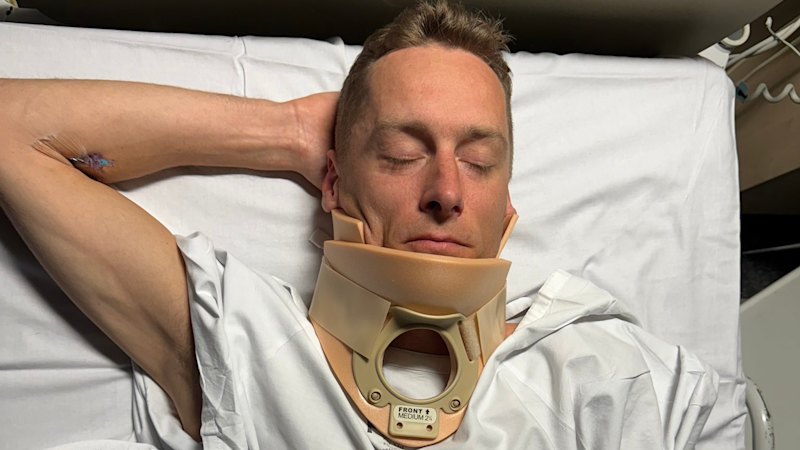
On November 1, 2025, the roar of the Melbourne Cup crowd was punctuated by a sudden, collective gasp. Champion jockey Blake Shinn, a fixture on the Victorian racing circuit, was thrown from his mount and hit the track hard enough to snap both the tibia and fibula in his left leg. The injury was not a single break; medical imaging later revealed four distinct fracture sites, a severity that sent shockwaves through the racing community.

The tibia and fibula are the two long bones that run parallel down the lower leg, bearing the weight of the body and providing the leverage needed for a jockey’s delicate balance. A fracture in either bone can sideline a rider for months; four fractures across both bones meant a complex reconstruction, extensive immobilisation, and a long road to healing. The immediate medical consensus, voiced by Dan Piovesan of the Pioda Health and Performance team, was blunt: “this is a 12-month injury.”
For a jockey whose livelihood depends on riding day after day, a year away from the saddle is more than a physical setback—it is a professional crisis. Shinn himself recalled the early days of his recovery: “The doctors were a little bit vague in terms of how long it would take for me to be back.” That vagueness left room for optimism, but also for a dangerous mindset. Shinn admitted he initially felt “delusional,” convinced he could accelerate the healing process and get back to racing sooner than his body would allow.
Part of the protocol involved a moonboot—a custom-fitted, pneumatic walking boot that stabilises the leg while allowing limited weight-bearing.
Enter Pioda Health and Performance, the specialist group tasked with guiding Shinn through the labyrinth of post-fracture rehabilitation. Their approach was anchored in transparency: they communicated the limits of the injury, respected the biology of bone healing, and avoided the temptation to rush progress. Part of the protocol involved a moonboot—a custom-fitted, pneumatic walking boot that stabilises the leg while allowing limited weight-bearing. Shinn wore the moonboot for three months, a period that gave the fractured bones time to knit together under controlled stress.
Physical recovery is only half the story for an elite athlete. The mental component can be just as decisive. Dan Piovesan, who oversaw Shinn’s rehab, praised the jockey’s mindset: “He is an amazing athlete and you can see why he is so successful because of his mentality.” That mentality, forged in the crucible of a career-defining injury, meant Shinn eventually accepted the prescribed timeline, shifted his focus to incremental milestones, and rebuilt his confidence one physiotherapy session at a time.
Exactly nine months after the fall, on August 1, 2026, Shinn mounted Nearco Frod for his first race back. The horse, a promising contender, and the jockey, still bearing the after-effects of his broken leg, faced a field of seasoned competitors. Yet the partnership clicked. As the gates opened, Shinn’s experience and Nearco Frod’s speed combined to secure a clear victory. The win was more than a statistic; it was a public affirmation that the recovery plan had worked, that the bone had healed, and that the jockey’s skill remained intact.
Today, Blake Shinn stands on the same turf that once saw him tumble, his left leg healed, his confidence restored. While the exact trajectory of his future mounts remains to be written, the story of his recovery offers a template for how transparent medical guidance, disciplined rehabilitation, and a resilient mindset can converge to defy even the most daunting prognoses. For a sport that prizes both physical daring and split-second decision-making, Shinn’s journey reminds us that the human body, when respected, can rebound in ways that surprise even its toughest competitors.