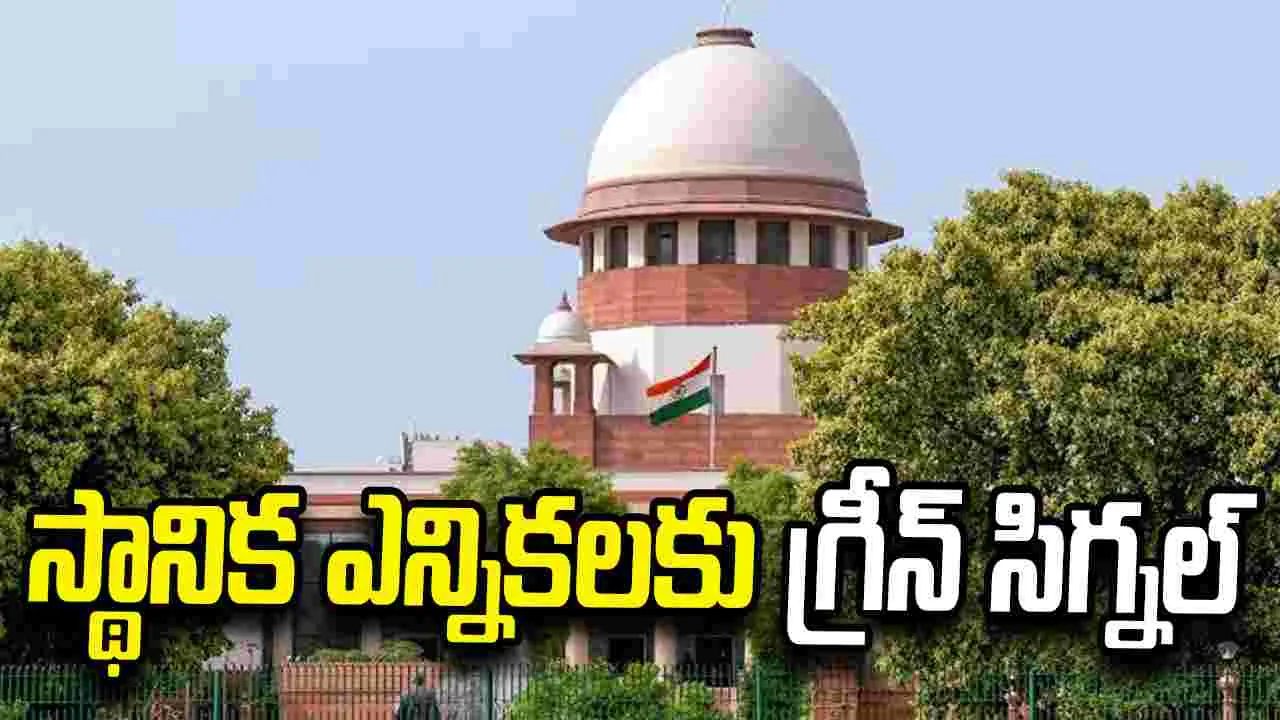
The Supreme Court of India gave a clear signal that local body elections in Andhra Pradesh could proceed. A bench headed by Chief Justice Surya Kant announced that the state government could go ahead with the polls, rejecting the argument that there was insufficient time to organize them. The Court’s decision meant that the YSR Congress Party-led administration would not be allowed to delay the process on the grounds of a short duration.

Along with allowing the elections, the Court issued a concrete directive. It ordered the Andhra Pradesh government to publish the necessary election notifications within two weeks, following the timeline previously laid down by the High Court.
A central part of the ruling concerned the allocation of seats for Backward Classes. The Supreme Court upheld the High Court’s judgment that 34% of the seats in local bodies should be reserved for BCs. In doing so, it dismissed the state government’s Special Leave Petition that had sought to alter that figure. The Court also clarified a broader constitutional limit: the combined reservation for all categories must not exceed 50% of the total seats, ensuring that the BC quota fits within the established ceiling.
The Court considered arguments from the Andhra Pradesh government and the YSR Congress Party regarding election timing.
The Court considered arguments from the Andhra Pradesh government and the YSR Congress Party regarding election timing. It rejected the Andhra Pradesh government's petition arguing that elections could not be held in a short duration. It also rejected the YSR Congress Party's petition seeking to postpone elections until the process is fully completed.
Chief Justice Surya Kant’s bench linked the act of delaying elections to a broader public‑interest concern. The Court stated that hindering the election process amounts to blocking public welfare, framing timely local polls as a service to the community rather than a mere administrative formality. This reasoning underpinned the rejection of both the state government’s time‑based objection and the YSRCP’s call for a postponement.
All of these determinations were made on a single date: 2026-10-09. On that day the Supreme Court simultaneously rejected the Andhra Pradesh government’s petition concerning the BC reservation, turned down the YSRCP’s plea to delay the elections, and issued the directives that would shape the upcoming local polls.
With the Court’s orders in place, the state administration now has a fixed timetable to issue election notices, and the 34% BC reservation stands as a settled feature of the ballot. The decision reinforces the principle that electoral timelines cannot be manipulated to stall democratic processes, while also preserving the protective quota system for historically disadvantaged groups within the constitutional 50% cap.
The legal clarity provided by the Supreme Court removes a layer of uncertainty, allowing the local body elections to move forward on the schedule the Court has mandated.