
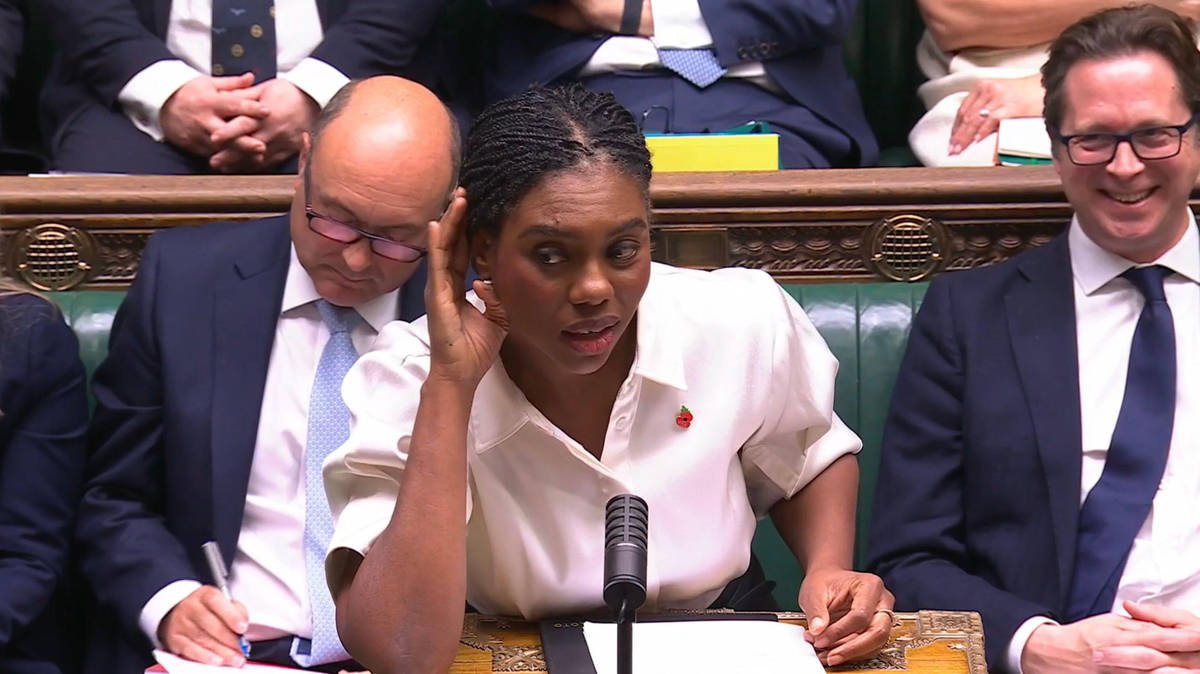
The atmosphere in Westminster has always been charged, but the recent Budget announcement has added a new, sharp edge to the political discourse. Kemi Badenoch, the leader of the Conservative Party, did not mince her words when reacting to the fiscal roadmap laid out by Chancellor John Healey. Her central argument is stark: the United Kingdom is on the brink of structural failure, crushed not by external enemies, but by the internal weight of its own social safety net. To Badenoch, the current trajectory is not merely a policy disagreement; it is a systemic crisis. She frames the issue not as a choice between different tax rates, but as a matter of national survival, arguing that the government must now exercise what she calls "tough love" with the public.
At the heart of this tension lie the projections from the Office for Budget Responsibility, the independent watchdog that monitors the nation’s finances. Their data indicates that welfare spending is set to rise significantly this year. The forecast points to a 5.7% increase, pushing total expenditure to £353 billion. This is not a marginal adjustment; it represents a rise of approximately £19 billion in annual outgoings. For the opposition, this number is the smoking gun that proves the state has lost control of its budget. For the government, it is a necessary adjustment to keep pace with a changing world. These figures have become the pivot on which the entire debate turns, separating those who see fiscal discipline from those who see social stability.
Badenoch’s critique is built on a specific diagnosis of the UK’s economic health. She describes the nation as "overspent, over-borrowed, overtaxed and drowning in an out-of-control welfare system." Each adjective carries weight. "Over-borrowed" references the growing pile of national debt, where interest payments are already consuming £14 billion. "Overtaxed" suggests that the burden on working families is at its limit. But it is the phrase "drowning in welfare" that defines her stance. She argues that the system has expanded beyond its intended purpose, becoming a permanent fixture rather than a temporary support. The implication is that the country is using future wealth to pay for present comfort, a pattern she views as dangerous for long-term growth.
Healey’s defense relies on the idea that retreating from welfare support during a storm would be far more damaging than adjusting the sails.
In response, Chancellor John Healey adopted a more measured tone, framing the economic climate not as one of internal failure, but of external pressure. He warned that the UK is facing a "global economic storm," suggesting that rising costs and inflation are forces beyond the immediate control of Westminster. While he did not deny the rising numbers, he positioned his actions as defensive rather than aggressive. The government’s approach, in his view, is to manage the impact of global trends rather than ignore them. This sets up a classic political dichotomy: the opposition sees a domestic management crisis, while the government sees an international economic challenge. Healey’s defense relies on the idea that retreating from welfare support during a storm would be far more damaging than adjusting the sails.
A specific point of contention in the Budget is the structure of benefits delivery, particularly Universal Credit. Badenoch used this program as a focal point for her broader critique, offering a memorable and provocative line: "Just because it’s called Universal Credit, doesn’t mean that everyone in the universe should be on benefits." This quote captures the core of her philosophical disagreement with the current system. She argues that the universality of the name does not imply a right to universal participation. For the Conservative leader, the system is too broad, too accessible, and perhaps too easy to stay on. This line of reasoning supports her call for "tough love," suggesting that eligibility and duration of support need to be tightened significantly to reduce the overall bill.
While the Budget has been unveiled, the story is far from over. Chancellor Healey noted that two long-awaited welfare reviews are scheduled to report next month. These reviews represent the government’s next major move in shaping the social contract. Badenoch’s criticism of the Budget being "not strong enough, not bold enough" implies that she expects these reviews to fail to make the cuts she deems necessary. The timing is crucial; these reports will determine whether the welfare system expands further or if the government begins the difficult work of restructuring it. The political pressure is already mounting for these reviews to deliver genuine savings, not just cosmetic changes.
Beyond the specific figures, the context of the Budget includes broader packages designed to assist households. For instance, a £2.6 billion energy bills support package is part of the fiscal mix, aimed at offsetting the cost of living for vulnerable families. Additionally, a £5.5 billion uprating of benefits is included to account for inflation. These moves highlight the complexity of the Chancellor’s task: he must support citizens against rising global costs while simultaneously trying to keep the national debt from spiraling further. The tension between supporting the public and balancing the books is the defining challenge of this period.
As the week concludes, the political landscape remains sharply divided. Kemi Badenoch has positioned herself firmly against the current economic path, presenting the Conservative Party as the voice of fiscal restraint. Chancellor John Healey stands by his choices, pointing to the external economic headwinds as the primary driver of the figures. The upcoming welfare reviews will likely serve as the next battleground, where the abstract arguments of the Budget season will meet the concrete realities of policy implementation. For now, the warning that Britain is collapsing under the weight of its own support system hangs in the air, a challenge that the next government, whatever its composition, will have to answer.