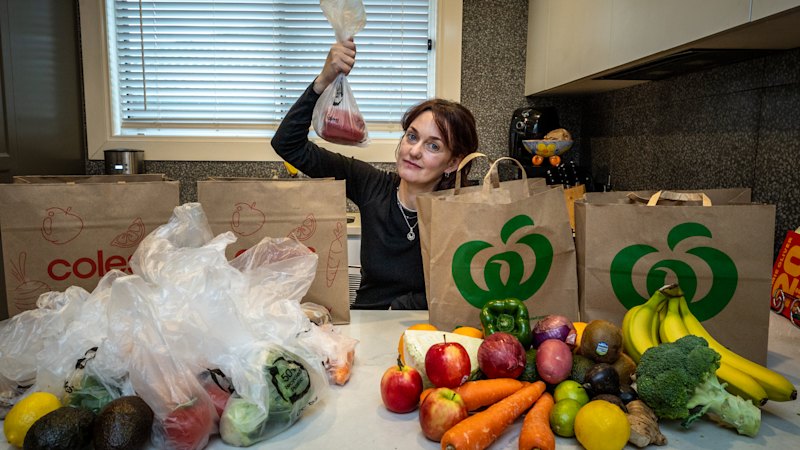
Imagine opening your online grocery delivery. You pull up to the curb, grab the bags, and carry them inside. For millions of Australians, this routine is as mundane as brushing their teeth. But beneath the surface of that everyday transaction lies a growing environmental fault line, one that separates Australia’s retail giants not by price or product selection, but by their willingness to abandon plastic.

For years, the narrative around supermarket sustainability has been murky. Both Woolworths and Coles Group have made public pledges to reduce waste, yet for the consumer, the difference has often felt negligible. That ambiguity has now been shattered by a national report from the Australian Marine Conservation Society (AMCS). The findings are not subtle; they are binary. In the realm of online grocery deliveries, one chain has largely eliminated plastic produce bags, while the other continues to pack nearly every order with them.
The data paints a picture of two companies operating on different planets regarding environmental responsibility. According to the AMCS analysis, 95 percent of Coles deliveries contained at least one plastic produce bag. In stark contrast, only 8 percent of Woolworths deliveries included such packaging. This is not a marginal difference in corporate policy; it is a chasm. It suggests that for the vast majority of Coles customers, the convenience of online shopping comes with an invisible tax paid in single-use plastic, whereas Woolworths has effectively decoupled its digital service from that waste stream.
The difference lies in the internal protocols set by each corporation.
To understand why this matters, one must look at what happens after the groceries are unpacked. Plastic produce bags—those thin, flimsy sheets used to wrap lettuce, broccoli, or apples—are among the most problematic items in the recycling stream. They are lightweight, often contaminated with food residue, and frequently jam sorting machinery at recycling facilities. When a customer receives 95 percent of their order wrapped in these materials, they are not just receiving vegetables; they are receiving a logistical challenge that ends in landfill or incineration. Woolworths’ approach, reducing that figure to a mere 8 percent, indicates a systemic overhaul of how produce is handled, stored, and delivered.
This divergence raises questions about operational choices rather than just consumer behavior. One might assume that if customers demanded less plastic, both chains would comply. However, the report highlights that the disparity exists within the same delivery model. Both companies offer similar online platforms, similar logistics networks, and serve overlapping demographics. The difference lies in the internal protocols set by each corporation.
The implications extend beyond the immediate trash can. The production of plastic produce bags relies on fossil fuels, contributing to carbon emissions before the bag is even used. By refusing to adopt these bags, Woolworths is not just reducing waste; it is lowering its carbon footprint per delivery. Conversely, Coles’ continued use of these bags ties its brand to a linear economy model that is increasingly viewed as obsolete. In an era where consumers are more environmentally conscious than ever, this gap could become a significant competitive disadvantage for Coles, turning a perceived convenience into a liability.
It is also worth noting the role of high-profile advocates in pushing these changes. Figures like Lewis Hamilton have long campaigned against plastic pollution in sports and entertainment, bringing global attention to the issue. While the supermarket sector operates differently than Formula One, the pressure from environmental groups and public figures creates a backdrop against which corporate performance is measured. The AMCS report serves as a scorecard, and the results are damning for one party and commendable for the other.

The 8 percent figure for Woolworths is not zero, and critics may argue that no plastic is too much. However, in the context of industrial-scale retail, moving from near-total reliance to near-total elimination is a monumental shift. It requires retraining staff, redesigning supply chains, and convincing customers to adapt to new ways of buying fresh food. Coles, with its 95 percent rate, has shown little urgency in making these difficult changes. This inertia suggests that for Coles, the cost of transition outweighs the perceived benefit of sustainability, at least in the short term.
As the debate over plastic waste intensifies, consumers are being asked to look closer at their receipts and their bins. The choice between Woolworths and Coles is no longer just about loyalty points or weekly specials. It is a vote for a specific type of future. Will our groceries arrive wrapped in the plastic of the past, or will they be delivered in a way that respects the limits of our environment? The AMCS report makes it clear that one chain has already answered that question. The other is still packing its bags.