In the crowded political landscape of India, few names are as jarring—or as deliberate—as the Cockroach Janata Party. Founded by Abhijeet Dipke, the group operates at the edges of mainstream politics, using shock value and idiosyncratic branding to carve out a niche for itself. For most citizens, the CJP is a curiosity rather than a serious contender, yet its actions in October 2026 forced a serious response from one of the world’s most heavily policed urban centers. The core of the CJP’s message, as articulated by its leadership, centers on alleged electoral fraud. Dipke has consistently framed his protests not as partisan critiques of a specific government, but as broader assertions of democratic integrity. This stance positions the party in a unique tier of opposition: small enough to be easily dismissed by national media, yet persistent enough to trigger significant local security protocols when it moves to public spaces. The party’s supporters, while a minority, are fiercely loyal, viewing the CJP’s unconventional methods as a necessary disruption in a stale political system. By linking their grievances to the national flag—a potent symbol of Indian unity and pride—the CJP elevates its local protests into matters of national sentiment, a tactic that complicates the response for law enforcement agencies tasked with maintaining order without appearing to suppress legitimate patriotic expression.

The specific trigger for the October 16th mobilization was the arrest of several CJP leaders in preceding weeks. The party characterized these detentions as political interference and announced a counter-protest titled “Lehra Do Tiranga,” a phrase that roughly translates to “Give a Lesson with the Tricolor.” The choice of words was calculated to invoke a sense of moral instruction, positioning the protesters as teachers and the state as the student. Dipke had publicly stated that the threat of further arrest would not deter him from participating, asserting that the national flag was a matter of personal pride. This defiance set the stage for a confrontation that was less about the number of attendees expected and more about the symbolic weight of the act itself. The proposal was to gather at Central Park in Connaught Place, the commercial and civic heart of Delhi, and march through the surrounding arteries of the city. For a city known for its grid-like traffic patterns and constant flux, planning a march through the central business district required a level of logistical coordination that far exceeded that of typical street protests. The authorities recognized early on that allowing the march to proceed without significant infrastructure changes would be akin to inviting chaos into the financial district.

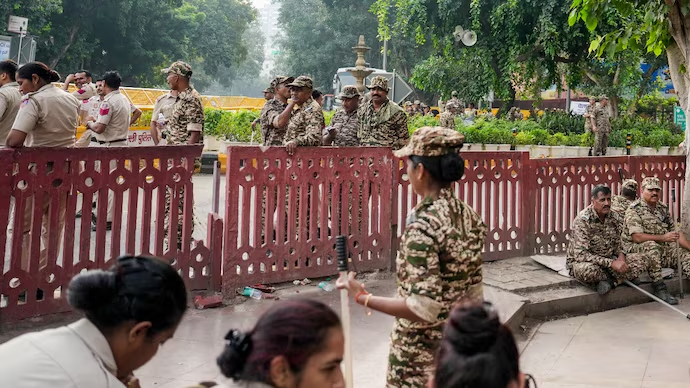
#WATCH | Delhi: Security tightened around Parliament Street Police Station in the wake of CJP's ‘Lehra Do Tiranga’ protest call at Connaught Place’s Central Park today. https://t.co/xzRncckEaJ
The Delhi Police response was immediate and exhaustive. Recognizing that the CJP’s use of the national flag could complicate any attempt to disperse the crowd, the force adopted a strategy of containment and facilitation rather than outright suppression. A prohibitory order was issued under Section 163 of the Bharatiya Nagarik Suraksha Sanhita, a relatively new codified law that consolidated earlier criminal procedure codes. This order formally banned the general public from assembling at the specific site of the protest. However, the police made a calculated exception: they announced that only 11 individuals would be permitted to carry the national flag and sing the national anthem, and only at a suitable, controlled location within Central Park. This limitation was designed to honor the symbolic intent of the protest while neutralizing its logistical impact. By capping the number of participants allowed to engage in the core act of flag-hoisting, the police turned a potentially massive rally into a manageable, staged event. The move also signaled a legal posture; the Delhi High Court had earlier declined to restrain the CJP from holding the protest, meaning the police had to manage the event on the ground without judicial backup to stop it entirely. The closure of Central Park itself became a key operational pillar, effectively removing the public from the space and allowing the police to control who could enter and under what conditions.
This limitation was designed to honor the symbolic intent of the protest while neutralizing its logistical impact.
The scale of the security deployment was the most visible element of the state’s response. Police authorities confirmed that 6,000 officers would be deployed across the area surrounding Connaught Place. This number reflects the tiered nature of Delhi’s security apparatus, where major civic events require not just local station police, but battalions from the City Police, Rapid Action Force, and potentially paramilitary support. The deployment was not merely a show of force but a logistical network designed to intercept any unexpected surges in crowd size. The CJP’s march was planned to traverse key routes, including Sansad Marg and Shaheed Bhagat Singh Marg, streets that serve as vital corridors connecting the commercial hub to the government district. By placing thousands of officers at chokepoints along these routes, the police aimed to create a buffer zone that would prevent the protest from spilling into unintended areas. The presence of so many uniformed personnel also serves a psychological function: it discourages unaffiliated agitators from piggybacking on the CJP’s march, ensuring that the event remains confined to the organization’s immediate circle. The sheer volume of manpower required to monitor 6,000 officers across a central district highlights the resource intensity of managing public dissent in a capital city.

CJP Protest Today LIVE 🔴 Security tightened, Connaught Place’s Central Park shut; Dipke ‘under constant surveillance’ https://t.co/lMOecRNiwh
For the millions of commuters in Delhi, the protest became a secondary crisis of mobility. The Delhi Traffic Police issued an advisory warning of possible disruptions on 21 key routes in and around Connaught Place. This list included major arterial roads that form the backbone of the city’s daytime traffic flow. The authority advised citizens to avoid the area entirely, suggesting the use of public transport and urging them to check real-time updates before commencing their journeys. The closure of Central Park and the restriction on vehicular movement in the immediate vicinity meant that even local traffic for businesses and residents in the area was severely impacted. The