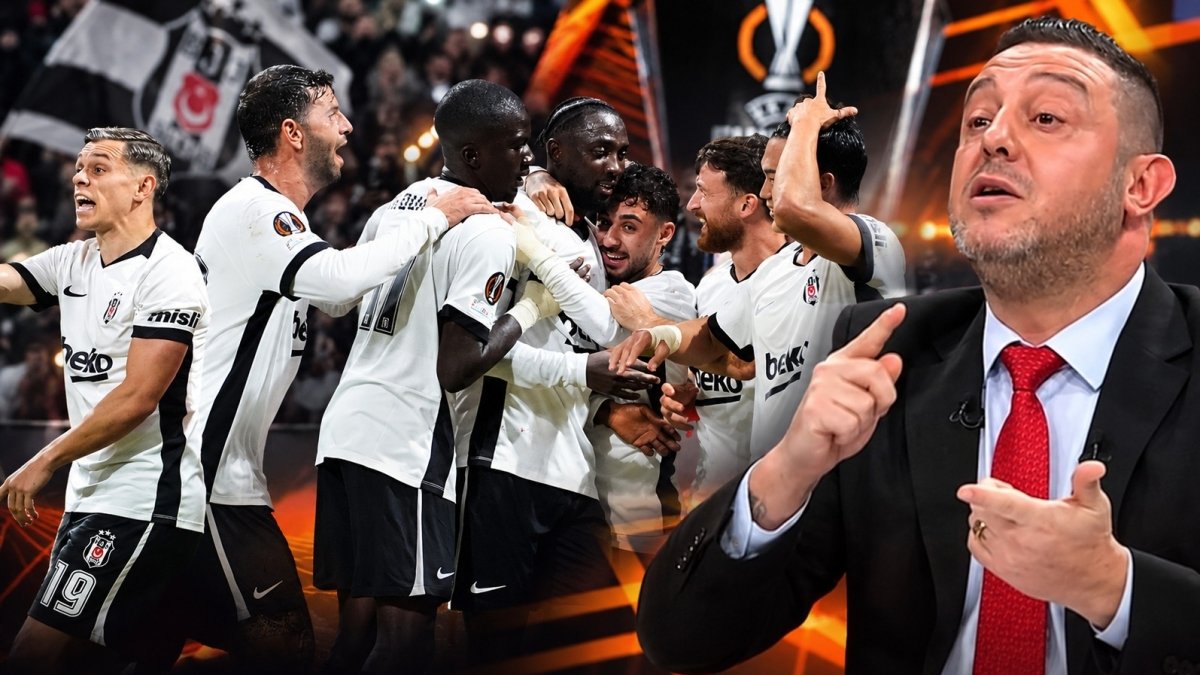
The atmosphere in London on October 23, 2026, likely carried the chill of uncertainty for Beşiktaş supporters watching from afar. Yet, when the final whistle blew on the UEFA Europa League match against Crystal Palace, ending in a 2-2 draw, one voice rose above the post-match analysis with a passionate defense of his team’s effort. Nihat Kahveci, a former Beşiktaş player and vocal commentator, did not offer standard praise. Instead, he leaned into the drama of the result, arguing that the Turkish club had been robbed of a victory by circumstances rather than lack of quality.

Kahveci’s argument began not with the scoreline, but with the schedule. He looked at the cluster of difficult fixtures Beşiktaş had just navigated and made a bold declaration. "I would sign for seven points a hundred times over in these three matches against Marseille, Crystal Palace, and Hoffenheim," he stated. This was not just hyperbole; it was a specific defense of the points collected from three of the most challenging opponents in their group. By citing the number one hundred, Kahveci emphasized his absolute willingness to accept the result if it meant keeping the team’s momentum alive. The reference to Marseille and Hoffenheim contextualizes the Crystal Palace match as part of a broader, grueling European campaign rather than an isolated event.
To understand why these points were so valuable, Kahveci painted a stark contrast to the previous season. He recalled a time when Beşiktaş had not even reached September 1st in the European context, failing to qualify for either the UEFA Champions League or the Conference League. "Last year, Beşiktaş didn't see September 1st, didn't go to UEFA [Champions League], didn't go to Conference," he explained. This historical anchor was crucial. It transformed a mediocre 2-2 draw into a miracle. For a fanbase accustomed to European struggle, the mere fact of competing in the Europa League was a victory in itself. Kahveci reminded his audience that this current squad was doing something the previous year’s squad had failed to achieve: they were competing at the elite level of European club football.
If the reality was a gritty draw, Kahveci suggested the alternative should have been a comfortable win.
The technical heart of Kahveci’s defense lay in the logistical nightmare Beşiktaş faced during the match. The team had not just rotated a few players; they had fielded a side with eight changes compared to their standard lineup. Furthermore, a key player, Ümit, had received a red card, forcing the team to manage the remainder of the game with numerical inferiority or at least reduced depth. "Ümit saw a red card, Beşiktaş came out with 8 rotations, they didn't lose," Kahveci noted. He framed this as a triumph of resilience over chaos. The "unluckiness" and "unexpected situations" he referenced were not minor setbacks but structural flaws in the lineup that the team somehow overcame. By pointing to the eight rotations, he argued that the team had held firm despite a fractured identity on the pitch.
If the reality was a gritty draw, Kahveci suggested the alternative should have been a comfortable win. He repeated a specific prediction with conviction: "If they had come out with the actual eleven, this match would have ended 4-2 or 5-3!" This claim suggests that the quality gap between Beşiktaş’s first-choice players and Crystal Palace was significant. It implies that the substitutions and the red card were not just tactical choices but catastrophic errors in execution that masked the team's true strength. By painting a picture of a potential five-goal victory, he reframed the 2-2 result as a failure of circumstance, not competence. The "actual eleven" he invoked represents a theoretical Beşiktaş that would have dominated the London side with ease.
Amidst the macro analysis of points and rotations, Kahveci also focused on a specific, frantic incident involving the player Ümit. "Brother, my heart, my lungs, Ümit! Why are you flying from 2 meters?" he asked, referencing a moment of play that likely involved a risky move or a goal from close range. This quote reveals a personal, almost familial connection to the player’s performance. He wasn't just analyzing tactics; he was reacting to the intensity of the match. The phrase "Why are you flying" suggests a moment where Ümit perhaps scored or attempted a shot from an unusually close distance, a detail that highlighted the high stakes of the match's pivotal moments.
Ultimately, Kahveci’s stance was one of pragmatic acceptance coupled with high praise. "In my opinion, at that moment, I'm okay with the draw. It's incredible. Really, Ümit," he said. This was not a grudging acceptance. It was an acknowledgment that in a match fraught with red cards, massive squad changes, and high pressure, holding the line was a success. He contrasted their current 7 points in the Europa League with the 9 points that would have been expected based on performance. "Why are we upset that we have 7 points instead of 9 in the Europa League?" he asked. This rhetorical question invited fans to look at the positive: they had earned seven points, or perhaps more in a broader context, and remained unbeaten.

The narrative Kahveci constructed was one of historical correction. He highlighted that Beşiktaş remained unbeaten in the Europa League this season, a statistic that stood in sharp relief against their previous year’s absence from European competition. He even added a caveat about a single away loss earlier in the campaign, dismissing it as a first-match anomaly. "There is one away [loss] but I don't count it because it was the first match. Well done," he concluded. This framing allows the current success to be unblemished. For a team that had not seen September 1st in Europe last year, an unbeaten run in the current group stage, despite eight-rotation matches and red cards, was a story of redemption. Kahveci’s "100 times