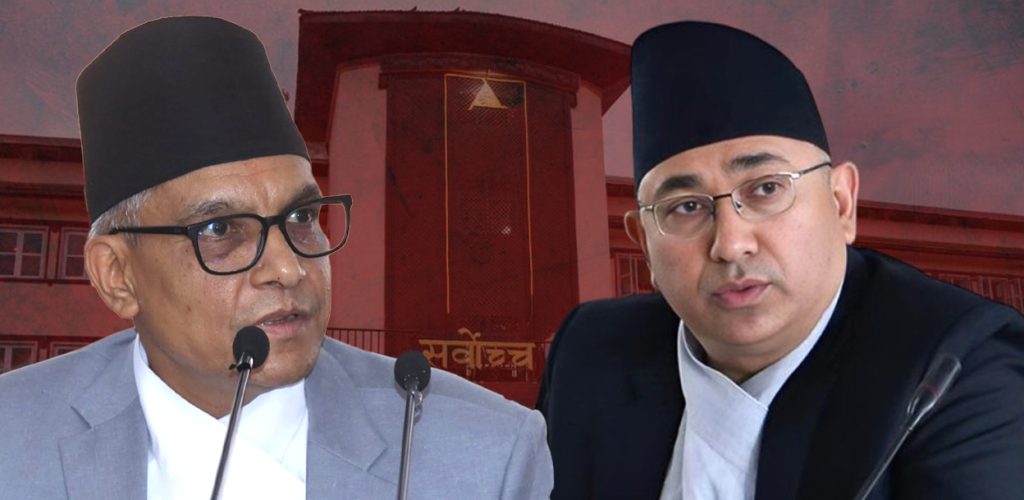
The Supreme Court of Kathmandu is a place of hushed reverence. It is where the nation's most complex legal disputes are distilled into written judgments, where the gavel falls not on a courtroom floor, but on the future of the country's governance. But on a crisp afternoon, the atmosphere shifted from hushed reverence to something far more volatile. A full-court meeting was called, not to hear arguments from lawyers, but to address a scandal that had erupted from the pocket of one of its own.

The controversy centers on Inam Sapkota, a figure at the center of a legal storm. The issue at hand is not merely a technicality, but a fundamental question of integrity: how close should a judge be to the parties before them? The Supreme Court held a full-court meeting to address four specific issues related to the Inam Sapkota controversy. These were not abstract concerns; they were the practical realities of a system under strain. The justices were forced to confront the uncomfortable possibility that the lines between judicial independence and personal connection had been blurred.
The meeting was convened to dissect four distinct issues. First was the matter of justices' personal contacts with Sapkota. This was followed by the critical question of the Constitutional Bench, a specialized group of judges tasked with hearing important cases. The third issue was the potential for judicial code violations, and the fourth was the broader question of how the court should respond to the public outcry. The discussion was intense, a rare glimpse into the internal deliberations of the country's highest judicial body. The justices were not just discussing a case; they were discussing the very fabric of their institution.
This was not a call for an external audit, but a move to establish facts from within.

Four issues raised at Supreme Court’s Friday full-court meeting Justices discussed their contacts with Inam Sapkota, allegations involving Chief Justice Manoj Kumar Sharma, the Constitutional Bench dispute and possible judicial code violations. https://t.co/E8BOXmVcnc —by @DulalDp
Amidst the tension, a proposal emerged that could reshape the court's internal governance. The justices discussed forming an internal investigation committee. This was not a call for an external audit, but a move to establish facts from within. The goal was to provide a common response, a unified front that could reassure the public and the legal community that the court was taking the matter seriously. The committee would be tasked with digging into the connections between judges and Inam, a delicate task that required a delicate touch. The proposal was a recognition that the court needed to clean its own house, to ensure that the integrity of the judiciary was not just a slogan, but a lived reality.
In the midst of this internal turmoil, one voice cut through the noise. Justice Phuyal stood firm, declaring, "I have done nothing to compromise judicial propriety or influence the administration of justice." The statement was a direct challenge to the narrative that had taken hold. It was a defense of personal conduct, a claim that the actions taken were within the bounds of propriety. But in a court grappling with a crisis of confidence, such a defense could not alone quell the doubts. The question remained: was the defense enough to restore faith in the institution?
The Supreme Court judges convened a full court session to discuss the Inam case judge's mobile phone scandal and proposed the formation of a study committee to investigate the connections between judges and Inam. Senior judges advised to convene a full court session on the matter. The path forward is now clear, but the destination remains uncertain. The formation of the study committee is a necessary first step, a move to bring transparency to a process that has been shrouded in secrecy. The justices have taken a step to address the crisis, but the work of rebuilding trust has only just begun.