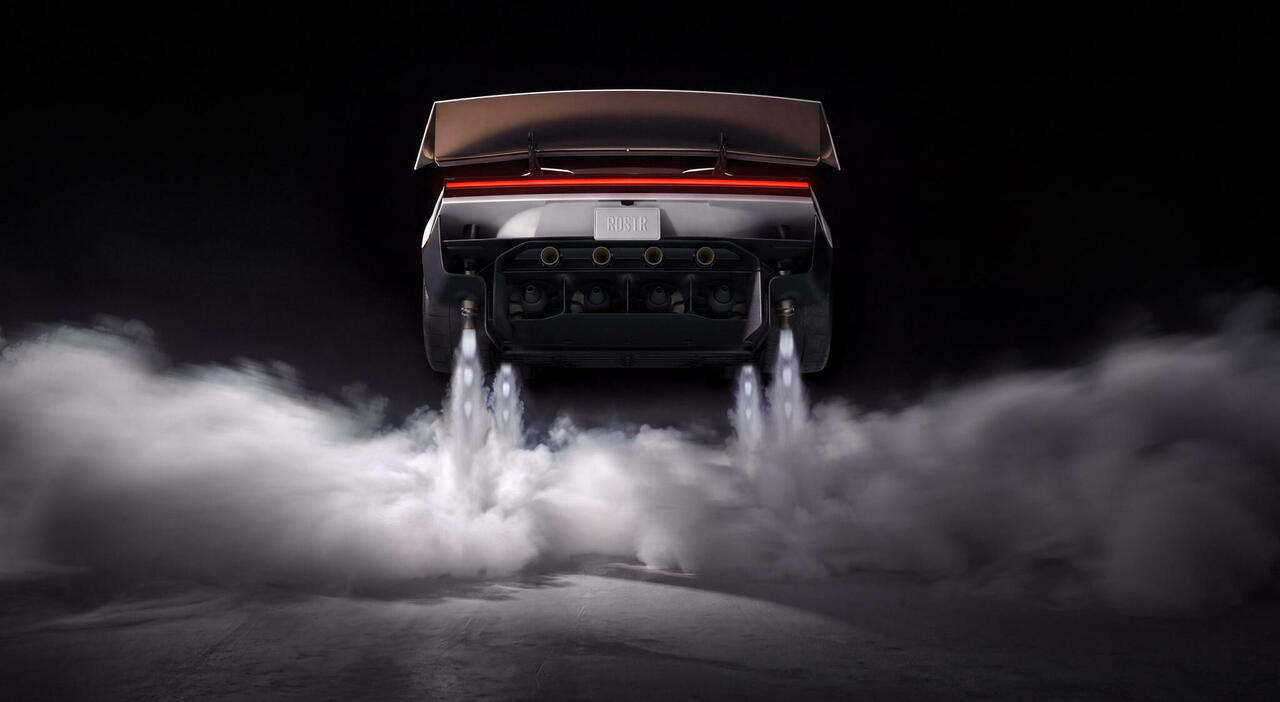
In a world where electric cars are becoming the norm, Tesla has once again pushed the boundaries of what is possible. On October 16, 2026, the company unveiled its latest marvel: the flying Roadster. This vehicle, a testament to Musk's visionary spirit, combines the sleek design of a sports car with the audacious ambition of a flying machine. However, as the details of the project began to surface, a cloud of uncertainty loomed over the horizon.

In 2017, Elon Musk had already shown a prototype of the flying Roadster. The vehicle was a marvel of engineering, with its cold gas thrusters and advanced aerodynamic design. The 2026 unveiling was a significant step forward, as Tesla finally revealed the full specifications and the pre-order price. The car was set to be produced in three variants: Performance, Thrust, and Rocket. Each version came with its own unique features and price tag, but the most intriguing was the Thrust variant, which was described as 'race ready.'

Turns out the future does have flying cars https://t.co/6fexPp6SXI
For Tesla fans, the excitement of reserving a flying Roadster was tempered by the fine print. The final price of the vehicle remained a mystery, and the terms and conditions were vague. Tesla had announced that the pre-order price for the Performance version was $250,000, with an initial deposit of $5,000. However, the Thrust and Rocket variants were shrouded in even more uncertainty. The Thrust variant, in particular, was described as 'race ready,' but it was unclear whether this meant it was intended for exclusive use in high-speed racing events or if it was simply a marketing ploy to entice enthusiasts.
The technical limitations of the flying Roadster were another point of concern.
The journey from prototype to production was fraught with uncertainty. Tesla had set a production start date for 2028, but the road to that goal was far from clear. The company had already faced numerous delays and challenges in its previous projects, and the flying Roadster was no exception. Elon Musk, known for his ambitious timelines, had previously stated, 'In 2026, we’ll have flying cars.' However, the reality of 2026 saw only a prototype, and the actual production of the flying Roadster was pushed to 2028.

Flying cars may be closer than we think. Elon Musk showcases a Tesla Roadster demonstration featuring a "kickflip" through the air over other vehicles in Texas, leaving the crowd in awe as he teases a not-so-distant future where cars could do more than just drive. "This will be an actual car on the roads." Watch the demonstration and see what's next for Tesla's Roadster: https://t.co/yO3RVNJMnI
The technical limitations of the flying Roadster were another point of concern. The Performance and Thrust variants were not approved for public road use, meaning that they could only be driven in designated areas. The base version, at least, was described as road-ready, but it was unclear whether this meant it could be driven on public roads or if it was simply a marketing term. The cold gas thrusters used in the Thrust variant were designed to hover the car above other vehicles, but the implications of this technology were far from clear. The final price, production timeline, and technical specifications all remained shrouded in mystery, leaving Tesla fans with more questions than answers.
As the details of the flying Roadster began to take shape, the market reaction was mixed. Tesla fans were excited about the prospect of owning a flying car, but the fine print and technical limitations were a cause for concern. The pre-order price of $250,000 was steep, and the uncertainty surrounding the production and delivery of the vehicle was a significant factor. Some enthusiasts were hesitant to reserve a vehicle that might not be delivered, while others were willing to take the risk, hoping that the final product would live up to the hype.

FLYING HIGH: Musk Unveils Tesla Roadster That Flips, Flies, and Hits 60 MPH in Under a Second [WATCH] https://t.co/InWD37Iwax
As Tesla fans eagerly awaited the production of the flying Roadster, the company faced a complex set of challenges. The final price, production timeline, and technical specifications all remained uncertain, and the market reaction was mixed. The flying Roadster was a testament to Musk's visionary spirit, but the fine print and technical limitations raised more questions than answers. As the clock ticked towards 2028, the truth behind this ambitious project was starting to unfold, and the fate of the flying Roadster remained to be seen.
In the end, the flying Roadster was a bold step forward for Tesla, but the fine print and technical limitations left many questions unanswered. As the company moved closer to production, the truth behind this ambitious project was starting to take shape, and the fate of the flying Roadster remained to be seen. For now, Tesla fans would have to wait and see whether the final product would live up to the hype.