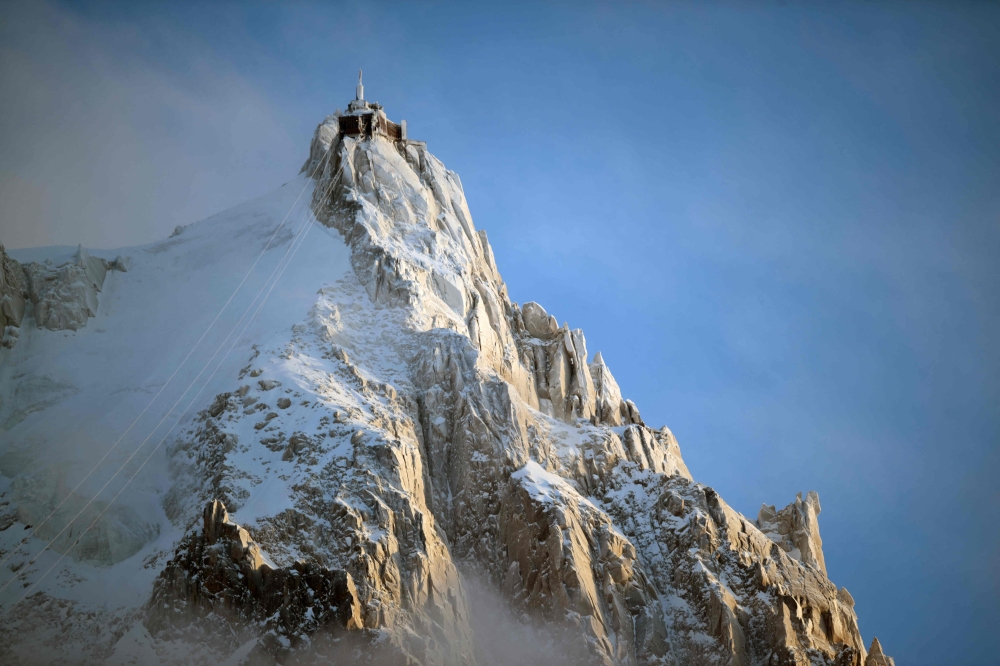
In October 2026, French surveyors announced that the summit of Mont Blanc now stands at 4,807.47 meters above sea level. This figure represents the most recent measurement of the mountain's elevation, taken after a campaign of observations that concluded in September of the same year.

According to the surveyors, the current height is 1.88 meters greater than it was in 2023. This increase has been documented over a three-year span, linking the 2023 baseline to the September 2026 reading.
The altitude was determined by experts from the Haute-Savoie chamber of surveyors. This body has been responsible for measuring Mont Blanc's height since 2001, maintaining a long-term record of the mountain's changing profile.
Instead, the variations in height are driven by fluctuations in the thickness of the seasonal snowpack and perennial ice that blankets the summit.
The measurement campaign culminated in September 2026, with the results being published on 14 October 2026.
Surveyors attribute the recent gain to weather conditions and snow accumulation. At the same time, glaciologists involved in the study note that while the mountain's rocky peak has remained essentially unchanged, the ice and snow cover that caps it have varied.
One of the sources cites climate change as a factor behind the observed increase. This perspective situates the local snow-depth fluctuations within the larger context of shifting atmospheric conditions affecting the Alpine region.
Glaciologists emphasize that the underlying bedrock of Mont Blanc has not experienced significant vertical movement. Instead, the variations in height are driven by fluctuations in the thickness of the seasonal snowpack and perennial ice that blankets the summit.
The Haute-Savoie chamber of surveyors began systematic height measurements of Mont Blanc in 2001. Over two decades, this continuous monitoring has produced a dataset that captures both short-term weather-related shifts and longer-term trends.
Regular surveys aim to understand how the Alps respond to evolving environmental factors. By tracking changes in snow and ice depth, scientists can better assess the impact of temperature variations, precipitation patterns, and wind exposure on high-altitude terrain.
The updated altitude of 4,807.47 meters highlights the dynamic nature of snow-covered peaks, where surface elevation can shift from year to year.
As of the October 2026 announcement, the surveyors consider the measurement a snapshot of the mountain's current state. Future campaigns will continue to record the summit's height, adding to the long-term record that began in 2001.
The next step is to repeat the survey process, allowing researchers to compare the 2026 reading with future data. Each iteration will help clarify whether the recent increase is part of a periodic fluctuation or a sign of a more sustained shift in the mountain's snow and ice regime.