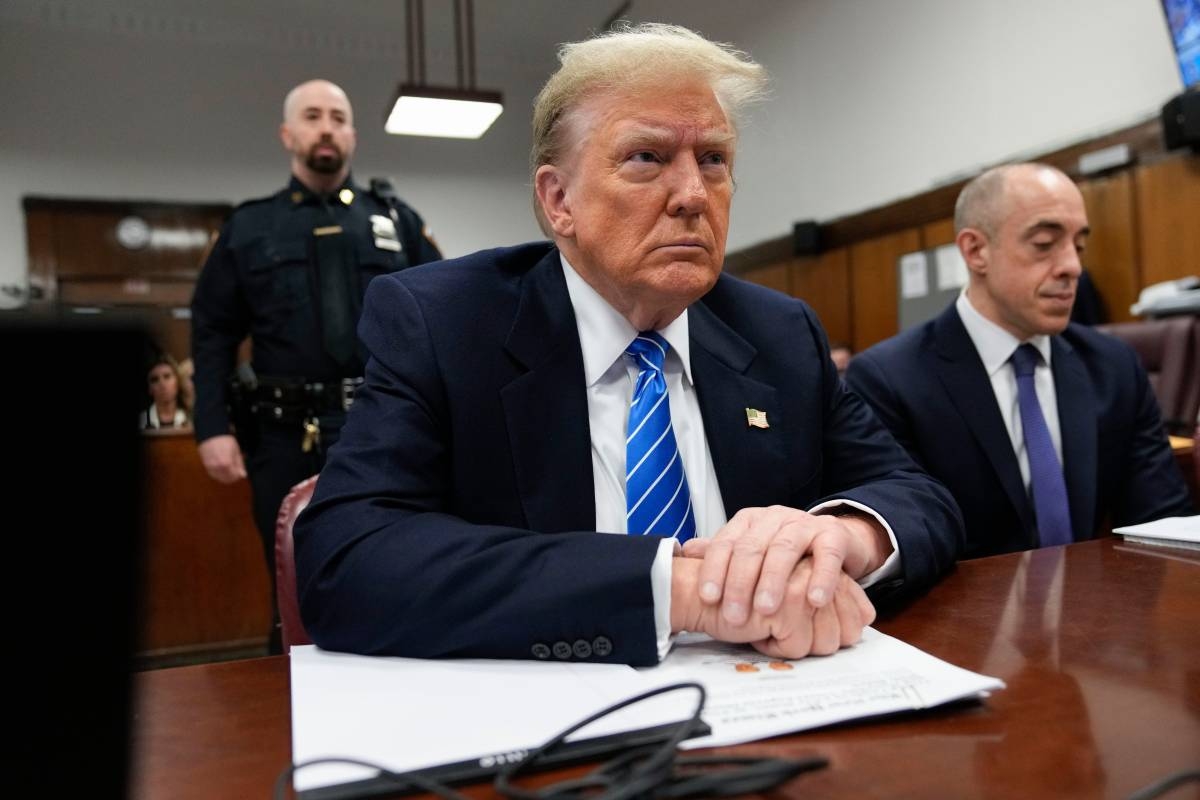
The marble corridors of a New York appellate courthouse became the unlikely stage for a constitutional collision as lawyers for President Donald J. Trump asked a panel of justices to do what has never been done: erase a former president’s felony conviction by invoking the very office he once held. The case, born from a hush‑money payment made years before he entered the White House, has now spiraled into a high‑stakes debate over the boundaries of federal power, campaign‑finance law, and the legal armor that cloaks a president.

At the center of the appeal is Trump’s 2024 conviction for falsifying business records, the first time a former American president was branded a felon. The underlying facts are not in dispute in the traditional sense—the payment was made, the records were doctored—but the legal architecture used to secure the conviction is now under direct assault. Trump denies any wrongdoing, and his legal team has crafted a two‑pronged attack that the appellate judges appeared to take seriously.
Trump’s lawyers argued that the case rests on a fatal flaw: jurisdictional overreach. They contend that the Department of Justice and the Federal Election Campaign Commission have exclusive authority to regulate and enforce contribution and expenditure violations, meaning the Manhattan District Attorney’s office may have overstepped by building a state‑level falsification‑of‑records case on a foundation of alleged federal campaign‑finance violations. If the hush‑money payment was, at its core, a matter of federal election law, then only federal authorities—not a local prosecutor—had the power to bring charges. The argument seeks to pull the legal rug out from under the entire prosecution, suggesting the case should never have been in a New York courtroom to begin with.
Their line of inquiry suggests the judges are not reflexively dismissing the defense’s preemption argument.
Prosecutors countered that they were not pursuing a federal campaign‑finance offense per se, but presenting the alleged violation as a factor underlying what they claim was a Trump‑orchestrated conspiracy. The distinction matters: the state’s theory is that the campaign‑finance context merely provided motive for the falsification of business records, not that it constituted the crime itself.
Yet the appellate justices, whose questions can often signal the direction of a ruling, appeared to wrestle openly with the prosecution’s logic. Their line of inquiry suggests the judges are not reflexively dismissing the defense’s preemption argument. If they ultimately conclude that the state case was impermissibly built on a federal crime it lacked authority to enforce, the conviction could collapse on jurisdictional grounds alone.

More than two years after President Trump was convicted of 34 felonies tied to a 2016 "hush money" payment to an adult film star, his lawyers are set to argue their appeal Thursday in New York. https://t.co/hcNNHfRGTL
Layered on top of the preemption argument is a second, even more constitutionally charged claim: presidential immunity. Trump’s legal team argues that the doctrine, which shields a sitting president from prosecution for official acts, could extend to overturn his hush‑money conviction. The precise contours of how immunity applies to a former president for conduct that occurred before his term are legally murky, but the argument introduces a sweeping question about whether the presidency itself provides a retrospective shield.
The timing of the hearing, coming after Trump’s return to power, adds an extraordinary dimension. The justices are being asked to consider whether a state‑level conviction can stand against a sitting president, even one secured before he reassumed the office. The interplay between the preemption and immunity arguments creates a legal pincer movement: either the case was federal all along and thus beyond the state’s reach, or the defendant’s status as president insulates him from the consequences.
As the hearing concluded, the outcome remained genuinely uncertain. The judges’ questions revealed a panel grappling with the case’s hybrid nature—a state prosecution animated by federal election‑law implications, now colliding with the unprecedented reality of a convicted felon serving as commander‑in‑chief. The Manhattan District Attorney’s office, which secured the historic conviction, now faces the prospect that the appellate court could dismantle the legal theory that made the case possible.
For Trump, the appeal represents more than a legal maneuver; it is a bid to remove the most personal stain on his political legacy. For the courts, it is a test of whether the machinery of state criminal justice can operate in the shadow of federal election law and presidential power. The judges have given no timeline for their decision, but their apparent openness to the defense’s core arguments has transformed what many saw as a long‑shot appeal into a genuine cliffhanger.

Trump Appeals 34 Count Hush Money Conviction, Citing Presidential Immunity and Challenging Trial Evidence https://t.co/R4ngtuaaAf