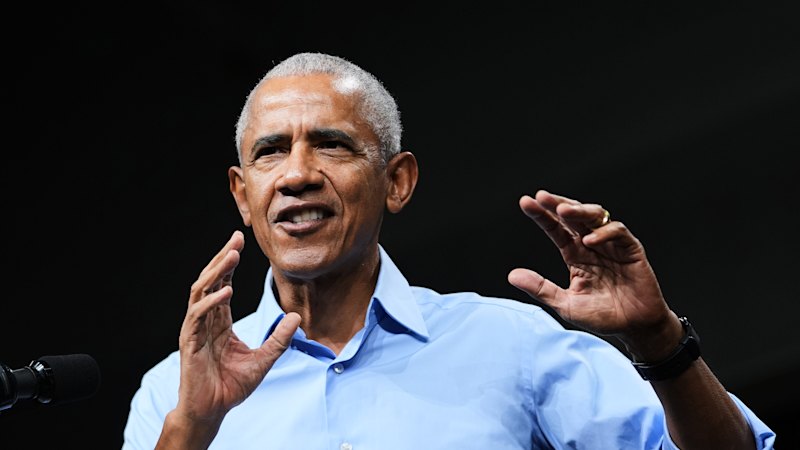
On an unspecified date, the American political landscape was defined by a stark visual contrast. While President Donald J. Trump held a rally in Georgia, his predecessor, Barack Obama, took to the stage in Cleveland and Detroit. The events created a rare split-screen moment for the electorate, highlighting the deepening divide as the nation approaches the November 3 mid-term elections. Obama's return to the campaign trail was not merely a show of support for Democratic candidates like Michigan Senate hopeful Abdul El-Sayed; it was an aggressive, direct challenge to the current administration, which he characterized as a source of national instability.

Obama's message to voters was framed with a sense of urgency. He described the upcoming November 3 vote as a vital 'circuit breaker,' a mechanism intended to halt the current trajectory of the government. His goal, he told crowds, was to 'at least rein in some of the foolishness.' For Obama, the stakes are clear: he argues that the current Republican leadership has abandoned traditional governance in favor of what he termed 'corrupt government, or inept government, or no government.' He urged his audience to flip the switch and restore a sense of accountability to Washington.
Former President Obama on Trump: “He's got the White House looking like Saddam Hussein opened a Cheesecake Factory.” https://t.co/FasNBiQNhu
Beyond policy, Obama took aim at the personal conduct of the President, specifically mocking the administration's focus on White House renovations. In a biting critique that drew laughter from his supporters, Obama suggested that the President's aesthetic choices were more suited for television than the Oval Office. 'He should be on HGTV,' Obama quipped, before delivering a sharper jab: 'He's got the White House looking like Saddam Hussein opened a cheesecake factory. Just gold everywhere.' The remark served to underscore his broader argument that the administration is preoccupied with superficial displays of wealth rather than the substantive duties of the presidency.
This sentiment appears to resonate with a significant portion of the public.
Obama's rhetoric grew more severe when he shifted to the topic of ethics. He accused the President of turning the White House into a platform for personal enrichment, a practice he labeled as 'straight-up grifting.' According to Obama, the administration has been uniquely focused on 'selling favours' for private gain. This sentiment appears to resonate with a significant portion of the public. Data from a Reuters/Ipsos poll reflects this skepticism: 69 percent of Americans now believe that policy decisions are being influenced by the President's private business dealings, while 63 percent suspect that the President and his family have inappropriately profited from cryptocurrency.

🔥🚨DEVELOPING: Former President Obama just went on stage to start taking shots at President Trump and criticized him for upgrading the White House. Obama: “He's got the White House looking like Saddam Hussein opened a Cheesecake Factory. It's gold everywhere.” https://t.co/Y933BpeuZQ
Turning to foreign policy, Obama criticized the President's handling of the conflict with Iran. He argued that the administration has led the country into an 'economically painful war' that 'nobody asked for.' Obama contended that these actions have backfired, actually increasing Iran's economic leverage. By threatening to attack shipping in the Strait of Hormuz, Iran has successfully unsettled global oil exporters, creating volatility that Obama claims is a direct result of the current administration's foreign policy choices.
In his address, Obama sought to debunk the idea that the current economic climate is the result of external, uncontrollable factors. 'As a former president, I can tell you sometimes factors beyond a president's control end up foiling the best-laid plans,' he acknowledged. However, he was quick to pivot, asserting that 'that is not the case here.' He placed the blame for the nation's current economic struggles squarely on the White House, arguing that the administration's specific actions are directly responsible for the rising costs that American families are facing.
As the campaign enters its final stretch, the race between Democratic candidates and their Republican counterparts—such as Mike Rogers—has tightened significantly. Obama's appearances are designed to energize the Democratic base, which he believes is the only force capable of checking the current administration's 'incompetence' and 'chaos.' As the White House remains silent on these criticisms, the former president's message remains a central pillar of the Democratic strategy: that the current government has fundamentally lost its way, and that the November 3 election is the only opportunity to reset the course.