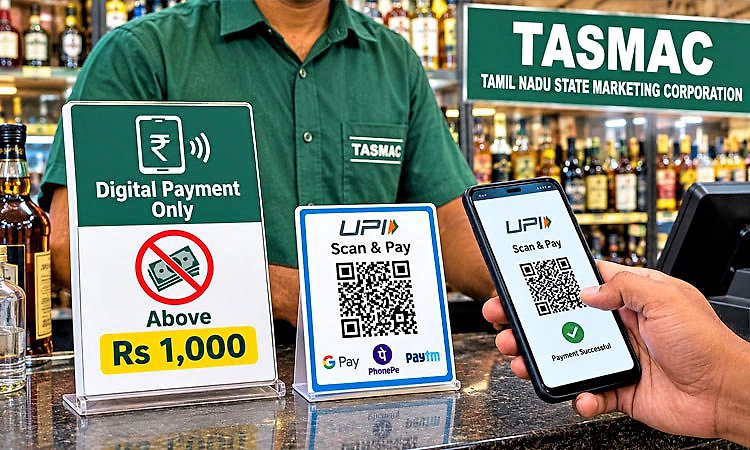
For decades, the hum of a cash register has been the rhythmic heartbeat of Indian commerce. It is a sound that signals trust, immediacy, and the physical exchange of value. But for the Tamil Nadu government, that familiar clink is now viewed as a point of failure. The state is preparing to flip a switch that will fundamentally alter how two major sectors operate: the unlicensed liquor trade and the mid-day meal program. The change is simple in concept but vast in implication. Effective in November 2026, any purchase costing more than 1,000 rupees will mandate a digital transaction. This is not a trial; it is a structural shift designed to close the loopholes that allow black markets to thrive and accounting errors to fester.

The primary target of this new regulatory framework is the sprawling network of unlicensed liquor shops, a figure the state has identified at 4,048 locations. These establishments have long operated in a grey zone, where cash transactions are king. Cash is untraceable, which makes it the preferred medium for businesses that exist outside the full reach of formal compliance. For these 4,048 shops, the cash economy is not just a convenience; it is a shield. It allows for the handling of fake notes without a digital paper trail and facilitates accounting errors that go unnoticed because there is no immediate, verifiable record of the sale. By forcing a digital handoff for amounts above 1,000 rupees, the government is effectively stripping away that shield. Every rupee spent above the threshold will be recorded, creating a transparent ledger that is far harder to manipulate or ignore.
Enforcement of this new era will be handled by the appropriate government authorities. As the entity with oversight over the legal liquor trade, these authorities will monitor the transition. Their role here is pivotal; they will be the ones to ensure that the 4,048 unlicensed shops, and the broader market they influence, adhere to the digital mandate. The government's involvement signals that this is not merely a tax collection issue, but a safety and transparency initiative. The aim is to curb black market activities by making the illicit trade too risky and too visible to sustain. By tying the enforcement to government authorities, the state ensures there is a dedicated operational arm for the policy, rather than leaving it to ad-hoc inspections.
In the context of public feeding, the risk is not just criminality, but inefficiency.
While the liquor trade is the most visible target, the mandate also ripples into the social welfare sector. The state's tax department has approved the initiative for mid-day meals, a program that currently operates through 4,048 delivery centers. This is a striking numerical coincidence that highlights the scale of the change. In the context of public feeding, the risk is not just criminality, but inefficiency. Cash leakage in large-scale public programs is a perennial problem, where funds meant for food are siphoned off through fraudulent vouchers or unrecorded cash exchanges. By moving these transactions to a digital platform, the government aims to ensure that every rupee allocated for a child's lunch actually arrives at the plate. The potential for faster transactions and reduced errors in this sector is equally significant, streamlining a process that has historically been slow and prone to human miscalculation.
The implementation of this rule will not be a sudden, overnight upheaval. The rollout is designed to be phased, allowing time for both the public and the 4,048 affected shops to adapt to the new norms. This phasing includes a specific accommodation: smaller purchases, those under the 1,000-rupee threshold, will continue to accept cash. This is a deliberate choice to maintain accessibility for low-value transactions, recognizing that not every interaction can or should be digitized. The threshold acts as a filter, capturing the high-volume, high-risk transactions that pose the greatest threats to the economy and public safety, while leaving the small, daily exchange of coins and notes largely undisturbed. This balance is critical to the policy's success; a mandate that forces digital payments for a bottle of water or a sandwich would face immediate public backlash. By focusing on the 1,000-rupee mark, the state targets the transactions where transparency matters most.
This policy is part of a wider trend visible across the region, where digital infrastructure is being used to solve age-old problems of trust and record-keeping. Around the same time, other states and sectors are seeing shifts in how business is conducted, such as in the defense sector where a 2.12 crore rupee purchase of equipment is proceeding through new channels. The Tamil Nadu move is more sweeping because it applies to millions of daily consumer interactions. It is a recognition that in a cashless-leaning world, the ability to verify a transaction is the new currency of trust. For the unlicensed shops, this means an end to the era where a stack of bills is the only proof of sale. For the mid-day meal centers, it means an end to the era where a teacher's word is the only record of who was fed.
As we approach November 2026, the anticipation is palpable. The 4,048 unlicensed shops will need to install or adapt to digital payment systems, a process that