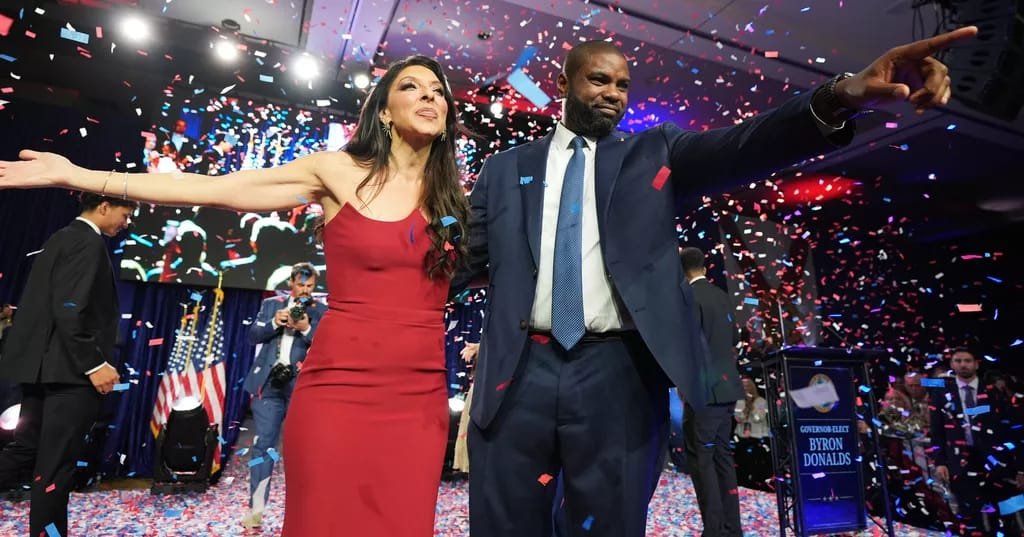
On the day of the election, Byron Donalds, a Republican, secured victory in the race for governor, becoming the first Black individual to hold the state's highest office. The win was not merely a personal milestone for Donalds, but a definitive signal of the state's shifting political identity. In a victory that felt both sudden and inevitable, Donalds defeated Democrat David Jolly in a contest that tested the limits of Florida's evolving electorate.
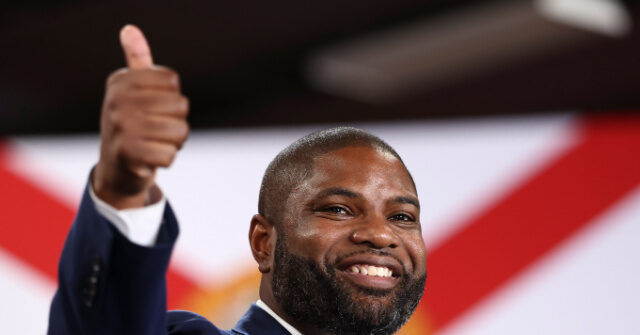
For decades, the governorship of Florida—the nation's third-most populous state—was a seat that Democrats could claim. It has been over thirty years since a Democrat last held the office. Now, as Donalds prepares to succeed the outgoing Republican Governor Ron DeSantis, the seat remains firmly within the Republican fold, cementing a period of GOP control that has fundamentally altered the state's trajectory.
To understand how Donalds arrived at this moment, one must look back at the years of Republican ascendancy that paved his way. The foundation for this victory was laid during the leadership of Ron DeSantis, whose management of the state during the pandemic served as a catalyst for massive economic and political shifts. While much of the country grappled with restrictions, Florida became a live test for the nation, attracting a massive influx of residents who were seeking to escape those very limitations.
Donalds, a staunch supporter of President Donald Trump, campaigned on a platform of continued conservative governance and economic stability.
This migration was not just a movement of people, but a movement of political influence. As people flocked to the Sunshine State, Florida experienced significant economic growth. Between 2019 and 2025, the state's inflation-adjusted GDP per resident surged by 16.9 percent, vastly outstripping the 5.5 percent growth seen in states like Pennsylvania. This economic vitality extended to the labor market, where Florida recovered payroll jobs much faster than its northern counterparts. This era of growth provided the Republican Party with a powerful narrative of success, one that Donalds would later inherit.
As the economy grew, so did the Republican voter base. The demographic math of Florida has shifted dramatically in recent years. In November 2021, for the first time in the state's history, registered Republicans outnumbered Democrats. Since that moment, the gap has not just persisted; it has exploded. Today, the Republican Party holds a massive advantage, with approximately 1.5 million more registered Republicans than Democrats in the state.
However, the true battlefield in the Donalds-Jolly race was not just the partisan divide, but the massive, unaligned middle. There are 3.3 million unaffiliated voters in Florida—a group of decision-makers whose allegiance is not tied to a party label. The race became a contest to see which candidate could best appeal to these independent voices, balancing the demands of a staunchly conservative base with the practical concerns of a growing, diverse population.
While the Republican machine provided Donalds with significant momentum, the campaign was far from a cakewalk. The race was defined by a sharp contrast in focus. Donalds, a staunch supporter of President Donald Trump, campaigned on a platform of continued conservative governance and economic stability. He sought to address the immediate anxieties of Floridians, specifically the rising costs of living and the escalating burden of homeowners' insurance.
David Jolly, the Democratic challenger, attempted to pivot the conversation toward different pressing issues. Jolly's campaign centered on the challenges of inflation, the need for housing solutions, and the burgeoning impact of AI data centers on the state's infrastructure. It was a fight between a candidate promising to maintain a proven conservative momentum and a candidate attempting to highlight the cracks in the state's economic foundation.
Even as Donalds consolidated support, the Republican Party faced its own internal pressures. The campaign took place against a backdrop of localized dissatisfaction within the GOP, driven by concerns over gas prices and the ongoing war with Iran. These issues created a friction point that tested the party's unity.
Despite these headwinds, Donalds leaned into his relationship with the national Republican leadership. His victory was bolstered by a strong campaign finance effort and the explicit endorsement of President Trump. For Donalds, the win was as much about national alignment as it was about state policy. He positioned himself as a bridge between the traditional conservative values of Florida and the populist energy of the Trump era.
As the dust settles on the election, the implications for Florida are clear. Donalds intends to build upon the legislative and economic successes of the DeSantis administration, with specific plans to focus on transportation and other critical state infrastructure. The transition marks the continuation of a Republican era that has seen the state move from a competitive battleground to a stronghold.
In his victory remarks, Donalds made it clear that his administration would not be a departure from the current direction, but an acceleration of it. "I want you to hear from Florida that we are still red," Donalds stated, addressing the national political stage. "Mr. President, I also want to tell you thank you for your support and thank you for being in my corner."
With a massive Republican registration advantage and a mandate to continue the