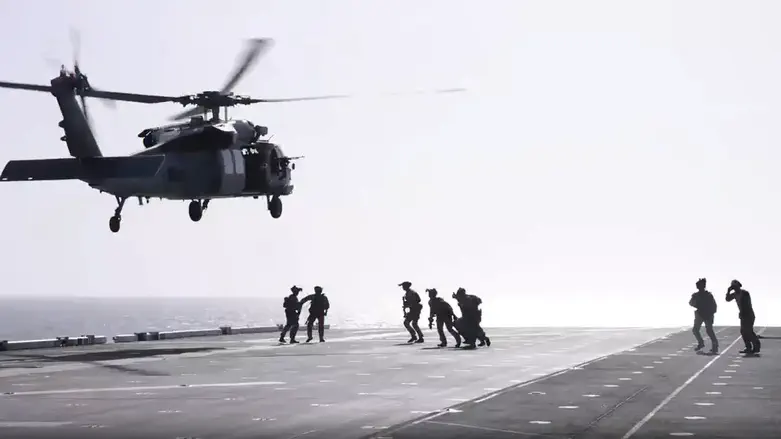
On October 10, the quiet waters of the Gulf of Oman became the site of a calculated military operation. A U.S. fighter jet, operating under the authority of U.S. Central Command (CENTCOM), intercepted the M/V Ocean Molica—a Panama-flagged cargo vessel that had recently departed an Iranian port. The encounter was not a spontaneous skirmish but the culmination of a rigid enforcement protocol. Despite repeated warnings to alter course and respect the U.S.-enforced naval blockade, the vessel continued its trajectory. In response, the fighter jet deployed a precision-guided munition, striking the ship’s stern with surgical accuracy. The goal was specific and limited: to disable the vessel’s propulsion system without causing harm to the crew on board.

This incident is a direct consequence of a policy shift that began on July 14, when U.S. forces formally resumed a naval blockade targeting all vessels entering or departing Iranian ports. This blockade, which governs critical shipping lanes including the approaches to the Strait of Hormuz, represents a significant escalation in the regional maritime posture. For mariners navigating these waters, the rules of engagement are now stark. CENTCOM has issued clear directives, advising all crews to monitor official broadcasts and maintain contact with U.S. naval forces via the bridge-to-bridge channel 16. The message is clear: the blockade is not merely a diplomatic posture, but an active, enforced boundary.

According to a release from U.S. Central Command (CENTCOM? after a commercial cargo vessel, the M/V Ocean Molica (“Arika Sun”), ignored warnings to divert and continued to try to run the blockade of vessels traveling to and from Iran, CENTCOM forces struck and disabled the vessel in the Gulf of Oman. Per the release, the Panama-flagged vessel, which had previously left an Iranian port, was struck by U.S. fighter jets with precision munitions in its stern, disabling all propulsion without injuring any crew.
In the three months since the enforcement began, the scale of the operation has become increasingly evident. The data provided by CENTCOM paints a picture of a busy, high-pressure environment. During this short window, 135 ships have been intercepted and forced to turn around, effectively halting their transit to or from Iranian territory. The M/V Ocean Molica—also known as the Arika Sun—is now one of four commercial vessels that have been physically disabled by U.S. forces for attempting to breach the blockade. These actions serve as a physical manifestation of the U.S. strategy to restrict the flow of goods and resources in the region.
The M/V Ocean Molica—also known as the Arika Sun—is now one of four commercial vessels that have been physically disabled by U.
Beyond the interception of commercial cargo, the blockade has a specific, strategic target: the Islamic Revolutionary Guard Corps (IRGC). CENTCOM reports that over the same three-month period, U.S. forces have destroyed 10 tankers linked to the IRGC’s multibillion-dollar shadow network. This network, which relies on a fleet of vessels to circumvent international restrictions, is a primary focus of the current U.S. maritime strategy. By targeting these specific tankers, the U.S. is attempting to dismantle the financial and logistical infrastructure that supports the IRGC’s operations.

U.S. Central Command forces disable Panama-flagged cargo vessel Ocean Molica in the Gulf of Oman after crew ignored warnings and tried to run the naval blockade against Iran; fighter jet struck the stern with a precision munition, disabling propulsion without harming the crew, CENTCOM says. https://t.co/c32wiJGY1j
The strike on the M/V Ocean Molica serves as a reminder that the Gulf of Oman and the Strait of Hormuz are currently among the most volatile shipping corridors in the world. As the blockade continues, the risk to commercial shipping remains high. CENTCOM’s posture remains firm, emphasizing that the safety of the crew is prioritized during these interventions, even as the vessels themselves are rendered immobile. For now, the blockade stands as a defining feature of the regional conflict, with the U.S. military maintaining a persistent, watchful presence over every ship that dares to challenge the line.