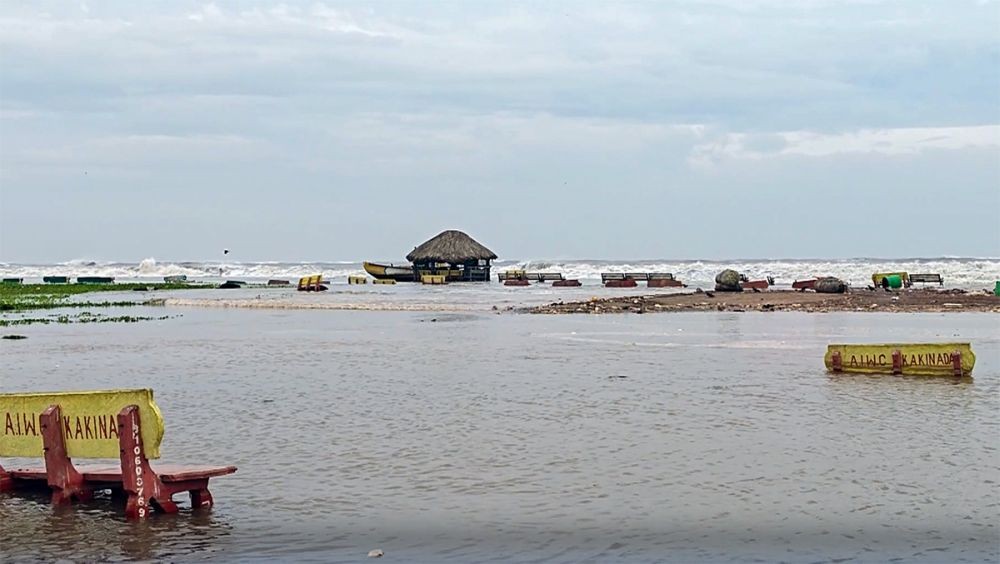
In the final days of October 2026, Cyclone Arnab gathered strength in the Bay of Bengal, its presence already being felt along India's eastern coastline. The storm, named for its swirling pattern and unpredictable nature, began to show its teeth on October 27 when high waves lashed the coast in Kakinada, a port city in Andhra Pradesh. These early signs served as a warning of what was to come, prompting authorities across the region to prepare for the impending impact.
On October 28, Cyclone Arnab made landfall in Andhra Pradesh, bringing with it heavy rainfall and strong winds that threatened to disrupt daily life. The storm's arrival triggered immediate responses from state governments, with officials in Andhra Pradesh taking swift action to ensure public safety. That same day, schools across the state were ordered closed, a precautionary measure designed to keep children out of harm's way as the storm passed through.

VIDEO | Cyclone Arnab: Rains lash Odisha's Baleswar. (Full video available on PTI Videos - https://t.co/d8jp61yd2p) https://t.co/N9R1QqRS0y
The storm's impact wasn't limited to Andhra Pradesh. As Cyclone Arnab continued its northwestward path, neighboring states also began to feel its effects. In Odisha, authorities announced school closures on October 28, recognizing the potential dangers posed by the approaching weather system. The decision to suspend classes reflected a growing awareness of the storm's potential to cause disruption and endanger students traveling to and from school.
On October 28, the state government ordered school closures in several districts, effectively halting academic activities as the storm's effects began to be felt.
Perhaps most significantly, Jharkhand found itself in the crosshairs of Cyclone Arnab's influence. On October 28, the state government ordered school closures in several districts, effectively halting academic activities as the storm's effects began to be felt. The India Meteorological Department (IMD) issued heavy rainfall warnings for nine districts in Jharkhand, indicating that the storm was expected to bring significant precipitation to the region. These warnings, coupled with the observed temperature drop, prompted authorities to err on the side of caution by suspending classes.

Cyclone Arnab leaves Andhra Pradesh reeling as deaths reported and 150 kmph gusts feared | Very severe cyclonic storm Arnab battered the Andhra Pradesh on Wednesday, with three people reported dead amid heavy rain, strong winds and flooding across several districts. The IMD forecast wind speeds of up to 135 kmph, with gusts reaching 150 kmph. Police rescued four people stranded by floodwaters in Kakinada, while three others were reported stranded at Kakinada Anchorage Port. Full Story Here 👉 https://t.co/Ps91FL1I4H #CycloneArnab #AndhraPradesh #TamilNadu #Weather #India
For students and parents across the affected regions, the school closures represented both a disruption and a necessity. While the interruption of academic activities posed challenges, the measures were seen as essential protections against the unpredictable forces of nature. In Jharkhand, where intermittent rainfall had already begun affecting daily life, the decision to keep schools closed until at least October 29 demonstrated the authorities' commitment to prioritizing safety over routine.
The India Meteorological Department played a crucial role in guiding the response to Cyclone Arnab. By providing timely and accurate warnings, the IMD enabled state governments to make informed decisions about when and how to implement precautionary measures. The heavy rainfall warnings for nine districts in Jharkhand, issued on October 28, were particularly instrumental in convincing authorities that school closures were necessary to prevent potential harm to students.

#NewsroomUnfiltered | Cyclone Arnab: Andhra CM writes to Amit Shah; seeks deputation of Central team at earliest to assess damage @tweet_aneri shares more details #CycloneArnab #AndhraPradesh #AndhraPradeshNews #CycloneAlert #CycloneDamage #AmitShah | @GrihaAtul https://t.co/pvl8X9pYQI
As Cyclone Arnab continued its path across eastern India, the full extent of its impact remained to be seen. The storm had already demonstrated its capacity to disrupt normal life, with school closures serving as the most visible indicator of the precautions being taken. For now, the focus remained on ensuring public safety, with authorities across the three states remaining vigilant as they monitored the storm's progress and adjusted their responses accordingly. The coming days would reveal whether the precautionary measures had been sufficient or if Cyclone Arnab would leave a more lasting mark on the communities in its path.