
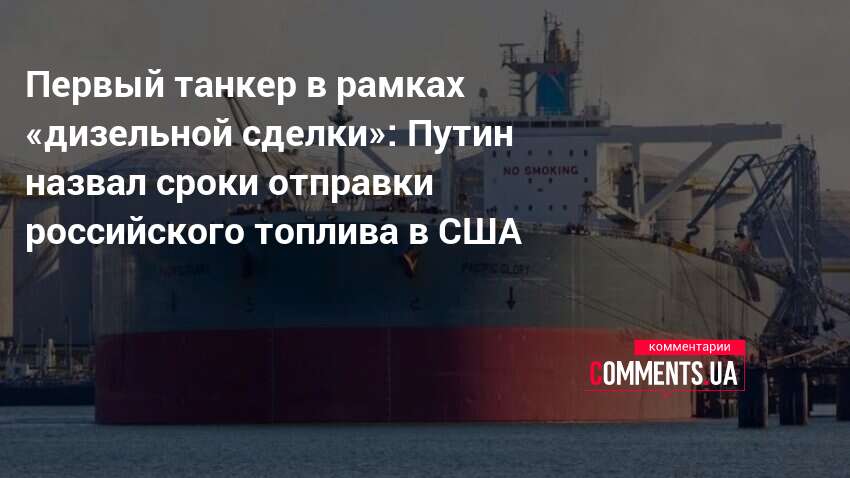
In the quiet diplomatic corridors of Strelna, a fundamental shift in the global energy landscape was signaled on October 21. During a meeting with U.S. presidential envoy Steve Witkoff, Russian President Vladimir Putin announced that the first tanker carrying diesel fuel destined for the United States would depart within two to three days. This is not merely a routine commercial transaction; it is the first physical manifestation of a high-stakes agreement reached on October 9 between Putin and U.S. President Donald Trump.

The scale of the movement is significant, even if it is only the beginning. The initial shipment is set to carry 40,000 tons of diesel. According to Putin, this sudden influx of supply has already begun to exert downward pressure on the global market, contributing to a 5-6% drop in global diesel prices. For a world sensitive to the cost of transport and heating, these numbers represent more than just market fluctuations—they represent a pivot in how energy is used as a tool of statecraft.
The logistics of this deal are being managed through a complex web of temporary permissions and shifting domestic policies. To facilitate the flow, the United States has granted a temporary license for these exports, a move that allows Russian diesel to bypass previous restrictions. This comes as Russia has removed its own export ban on diesel, a measure taken to address domestic shortages caused by Ukrainian attacks on Russian refineries.
President Zelenskyy has criticized the deal, labeling it an "investment in war.
Russian Vice Premier Alexander Novak has been vocal about the intent behind these movements. "The first tanker is planned to depart from the port tomorrow, October 22, bound for the United States," Novak stated, framing the move as a fulfillment of capacity. He added, "We will be meeting the needs of the United States within our capabilities." The timeline suggests an aggressive ramp-up: Russia is reportedly ready to export 500,000 tons of diesel in November, with volumes potentially reaching up to 1 million tons by December. The long-term vision is even more expansive, with Russia aiming to fully restore its diesel export volumes by the end of 2026.
While the tankers prepare to leave port, the diplomatic machinery behind the deal has been working across several capitals. Before meeting in Strelna, envoy Steve Witkoff was involved in negotiations in Oslo, a summit that included Ukrainian President Volodymyr Zelenskyy, Norwegian Prime Minister Jonas Gahr Stre, and Finnish President Alexander Stubb. U.S. Vice President Jared Kushner also participated in the Oslo talks remotely.
Finnish President Stubb reported that progress had been made regarding security and economic elements, details which the special envoy intended to present to Russian leadership. This layered negotiation process underscores the complexity of the situation: a trade deal involving fuel is inextricably linked to the broader security architecture of Europe. It is a delicate balancing act where economic necessity meets the hard realities of a continuing conflict.
Not everyone views this energy rapprochement as a step toward stability. In Kyiv, the reaction has been one of sharp condemnation. President Zelenskyy has criticized the deal, labeling it an "investment in war." This sentiment is echoed by Ukraine's official on sanctions policy, who points out a stark mathematical reality: while the shipments are significant, the U.S. consumes more than 300,000 tons of diesel per day, meaning the scale of these tankers is a mere fraction of American demand.
There is also a political dimension to the friction. President Trump has expressed dissatisfaction with Zelenskyy's reluctance to agree to peace terms and to cease attacks on Russian refineries. In a move that signals a shift in American strategic posture, Trump asserted that Ukraine needs a new leader—one capable of negotiating with Moscow. This tension is currently playing out in the halls of power, as the U.S. Congress has proposed a bill to block the U.S.-Russia diesel agreement, highlighting the deep domestic divide over whether energy security should be decoupled from geopolitical conflict.
As the first 40,000-ton tanker prepares to depart on October 22, the world is watching to see if this is a temporary reprieve or a permanent realignment. The immediate impact is visible in the 5-6% dip in global prices, but the broader implications are still unfolding. If Russia meets its projected targets—moving toward 3.5 million tons in potential monthly exports—the global energy market may look fundamentally different by the end of 2026.
For now, the movement of diesel serves as a barometer for a changing world order. It is a landscape where temporary licenses and sudden shipments are used to navigate the space between total economic warfare and a fragile, transactional peace. The tankers are moving, the prices are falling, and the geopolitical consequences are only just beginning to be calculated.