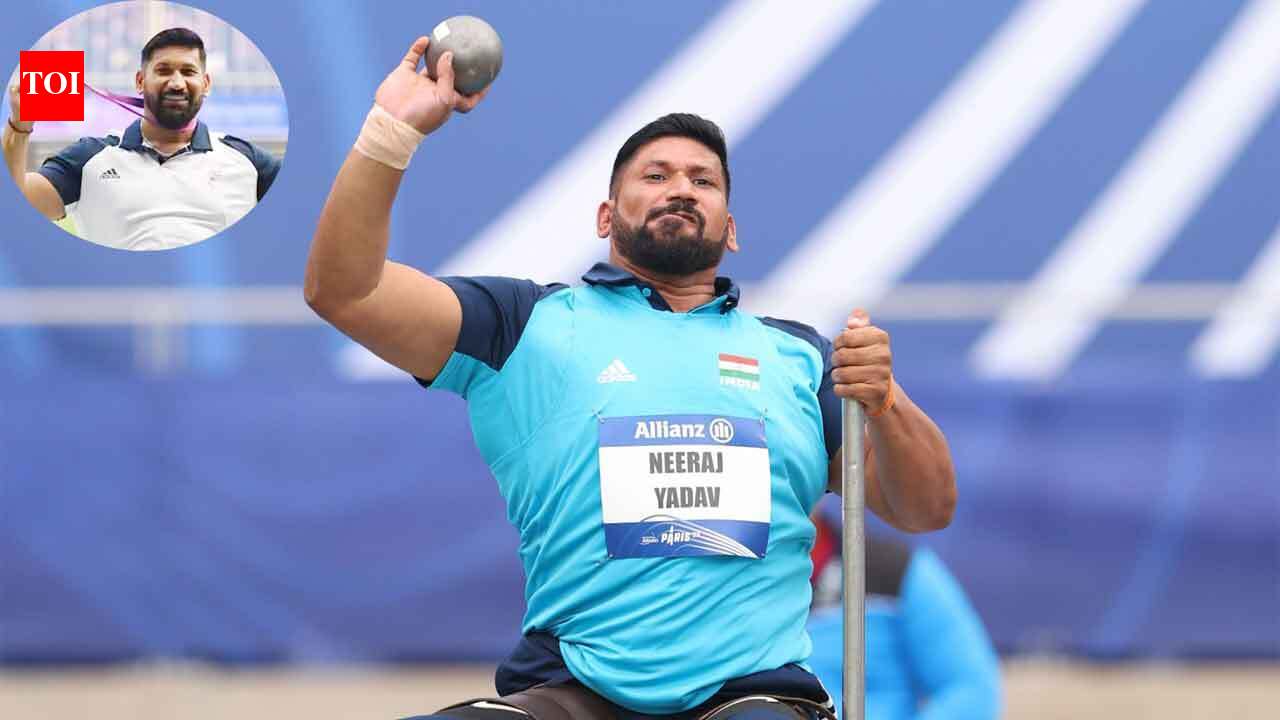
For anyone watching sports from the outside, victory is often measured in medals, records, and the bright flash of stadium lights. But for athletes who navigate physical disabilities, the journey to the podium is paved with private battles that most of the world never sees. Neeraj Yadav understood those battles intimately. Born in Ghaziabad, Uttar Pradesh, his life took a defining turn at just seven years old when he was diagnosed with childhood polio. Yet, rather than letting the condition dictate the boundaries of his world, he spent his life pushing past them.

Long before he became a dominant force in track and field, Yadav channeled his competitive fire into wheelchair tennis. Over those years, he built the foundation of an elite competitor, mastering the intricate coordination and explosive upper-body strength required to maneuver a chair under high-pressure competitive conditions. When he eventually transitioned to para-athletics, competing in the F55 category for athletes with impaired muscle power or restricted range of movement, that athletic foundation served him exceptionally well.
By the time he reached the international stage, Yadav was a formidable competitor. He cemented his legacy by capturing three Asian Para Games gold medals across his career. His prowess was prominently on display at the 2018 Jakarta Asian Para Games, where he claimed a prestigious gold medal. His dominance continued into subsequent years, including triumphs tied to the 2023 Asian Para Games competitions. Along the way, he etched his name into the record books as a testament to his technical precision and sheer physical power.
Even the most celebrated athletic careers, however, can be derailed by administrative and personal tempests.
Even the most celebrated athletic careers, however, can be derailed by administrative and personal tempests. Yadav's trajectory hit a severe obstacle when the National Anti-Doping Agency provisionally suspended him after an out-of-competition sample tested positive for stanozolol. For an elite athlete whose identity and daily purpose are inextricably linked to competition, a doping suspension is more than a temporary pause; it is an existential crisis that cuts them off from their training, their peers, and their primary source of self-worth.
The weight of these compounding pressures appears to have become insurmountable. On a Tuesday night, the 42-year-old para-athlete was found dead at a flat in New Delhi. Authorities and associates indicated that he is suspected to have consumed poison in an apparent suicide. The Indian Paralympic community, which had long celebrated his triumphs on the track and court, was left reeling by the sudden and devastating loss of one of its most prominent figures.
In the wake of the tragedy, confirmation of his passing came from those who knew him best within the athletic federation. Chief para-athletics coach S Satyanarayana voiced the collective grief of a stunned community, noting the emotional toll that recent events had taken on the champion. Reflecting on the tragedy, S Satyanarayana stated, "Yes, Neeraj has died by suicide. That is what I have also come to know. I have been told that he consumed poison at his flat last night. This is extremely unfortunate and tragic." As investigations into the surrounding circumstances and doping allegations continue, Indian sports is left to mourn a trailblazer whose extraordinary journey from a childhood polio diagnosis to continental glory remains an indelible part of the nation's sporting history.