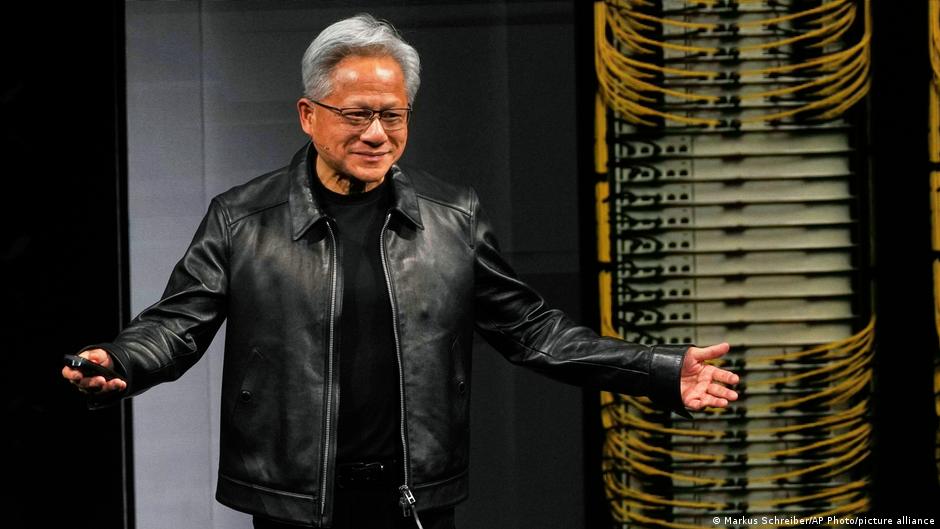
In Berlin on October 21, 2026, Jensen Huang, the chief executive of Nvidia, stood before an audience and painted a picture of promise for Europe's artificial intelligence economy. The tech leader's optimism cut through the autumn air, suggesting that despite global uncertainties, the continent was positioned to become a significant player in the AI revolution. Huang's remarks came during a conference dedicated to technological advancement, where he highlighted Europe's potential to harness AI innovation for economic growth and competitive advantage.
On the very same day, Germany's Finance Ministry found itself in an awkward position after introducing an erroneous tobacco tax hike. The unexpected policy change created confusion within the business community and among consumers, as the ministry quickly worked to correct the mistake. This incident underscored the challenges of policy implementation in a complex economic environment, even as Germany continued to navigate post-pandemic recovery and energy transition.

Nvidia CEO Jensen Huang on Germany: "Nothing pains me more, frankly, than to see one of the most technologically advanced countries to be left so far behind in technology. And I think the reason for that is this: maybe it's the European way to overthink everything. Germany has so much talent. Just get to work." https://t.co/ScspDQhMx4
Amid these policy stumbles, Germany received a dose of positive economic news. The Bundesbank, the country's central bank, forecasted growth for the fourth quarter of 2026, offering a cautiously optimistic outlook for Europe's largest economy. This projection suggested that despite various headwinds, Germany's economic machinery was still capable of generating momentum, though the central bank remained guarded about the strength and sustainability of this recovery.
The armed forces reported a "considerable" threat of sabotage, pointing to recent incidents involving drones and Navy ships.
Political circles were also abuzz on October 21, as Alice Weidel, a prominent figure in the Alternative for Germany (AfD) party, prepared to present "A New Deal for Europe" in Strasbourg. The proposal signaled the party's vision for reshaping Europe's political and economic landscape, reflecting broader debates about the future direction of the European Union and its member states' relationships with one another and global partners.

Jensen Huang says that AI is "a complete reset" in the race between Germany, Japan and China. Jensen Huang: "Electrification resulted in really three geographical leaders: Germany, the United States, and Japan. For the last 50 years, because of the current industrial revolution, which is computing and digital technology, the United States has largely exported its heavy manufacturing, its buildings, and its crafts really to China." "China is probably the only nation today that is deep in manufacturing and deep in computer science and very comfortable in both." "The good news is there's a complete reset. The last 50 years were about software programming. There's a new era now. The computer programs itself. You just have to show the computer what you want." "All the digital technology in the world will not replace electromechanical physical technology. Electrons will never replace atoms." "This industrial revolution is so mighty, so powerful. You don't have another chance. Whether we have another chance or not, we should always assume we don't." The German chancellor's response: "I share your view that the Americans made a big mistake to export their manufacturing, and now they are faced with a very small, successful, but very small-based industry."
While political and economic developments unfolded, Germany's military, the Bundeswehr, issued a stark warning about national security. The armed forces reported a "considerable" threat of sabotage, pointing to recent incidents involving drones and Navy ships. These concerns reflected growing anxieties about potential hostile actions within and around Germany's borders, adding another layer of complexity to the country's strategic planning and defense posture.
Compounding Germany's challenges was the dramatic collapse in trade with Russia. Data revealed a staggering 96.4% decline in German imports of Russian goods during the first half of 2026 compared to 2021 levels. This dramatic shift, while not entirely halting all commerce, represented a fundamental reorientation of Germany's economic relationships following geopolitical tensions and policy decisions that reshaped Europe's energy and trade landscape.

JENSEN HUANG SAYS 🇩🇪 GERMANY'S DATA IS A NATIONAL RESOURCE THAT SHOULD NOT BE EXPORTED He explains why countries must maintain control over their own data and intelligence: - A nation's data represents its culture, values, knowledge, and experience, making it a natural resource that belongs to its people - Germany should import technology to turn its own data into national intelligence - Exporting German culture, knowledge, and history only to import German intelligence back makes no sense
As these various strands of economic policy, technological promise, and geopolitical concern converged on October 21, 2026, Germany found itself at a crossroads. Nvidia's Huang offered a vision of future prosperity through AI, while immediate challenges ranging from policy errors to security threats demanded attention. The day's events encapsulated the broader tensions between Europe's technological aspirations and its current economic and geopolitical realities, suggesting that the path forward would require careful navigation between innovation and stability.
