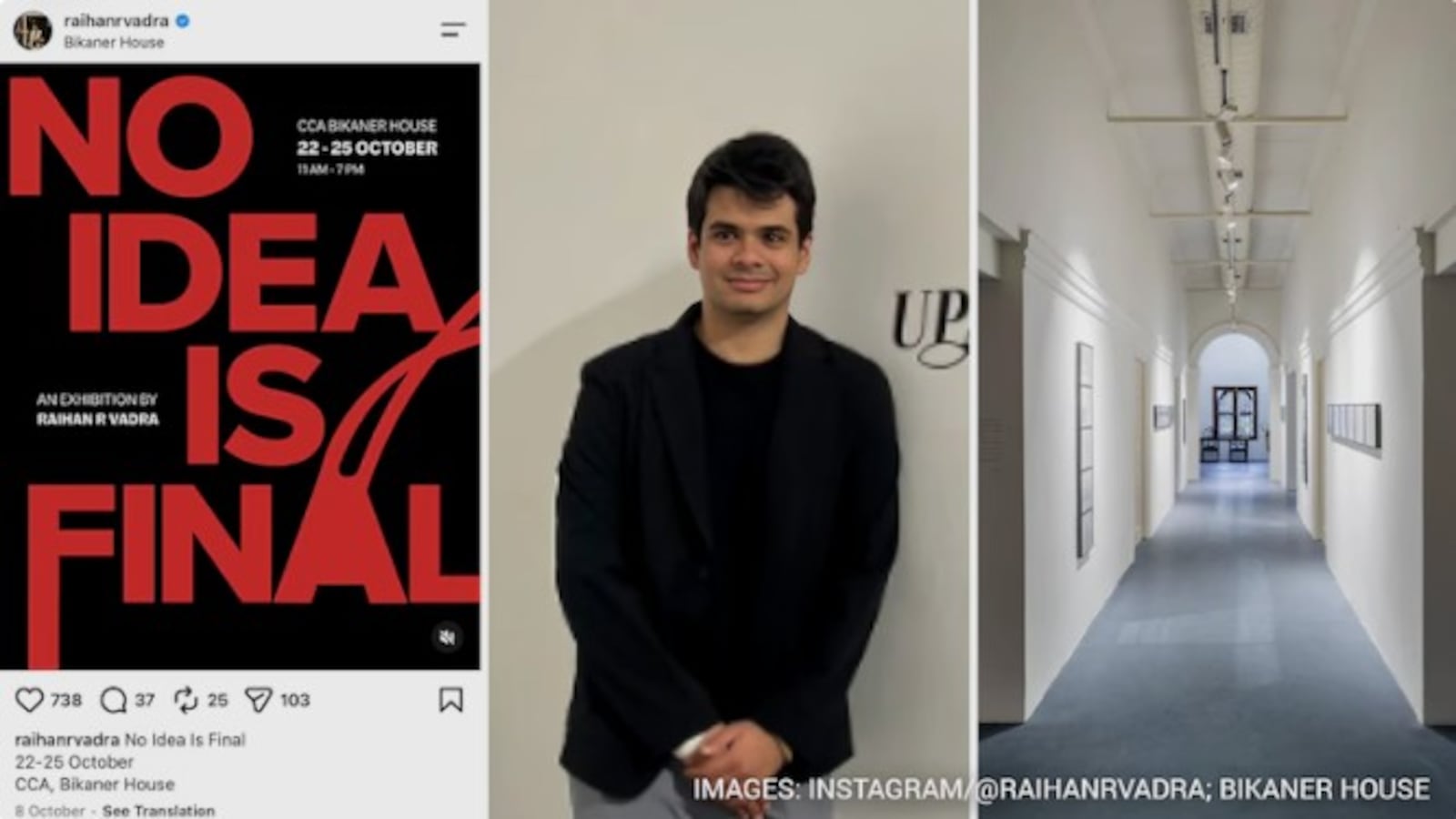
On October 22, 2026, the halls of Bikaner House in Delhi were meant to serve as a canvas for the contemporary Indian experience. Raihan Vadra, an artist and the son of Congress leader and Member of Parliament Priyanka Gandhi Vadra, had curated an exhibition titled 'No Idea Is Final.' The collection was intended to be a visual exploration of the world, a synthesis of perspective captured through a lens. However, the exhibition quickly became a flashpoint for a much deeper conflict regarding the role of art in public spaces. Of the 105 photographs originally selected for display, 75 were abruptly removed by the management of Bikaner House. The reason provided was as stark as it was controversial: the images contained political messaging, and the institution maintained that its exhibitions should be strictly confined to the realms of culture and wildlife.

The photographs in question were not abstract or obscure; they were documents of recent protests by young individuals in Delhi. For Vadra, the removal of these images was not merely a logistical disagreement with a venue, but a fundamental misunderstanding of the artistic process. As he questioned the decision, he pointed to the irony of the censorship. Among the images taken down were photographs of the Indian flag, a symbol that one might assume would be beyond the reach of institutional scrubbing. "They’re just pictures of the Indian flag," Vadra noted, expressing his frustration at the lack of clarity in the institution's policy. He argued that the act of documenting the streets was an essential part of his work, stating, "I had to tell them that an art institution should not have such a policy. I mean, most art is political, right?"
The controversy soon transcended the walls of the gallery, drawing in the heavyweights of Indian politics. Priyanka Gandhi Vadra, a prominent figure within the Congress party, did not remain silent as her son’s work was dismantled. In a series of statements that framed the incident as a symptom of a broader democratic malaise, she offered a sharp critique of the decision-makers at Bikaner House. Her defense of her son was both personal and philosophical. She reached out to him with a message of encouragement, telling him, "You stand for what is true and everything beautiful will find its way to you. I am proud of you, always will be."
Among the images taken down were photographs of the Indian flag, a symbol that one might assume would be beyond the reach of institutional scrubbing.
For Priyanka Gandhi, the removal of the photographs was not an isolated administrative decision but a reflection of a deeper anxiety among those who hold authority. She argued that the impulse to censor is rarely a sign of strength, but rather a manifestation of insecurity. "When someone with power becomes afraid of the expression of another," she remarked, "he doesn’t know it, but he has already lost the very power he is trying to protect." This perspective positions the Bikaner House incident within a wider, ongoing national conversation about freedom of expression and the extent to which institutions can or should sanitize the public square. As the debate continues, the empty spaces on the walls of Bikaner House remain a silent testament to the friction between artistic intent and the institutional desire for neutrality.