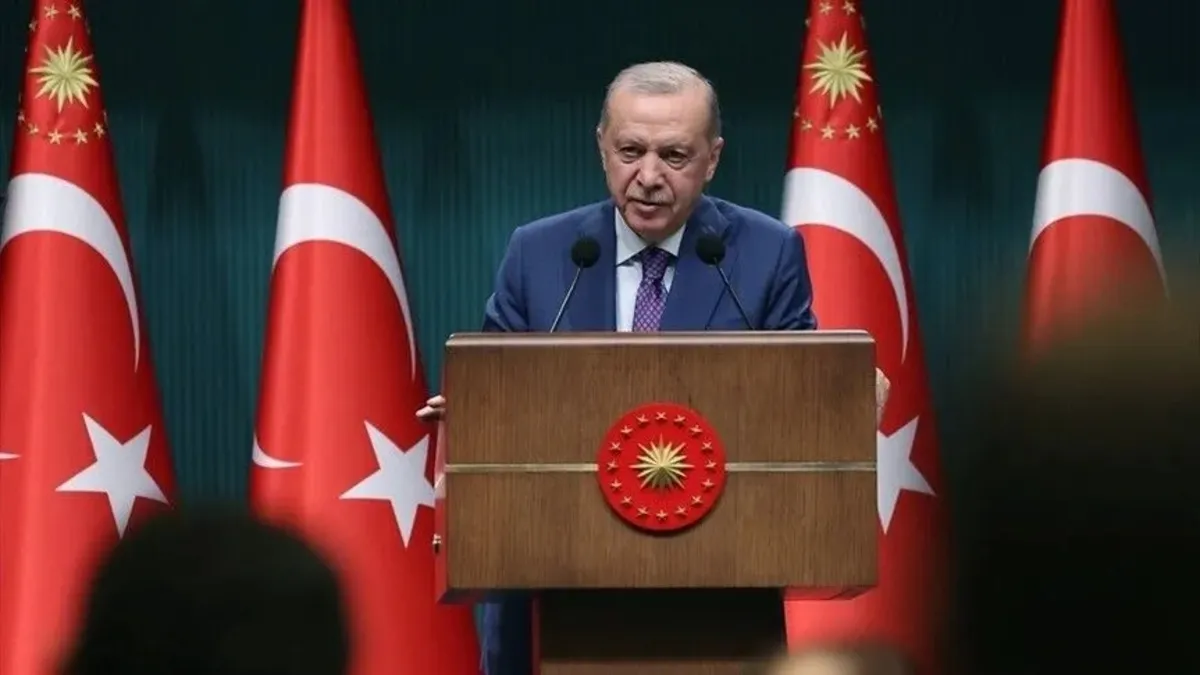
On October 26, 2026, the Turkish government convened for its 74th cabinet meeting, a session that served as a platform for President Recep Tayyip Erdoğan to clarify the nation’s trajectory amidst a complex geopolitical landscape. The meeting, which touched upon internal politics, economic stability, security, and the intricacies of foreign policy, underscored a period of intense activity for the administration. As the President noted, the cabinet had been witness to developments that have significantly expanded Turkey’s sphere of influence in the international arena since their previous gathering.

Before addressing the broader political horizon, the President opened the proceedings with a somber note of national mourning. A military vehicle accident in Ankara had claimed the life of an Albay named Gökgöz. In his remarks, President Erdoğan extended his condolences to the family of the fallen officer, his colleagues, and the Turkish Armed Forces, offering prayers for the deceased and acknowledging the sacrifice inherent in the service of the nation’s security.
Central to the cabinet’s deliberations was the maritime jurisdiction agreement with Libya, a deal that has drawn significant attention from global powers. President Erdoğan was unequivocal in his defense of the accord, rejecting the criticism leveled by international actors, most notably the European Union. He dismissed these reactions as lacking any legitimate justification, framing the agreement as a vital component of Turkey’s national interest. The President’s message to the international community was firm: Turkey is not a country that can be subjected to external operations or forced to abandon its strategic objectives.
He dismissed these reactions as lacking any legitimate justification, framing the agreement as a vital component of Turkey’s national interest.
Beyond the specifics of maritime law, the President addressed what he described as attempts to undermine the state through domestic political pressure. Responding to opposition figures, Erdoğan emphasized that Turkey is not a nation that was found on the street, nor is it a country that can be surrendered to the chaos of the streets. This rhetoric served as a clear signal of his administration’s commitment to maintaining internal stability and social order, framing the government’s resilience as a non-negotiable pillar of his leadership.
In a pointed segment of his address, the President turned his attention to the media landscape and the accusations regarding press freedom. He challenged those who utilize the banner of press freedom to attack the state, suggesting that these critiques are often a veil for hidden agendas. He issued a direct call to his detractors: if they are capable, they should step forward and explain their own distorted and dirty relationships rather than hiding behind rhetoric. This confrontation highlights the ongoing friction between the executive branch and its critics, with the President positioning his administration as the defender of the nation against what he characterizes as disingenuous political maneuvering.
As the administration looks outward, it continues to balance a diverse array of diplomatic relationships. The cabinet meeting served as a reminder that Turkey’s foreign policy remains active, with the President highlighting ongoing efforts to maintain stability and foster cooperation with a wide range of partners, including nations as geographically distant as Cambodia and Canada. These relationships, according to the President, are part of a broader, consistent effort to ensure that Turkey remains a central, influential player in global affairs, capable of navigating economic and security challenges while asserting its own sovereign path.