
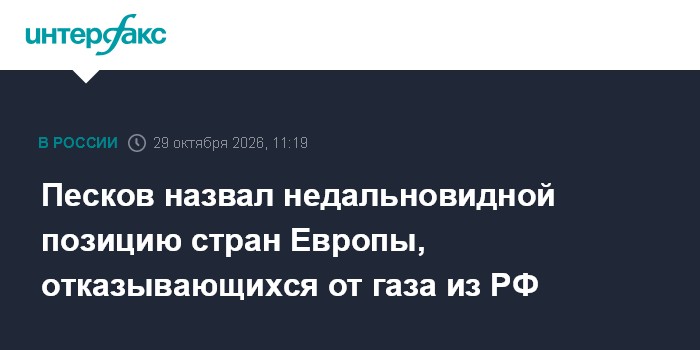
In late October 2026, Dmitry Peskov, the press secretary to the Russian President, delivered a stark assessment of Europe's energy strategy. "Is this a far-sighted position? Definitely not," Peskov declared, characterizing the European Union's decision to reduce reliance on Russian energy resources as deeply unwise. The Russian official framed this shift not as a strategic move, but as a self-inflicted wound that would harm the very economies Europe sought to protect.
Peskov argued that the prosperity of European economies has long rested upon a foundation of affordable energy resources from Russia. "The prosperity and competitiveness of the European economy were largely based on cheap energy resources from Russia, on cheap pipeline gas," he explained. According to this perspective, Europe's economic growth over recent years was inextricably linked to access to Russian energy at favorable prices, creating a competitive advantage that now appears to be deliberately discarded.
Perhaps most striking was Peskov's colorful metaphor: "They are now cutting the branch they are sitting on." This Russian idiom perfectly captures his view that Europe is actively undermining its own economic stability by rejecting Russian energy resources. The press secretary suggested that this decision would not only eliminate a key competitive advantage but would also contribute to the worsening economic situation across the continent. "Europe should not rule out buying gas from Russia in the future," Peskov cautioned, implying that the current rejection of Russian energy was both economically damaging and potentially short-sighted.
The Russian narrative presents a clear prediction: as Europe distances itself from Russian energy, it will face economic challenges.
From the Kremlin's viewpoint, Europe's energy transition represents a fundamental misunderstanding of economic interdependence. Peskov's statements consistently portrayed Russia not as a political adversary but as an essential economic partner whose resources contributed directly to European prosperity. The criticism suggests that Russian officials believe Europe is making an emotional rather than rational decision, prioritizing political considerations over economic realities.
The Russian narrative presents a clear prediction: as Europe distances itself from Russian energy, it will face economic challenges. Peskov's characterization of Europe's position as "unwise" and "not far-sighted" reflects a confidence that the economic consequences will soon become apparent.
As Europe continues its energy transition away from Russian resources, the debate over economic consequences versus political independence remains central. Peskov's comments represent one perspective in this complex conversation, emphasizing the historical economic ties between Russia and Europe and warning against what he sees as a damaging rupture in those relationships. The full impact of Europe's energy decisions may take years to materialize, but according to the Russian assessment, the early signs already point toward economic challenges ahead.