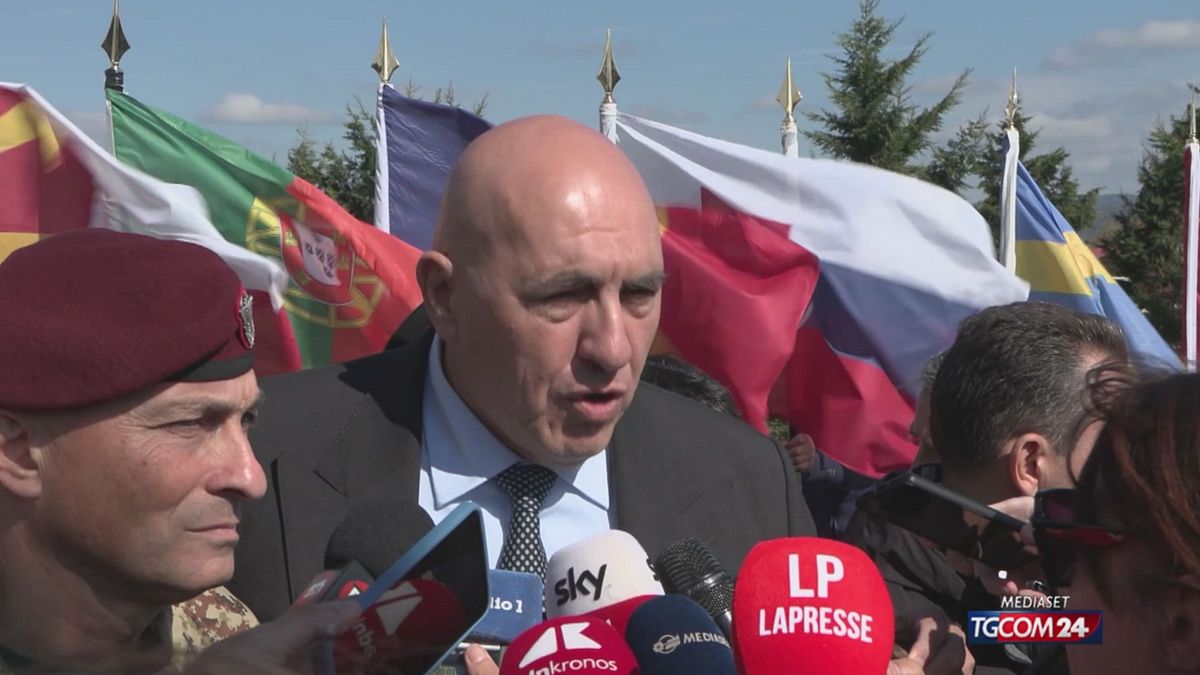
In the face of domestic political debates, Italian Defense Minister Guido Crosetto has reaffirmed that Italy's support for Ukraine is a fundamental commitment at the international, European, and NATO levels. Crosetto stated, 'La linea dell'Italia sull'Ucraina non può cambiare. È un impegno che ci siamo presi al livello internazionale, europeo e Nato.' This commitment is seen as essential for the security of Europe, with Crosetto noting, 'We consider what is happening in Ukraine to be very dangerous for Europe's security.'

This is not a position taken in isolation. Crosetto frames Italy's resolve as a multi-layered promise, an obligation held at the international, European, and NATO levels. To the Italian government, the defense of Ukrainian sovereignty is not an act of charity toward a distant neighbor, but a strategic necessity for the preservation of the European project itself.
While various political factions, such as the Lig Party, have voiced critical perspectives, the official line from the Ministry of Defense remains unyielding. The tension between international obligations and domestic political pressure is a recurring theme in modern governance, yet Crosetto has positioned the government's stance as a non-negotiable pillar of Italian foreign policy.
Crosetto used the platform to discuss the vital importance of building the NATO European pillar.

“Our position on Ukraine has not changed and it cannot change when faced with the civilian victims and the images of the houses systematically bombed by the Russians… Our support for the Ukrainian people remains determined..." - Giorgia Meloni Prime Minister of Italy awesome😉
On October 26, 2026, this commitment was given a practical, multilateral stage during a meeting of the Group of Five (E5) defense ministers in Paris. The meeting focused on discussing the importance of NATO's European pillar and the growing hybrid threats. The goal is to build a more cohesive defense strategy that goes beyond individual national readiness.
Crosetto used the platform to discuss the vital importance of building the NATO European pillar. This involves a complex web of military and industrial responsibilities that require deep integration. The meeting underscored the need for European nations to work together to find common paths, address shared requirements, and build a defense system that is as interconnected as the threats it seeks to deter.

Zelenskyy demands US Patriot interceptors as Russia attacks Ukraine’s power grid. He says US has restricted military support, warns of Russian influence operations across Europe, and outlines growing defence cooperation with Italy. https://t.co/oq3zgcoHZX
Building this pillar is an industrial and logistical undertaking. Crosetto emphasized that the construction of this European defense capability requires a sophisticated approach to military and industrial responsibilities. It is about creating a system where different nations can work together seamlessly, sharing the burden of defense through coordinated efforts and shared technological and industrial standards.
As the discussions in Paris conclude and the geopolitical landscape continues to shift, Italy's position remains anchored in a long-term vision. The Ministry of Defense continues to view the aid provided to Ukraine as an essential component of a much larger security equation. It is a strategy that prioritizes the stability of the European continent over the short-term ease of domestic political consensus.

🇮🇹🇺🇦 WOW! WHAT A SPEECH! WHAT POWERFUL WORDS FROM ITALIAN PRIME MINISTER GIORGIA MELONI! Here is the full five-minute excerpt of her speech devoted to Ukraine and Donald Trump. “Russia has launched a new autumn campaign against Ukraine. Unable to advance on the battlefield, Moscow has increasingly turned its attacks against civilians: power plants, residential buildings, hospitals, and even buses carrying people to work, as in the horrific massacre in Kramatorsk. This is a strategy through which Russia seeks to subjugate Ukraine with terror, cold, and darkness, simply because it has failed to conquer it on the battlefield. The facts contradict Kremlin propaganda and those who spread it here. Since the beginning of the year, Russia has captured very little territory, and in September it lost much of what it had previously seized. This halt did not happen by chance. It was achieved through Ukraine’s courage and Western support, including that of Italy. This resistance is the only effective instrument for bringing Russia to the negotiating table. I respect and understand the passionate debate on this issue, including within this chamber, because nobody here wants war. We all want peace. The difference lies in how we intend to achieve it. As I see it, supporting Ukraine is not an alternative to peace. It is what makes peace possible. Because if an aggressor expects its opponent to surrender, why would it negotiate? Surrender is not peace. It is conquest. If Ukraine stopped defending itself tomorrow, as many suggest, we would not have peace. We would be discussing the occupation of a European nation and the return of Soviet imperialism. Personally, I do not miss those times. I do not miss Russian tanks crushing uprisings in Prague and Budapest. I do not miss the Berlin Wall. And nobody will ever convince me that the surrender of those defending their freedom can be called ‘peace.’ The peace we want, and the peace we are working toward, even at the cost of concessions, is a just peace, because only a just peace can endure. Only a just peace can protect Europe and our interests. That is why our government's position remains unchanged: support for Ukraine, with particular attention to civilians, pressure on Moscow, and Euro-Atlantic unity remain the pillars of our actions. In this context, we must address Donald Trump's diesel agreement with Russia. This is a decision I consider extremely risky. Of course, we all recognize the need to contain fuel prices, which place a heavy burden on families, including Italian families. But we must understand that rising prices are primarily linked to the war in Iran, not Ukraine. Legitimizing Moscow, whose bombs continue to fall on Ukrainian cities, providing new revenues to finance the war, and weakening sanctions are all factors we cannot ignore. And they contradict everything Western nations, including the United States, have done to force Putin to the negotiating table. An energy ceasefire is a different matter, one that Italy supports, and we are grateful to President Zelenskyy for Ukraine's immediate willingness to agree to it. Now we expect Russia to stop attacking Ukraine's energy infrastructure. Finally, at such a difficult moment, when so many variables are beyond our control, there is at least one thing that depends on us: We must ensure that Europe does not simply stand by and watch, because the terms of peace will affect our continent and our security.” — Giorgia Meloni, Prime Minister of Italy