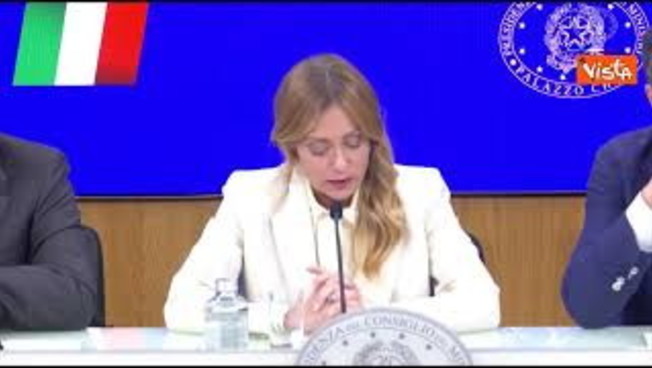
On the evening of October 28, 2026, Giorgia Meloni, the President of the Council, stood before the press outside Palazzo Chigi to address the complexities of Italy’s fiscal landscape. The announcement followed a Council of Ministers meeting that had just wrapped up a significant phase of the government’s economic planning. Meloni sought to clarify the nature of the recent measures, emphasizing that the initiative was not a maneuver directed against any specific political group. Instead, she framed the actions as a response to a difficult moment, a period where the state was asked to extend a hand to those with fewer resources. In this context, the government’s commitment to coherence and a linear, long-term strategy became the central theme of her address, setting the stage for a detailed breakdown of the financial and regulatory changes ahead.

To underscore the sincerity of the state’s efforts, Meloni highlighted a specific internal adjustment: the reduction of ministry budgets. This internal austerity measure is designed to save approximately 1 billion euros. The rationale is straightforward yet symbolic. By cutting its own administrative costs, the state provides a "good example" to the citizenry. It is a tangible demonstration that the government is sharing in the burden of fiscal tightening. This move is part of a broader 26 billion euro budget maneuver, a figure that encapsulates the scale of the financial restructuring underway. Meloni argued that this approach avoids the pitfalls of unstructured spending, stating that the government has not distributed resources in a haphazard manner nor made promises it could not actually keep. The emphasis on precision in budgeting reflects a desire to restore trust in public institutions through measurable action rather than rhetorical flourish.
Turning to a more consumer-facing aspect of the new regulations, Meloni introduced a significant change to the Italian Highway Code. The proposal allows vehicle owners to have personalized number plates, provided they choose the content within certain constraints. This feature is not mandatory but optional, available to those who wish to avail themselves of it. The Prime Minister suggested that the creative capacity of Italians would certainly come to the fore in this endeavor. It is a small, modernizing touch that contrasts with the serious tone of the fiscal adjustments. The decree outlining these new rules is scheduled to be issued by spring 2027, ensuring that the regulatory framework is in place well before the new standards take effect.
This balance between personalization and regulation is a key element of the updated Highway Code reform.
The total cost for a pair of personalized plates is set at €600. This price point positions the feature as a premium option, one that reflects a market where individual expression on the road has a tangible financial value. The constraints on the content of the plates ensure that while owners can express themselves, they do so within legal and safety boundaries. This balance between personalization and regulation is a key element of the updated Highway Code reform.
The rollout of these changes is methodically planned. The decree governing the new plate system is to be issued by spring 2027. Following the issuance of the decree, the new rules will officially come into effect on April 30, 2027. This timeline provides a clear window for automotive manufacturers, plate producers, and administrative agencies to prepare. It separates the legislative announcement from the operational implementation, allowing time for the logistical and technical adjustments required to handle personalized requests. The specific date in April 2027 serves as a concrete milestone for the public, marking the moment when the new regulations transition from policy to practice on Italian roads.
Throughout the press conference, Meloni maintained a neutral and supportive stance regarding the measures. The announcement of the 26 billion euro maneuver was presented not as a political score, but as a necessary step in a complex economic environment. By avoiding language that assigned blame to specific parties or sectors, the government aimed to present a united front. The focus remained on the objective need to assist those in need while simultaneously tightening the state’s own belts. This framing was consistent across the three distinct points of emphasis: the internal budget cuts, the overall fiscal maneuver, and the new regulatory options for vehicle owners. Each element was tied back to the central narrative of responsible governance and long-term strategy.
The introduction of personalized plates is explicitly part of a wider reform of the Highway Code. This legislative update aims to modernize vehicle registration and ownership practices. By allowing more flexibility in plate selection, the reform responds to evolving cultural expectations regarding vehicle identity. The decree that will be issued by spring 2027 will codify these changes, establishing the legal basis for the new option. The process is designed to be optional, ensuring that it does not impose new costs or requirements on those who prefer the standard, sequen