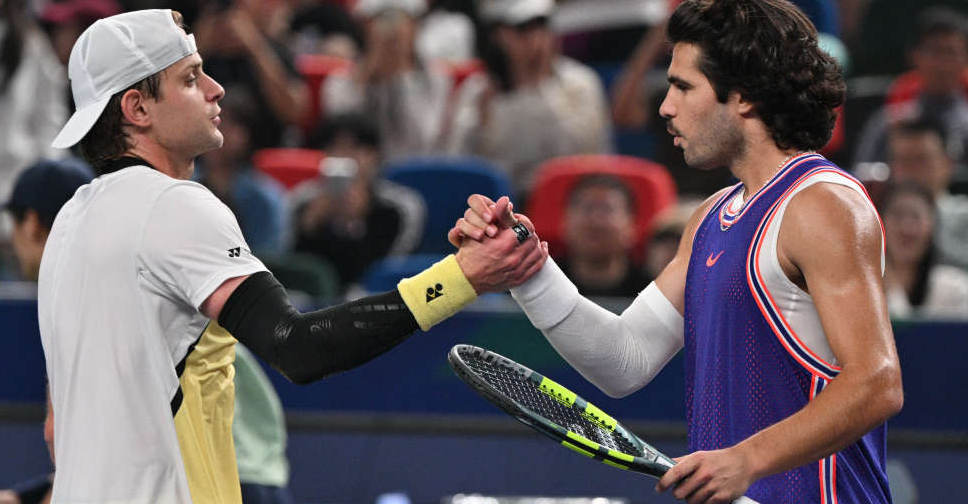
The hierarchy of men’s professional tennis is rarely static, but it is seldom undone by a single afternoon in Shanghai. On October 12, 2026, the ATP Masters 1000 event in China became the stage for a seismic shift in the rankings. The tournament, a grueling test of endurance and precision, often serves as a barometer for the year’s final standings. As the round of 32 commenced, the focus was firmly on the established titans of the court, yet the sport’s unpredictable nature intervened with a result that would ripple far beyond the confines of the stadium.

Carlos Alcaraz, a seven‑time Grand Slam champion whose career has been defined by his meteoric rise and tactical brilliance, entered the match as the heavy favorite. However, his opponent, the unseeded Belgian Zizou Bergs, had other intentions. Alcaraz, who had been sidelined for nearly five months prior to this event, showed clear signs of rust, struggling to find the rhythm that has made him a household name. Bergs capitalized on this vulnerability with clinical efficiency. In a match that demanded absolute focus, Bergs dismantled the Spaniard’s game, securing a victory with set scores of 7‑5 and 7‑6(4). The upset did more than just clear the draw; it sent a shockwave through the tournament, eliminating several high‑profile contenders in one fell swoop.

US Open champion Zverev to become tennis world number one https://t.co/Jhsmr5QTON
While the crowd in Shanghai processed the exit of a superstar, the implications of the result were being calculated in real‑time by the ATP. The defeat of Alcaraz served as the final piece of a complex mathematical puzzle, confirming that Alexander Zverev would finish the 2026 season as the world number one. At 29 years old, Zverev has long been a fixture of the elite circuit, but this achievement elevates him into a singular category. He is now the first German player in history to claim the year‑end world number one ranking, a feat that cements his legacy in the annals of the sport.
With five ATP Masters 1000 titles already to his name, he has demonstrated a capacity to perform under the immense pressure of the tour’s most prestigious events.
Zverev’s path to the top has been characterized by a relentless pursuit of excellence. With five ATP Masters 1000 titles already to his name, he has demonstrated a capacity to perform under the immense pressure of the tour’s most prestigious events. This year‑end ranking is the culmination of that sustained excellence. It is a testament to a player who has managed to navigate the physical and mental demands of the professional circuit with a level of consistency that few of his peers can match. For a player who has often been on the cusp of greatness, this milestone represents the definitive realization of his potential.

US Open champ Zverev to become tennis world number one https://t.co/eWHnvpOimo
Zverev’s achievement marks a historic milestone for German tennis, as he becomes the first player from Germany to finish a season as the world number one. This distinction transcends the court, positioning him as a central figure in the broader narrative of German athletic success.
As the dust settles in Shanghai, the tennis world is left to reconcile with a new reality. The tournament continues without some of its most recognizable faces, but the narrative of the 2026 season has been firmly established. Alexander Zverev stands at the peak, a position earned through years of competition and confirmed by the shifting fortunes of his rivals. While the sport will undoubtedly continue to evolve, the record books will now forever reflect this moment—a day in October when the rankings shifted, a new history was written, and a 29‑year‑old German claimed his place at the top of the world.

US Open champion Zverev to become tennis world number one - https://t.co/8Ogq71LCOp