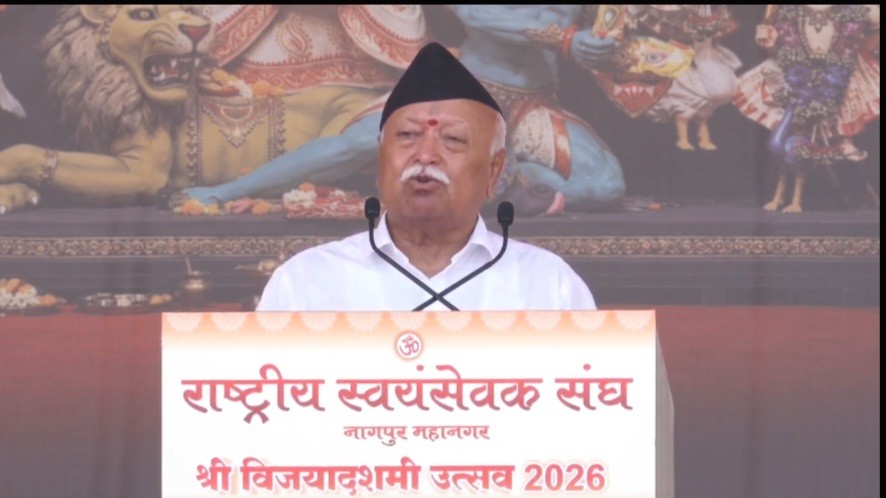
The occasion, steeped in tradition, was more than a ceremonial gathering; it was a clarion call to a country that has long been the crucible of diverse cultures and political currents.

When Bhagwat opened his speech, he began with a stark observation that reverberated through the hall: "A storm has blown in the West. Look at what transpired in France, Bangladesh, and Nepal." The words were a reminder that upheavals in distant lands can ripple across borders, sowing doubt and discord. By citing these examples, he framed the current global unrest as a warning rather than a distant phenomenon.

"Regime change won't happen in India." - Mohan Bhagwat, RSS Chief 🔥🔥
He continued, "No matter how strong emotions run, our actions must stay within the boundaries of the Constitution, the law, and civil decorum." The message was clear: India’s strength lies in its adherence to democratic principles, not in the turbulence of passion. Bhagwat underscored the importance of national consciousness, urging citizens to look beyond fleeting grievances and to embrace a collective identity that respects the rule of law.
The RSS’s own initiatives—Seva, a volunteer service ethos, and Panch Parivartan, a grassroots reform agenda—were highlighted as models for constructive engagement.
The chief’s address took a decisive turn when he declared, "Regime change will not happen in India." He warned that attempts to force a shift in power—whether from external actors or internal factions—are destined to fail. Bhagwat emphasized that such efforts, though present, are futile against the entrenched democratic institutions that have guided India since its independence.

#IssWaqt | How did RSS chief Mohan Bhagwat’s Vijayadashami address highlight the distinction between democratic protests and calls for regime change? Correspondent, @ishailendrain, reports. #RSS #MohanBhagwat #RegimeChange #Protest #CJJ https://t.co/K5gjfW6R2i
Bhagwat urged political parties and movement leaders to prioritize social harmony over opportunism. He argued that public movements should focus on resolving issues rather than stoking social animosity or serving short‑term electoral gains. The RSS’s own initiatives—Seva, a volunteer service ethos, and Panch Parivartan, a grassroots reform agenda—were highlighted as models for constructive engagement.
He emphasized national progress and social unity, reinforcing the message that the government and civil society must work hand in hand to preserve stability. Modi’s endorsement added a layer of political gravitas to the chief’s warnings.

Today, on the special occasion of RSS Sthapana Divas, my greetings to all Swayamsevaks. I also pay homage to all those greats who have nurtured the RSS over the years. The RSS has completed a remarkable century of service, nation-building and social harmony. Countless Swayamsevaks have worked for society with a deep sense of duty and a nation-first spirit. May this spirit keep strengthening national development in the times to come. राष्ट्रीय स्वयंसेवक संघ के स्थापना दिवस के विशेष अवसर पर सभी स्वयंसेवकों को मेरी हार्दिक शुभकामनाएं! मैं उन सभी विभूतियों को भी नमन करता हूं, जिन्होंने अपने अथक परिश्रम और सेवाभाव से संघ को सींचा और संवारा है। राष्ट्रीय स्वयंसेवक संघ ने सेवा, राष्ट्र निर्माण और सामाजिक प्रतिबद्धता का गौरवशाली शताब्दी वर्ष पूर्ण किया है। अनगिनत स्वयंसेवकों ने अपने समर्पण, कर्तव्य-निष्ठा और राष्ट्र-प्रथम की भावना से सदैव समाज के उत्थान के लिए कार्य किया है। मुझे विश्वास है कि यह भावना आने वाले समय में भी देश को और सशक्त एवं सुदृढ़ करेगी। @RSSorg
The address also marked a milestone: the 101st anniversary of the RSS foundation. Bhagwat reflected on the organization’s journey, noting that its longevity is a testament to its commitment to the nation’s values. The anniversary served as a reminder that the RSS’s historical roots are intertwined with India’s modern democratic fabric.
Today, the nation listens to the echoes of Bhagwat’s words. While global unrest continues to cast shadows, India’s constitutional framework remains a bulwark against regime change. The call for unity, legal restraint, and constructive public action remains a guiding principle for those navigating the complex terrain of contemporary politics.