
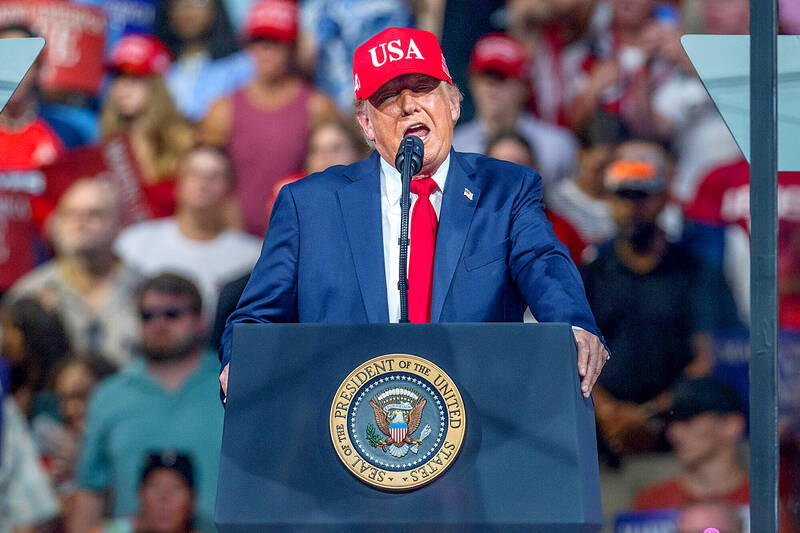
Standing at a podium during a Tuesday campaign rally, Donald Trump announced that Taiwan has officially committed to a massive purchase of American natural gas. The claim centers on a 30 percent stake in the output of the proposed Alaska pipeline, locking the island economy into a 20-year supply relationship. For many onlookers, the announcement sounded like the closing of a historic chapter in trans-Pacific energy trade. Yet for the people tasked with moving that energy—regulators, engineers, and investors—the declaration lands more like an invitation to read the fine print of a contract that hasn't quite been written yet.
The heart of the Trump administration's story is an investment package worth $4.4 billion. This figure represents cash coming out of Taiwan's pockets, separate from the ongoing cost of the gas itself. In the volatile world of global energy markets, such a sum is meant to buy security and predictability. For a state energy company, committing that kind of capital to a fixed 20-year timeline is not merely a financial transaction; it is a bet on the physical reality of the infrastructure that is supposed to deliver the fuel. Trump framed this as a victory for American industry, leveraging the deal to underscore the economic leverage the United States holds over its allies and rivals alike.
It is easy to overlook the fact that the Alaska LNG project is not a blank slate. This pipeline initiative has been on the drawing boards for decades, a slow-burning idea that has repeatedly bumped into regulatory and environmental hurdles. Until recently, it was a classic example of an ambitious plan with an uncertain future. Trump's rally speech attempted to rewrite that history by asserting that all necessary federal permits have now been granted. In the mind of the public, this transforms the project from a waiting room into a construction site, even though the reality of laying thousands of miles of pipe through the Alaskan wilderness is a task that resists such simple bureaucratic conclusions.
It is a preliminary document that says, "We are interested, and we are serious," but it does not carry the same legal weight as a definitive supply contract.

AMERICAN ENERGY DOMINANCE. President Trump did what other Presidents couldn't: secured the crucial 800-mile Alaska LNG pipeline, the largest energy infrastructure project in the history of Alaska. 🇺🇸 https://t.co/mRGghllcAR
To understand why this announcement feels premature, we must look back to early March 2025. That was the month when the CPC Corporation, the state energy giant of Taiwan, signed a letter of intent regarding imports from Alaska. It is a crucial distinction in the language of international commerce: a letter of intent is a handshake, not a signature on the final deed. It is a preliminary document that says, "We are interested, and we are serious," but it does not carry the same legal weight as a definitive supply contract. By the time Trump took the stage on Tuesday, he was speaking the language of a closed deal, while the actual documents on the table remained in their earlier, flexible stage of negotiation.
The numbers in this story do not stop at $4.4 billion. Tucked into the wider proposal for the pipeline project is a proposed $54 billion investment from South Korea. This figure is astronomical compared to the Taiwanese commitment. It suggests that the pipeline's survival might depend more on a larger, perhaps more elusive, funding partner than it does on the island economy in the West. If the Korean money evaporates or stalls, the $4.4 billion from Taipei could leave the project stranded with a massive chunk of the cost still uncovered. The 30 percent commitment from Taiwan acts as a down payment in a much larger game, and its value is heavily dependent on whether the rest of the capital actually materializes.

President Donald Trump said Taiwan agreed to buy 30% of the gas from a liquefied natural gas pipeline project in Alaska over the next 20 years, touting the initiative ahead of midterm elections https://t.co/1wtLt0C4lc
The most controversial aspect of the rally speech is the status of federal permits. In the world of infrastructure, a permit is not just a checkbox; it is a living document that can be challenged, appealed, or overturned by the courts. For a project with decades of baggage, the regulatory path is rarely a straight line. By declaring the permits secured, the White House is attempting to preemptively silence the environmentalists and policymakers who have spent years arguing that the project’s ecological footprint is too large to justify the investment.
Taiwan's stance on this matter is supportive. For a state that imports nearly all of its energy, diversifying its supply chain and ensuring a reliable partner in the Pacific Northwest is a strategic priority. The CPC Corporation is the vehicle for that strategy, and their willingness to engage with the Alaska project in March 2025 shows a genuine appetite for the gas. However, as the deal moves from the letter of intent stage to a formal 20-year contract, the risks for the buyer increase. The island is effectively tying its economic future to a pipeline that is still a work in progress, hoping that the political push from Washington will be enough to keep the ground from shifting under its feet.