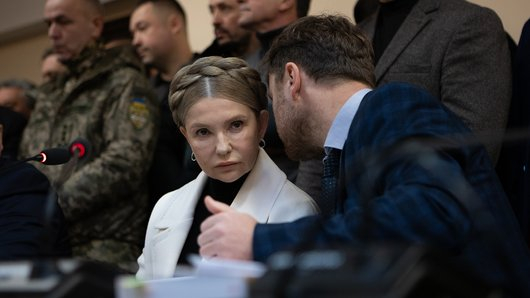
For Yulia Tymoshenko, the leader of the 'Fatherland' parliamentary faction and a long-standing figure in Ukrainian politics, the courtroom has become an unexpected theater of financial struggle. On October 26, 2026, the High Anti-Corruption Court of Ukraine (VAKS) issued a ruling that fundamentally altered the terms of her ongoing legal ordeal. The court decided to slash her bail requirement from a staggering 33 million hryvnias down to 266,000 hryvnias, a move that brought immediate relief to a case that had been defined by its astronomical financial demands.

The legal pressure surrounding the People’s Deputy stems from serious accusations: she is charged with attempting to bribe three deputies from a rival faction to secure their votes. In the eyes of the prosecution, this was not merely a political maneuver but a criminal act that warranted a substantial preventive measure. The initial bail, set at 33.2 million hryvnias, was framed by the state as a necessary guarantee, given the gravity of the charges and the assertion that the defendant possessed the financial means to meet such a high threshold. Prosecutors maintained that the amount was appropriate for someone in her position, suggesting that the bail served as a necessary tether to the judicial process.
Tymoshenko, however, viewed the initial figure as an instrument of pressure rather than a standard legal requirement. She argued that the bail amount was both excessive and disproportionate, effectively creating an insurmountable barrier that ignored her actual financial circumstances. "I asked to reduce the bail amount, stating that the preventive measure in the form of a 33 million hryvnia bail was 'excessive and disproportionate'," Tymoshenko stated during the proceedings. Her defense team leaned heavily into the argument that the court’s initial demand was disconnected from reality, serving as a punitive measure before any verdict had been reached.
She has suggested that the legal machinery currently directed at her is designed to sideline her influence and obstruct the activities of the 'Fatherland' faction.
Beyond the technical arguments over currency and liquidity, the case carries the heavy weight of political suspicion. Tymoshenko has consistently maintained that the charges against her are not rooted in a pursuit of justice, but in political motivation. She has suggested that the legal machinery currently directed at her is designed to sideline her influence and obstruct the activities of the 'Fatherland' faction. This narrative of political persecution has been a central pillar of her response to the court, framing the prosecution’s demands as part of a broader strategy to neutralize her role in the parliamentary landscape.
The friction between the prosecution’s view of her wealth and her own claims of financial limitation was further complicated by the physical evidence gathered by investigators. During the investigation, authorities seized 40,000 dollars from her office, a sum that the prosecution likely pointed to as evidence of available resources. Yet, for Tymoshenko, these seizures and the subsequent bail demands were part of a pattern of overreach. She has maintained that she simply does not have the millions demanded by the court, a claim that the VAKS eventually acknowledged by significantly lowering the financial bar for her release.
The ruling on October 26, 2026, marks a pivotal shift in the trajectory of the case. By reducing the bail to 266,000 hryvnias, the court has effectively acknowledged that the initial figure was unsustainable. Furthermore, the decision includes a provision for the return of funds to those who had already provided bail in January, signaling a correction in the court’s approach to the preventive measures. As the case moves forward, the focus remains on the core allegations of bribery, but the battle over the terms of her freedom has already underscored the deep-seated tensions that define the current political and judicial climate in Ukraine.