
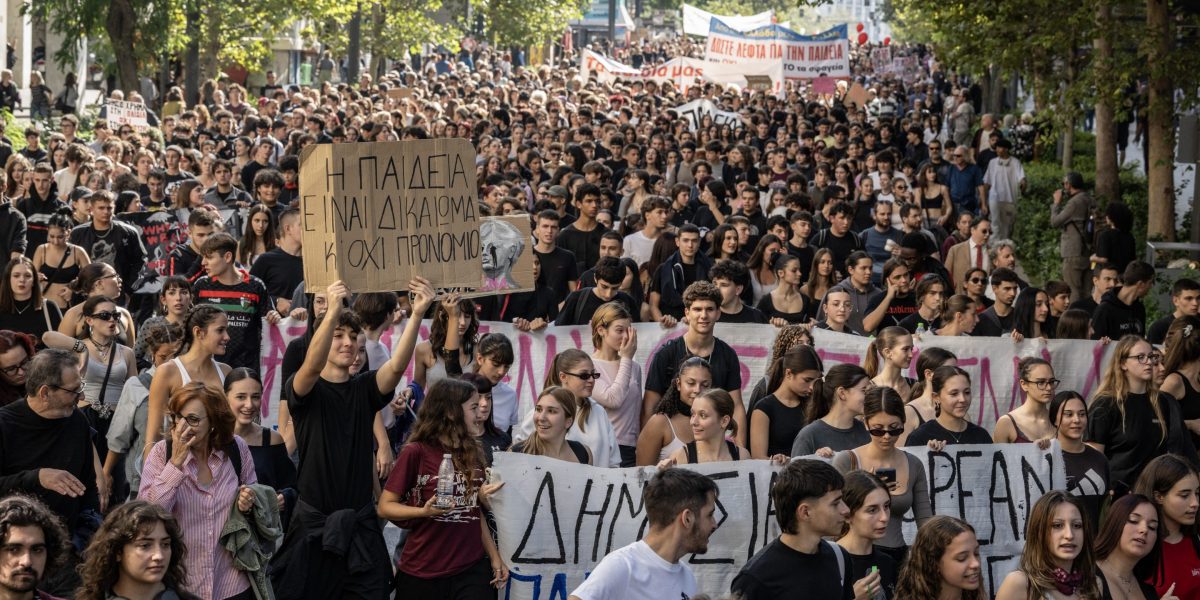
On October 21, 2026, the streets of Athens did not merely echo with the usual urban hum; they vibrated with the collective frustration of ten thousand people. This was not a localized grievance but a widespread surge of public anger that rippled across the Greek landscape. In Athens, the sheer scale of the demonstration signaled a profound breakdown in the relationship between the state and its citizens. The marchers were not a monolith; they were a coalition of the essential—students looking toward a precarious future, teachers fighting for the dignity of their profession, and doctors struggling to maintain a healthcare system under immense pressure.

The unrest was not confined to the capital's sprawling boulevards. The spirit of dissent traveled north to Thessaloniki and west to Patras, creating a multi-city wave of protest that paralyzed various hubs of Greek life. These demonstrations were fueled by a convergence of crises: the skyrocketing cost of living and a perceived systemic neglect of the nation's foundational institutions. As citizens gathered in these major cities, the demands remained strikingly consistent: more state investment in education and healthcare, better working conditions, and wages that actually reflect the reality of modern inflation.
At the heart of the movement is a desperate plea for the future of Greek education. Students and teachers have become the vanguard of this struggle, arguing that the current level of state funding is insufficient to sustain a functional learning environment. For students, the crisis is not merely academic; it is existential. The cost of living has turned the simple act of pursuing a degree into a financial gauntlet. The demand for affordable student housing has moved from a peripheral concern to a central pillar of the protest movement, as the lack of stable living conditions threatens to derail the next generation of Greek professionals.
Parallel to the student outcry is the growing resentment among the professional class.
While the government has attempted to signal its support through specific measures, those on the ground see these gestures as fundamentally inadequate. One such measure is a monthly rent subsidy intended to assist students in finding housing. However, the math simply does not add up for those living in the current market. The subsidy, set at 120 euros—roughly $135—is viewed by many as a tokenism that fails to address the scale of the problem. Critics point out that such an amount does not even cover half of a typical rent payment, and the timing of the disbursement, often arriving only at the end of the year, offers little relief to those facing immediate monthly expenses.
Parallel to the student outcry is the growing resentment among the professional class. Doctors and teachers have joined the fray, protesting against staff cuts that threaten the quality of public services and low salaries that fail to provide a livable wage. This is a workforce stretched thin, facing a landscape where the tools they need to perform their jobs are being stripped away even as the demand for their services remains high. The intersection of healthcare and education protests suggests a broader sentiment: a feeling that the social safety net is being systematically unraveled.
The demonstrations have not been without physical consequence. In Athens, the tension between protesters and authorities resulted in 21 arrests. The unrest was mirrored in Thessaloniki, where 10 people were detained following conflicts with police. These flashpoints of violence underscore the volatility of the current political climate, where the frustration of the populace is meeting the rigid enforcement of the state, creating a cycle of confrontation that complicates any path toward peaceful resolution.

A wave of cost-of-living, education and housing protests swept across Europe, with France at the center and violent clashes in several cities. 🇫🇷 France: About 550,000 marched nationwide; Limoges town hall and a Lyon tourist office were set on fire, around 1,800 people were arrested and about 150 police officers injured. 🇧🇪 Belgium: Student-led protests in Brussels and Liège turned violent, with police using tear gas and water cannons and making about 45 arrests in Liège. 🇮🇹 Italy: About 100,000 marched peacefully in Rome, while clashes near Milan’s Duomo led to around 50 detentions. 🇵🇹 Portugal: Tens of thousands protested the housing crisis and low wages, with demonstrators camping overnight in Lisbon. 🇦🇱 Albania: Student-led protests demanding Prime Minister Edi Rama’s resignation entered a fifth day, with hundreds detained and more than 120 police injured. 🇪🇸 Spain: An ongoing housing movement has drawn mass marches and protest camps, contributing to the snap election set for November 29. The protests are largely uncoordinated but share anger over rising prices, housing costs and underfunded public services, and early signs of mobilization have been reported in Greece, Germany and Austria.
Greece is not an island in this struggle, at least not metaphorically. The protests occurring on October 21, 2026, mirror a broader European trend of dissatisfaction. Similar demonstrations have been observed in France and Italy, where rising living costs and the perceived inadequacy of state investment in public sectors have ignited similar sparks of discontent. This suggests that the Greek experience is part of a larger, continental tension between the economic realities of the modern era and the traditional responsibilities of the state.
As the dust settles on these latest marches, the political stakes for the Greek government continue to climb. With parliamentary elections expected in 2027, the current administration is navigating an increasingly treacherous landscape. The demands for increased wages, improved working conditions, and significant state investment in the pillars of society are not merely requests; they are challenges to the government's ability to govern effectively. For now, the streets remain a barometer of a nation in flux, waiting to see if the voices of the ten thousand will be met with systemic change or continued austerity.