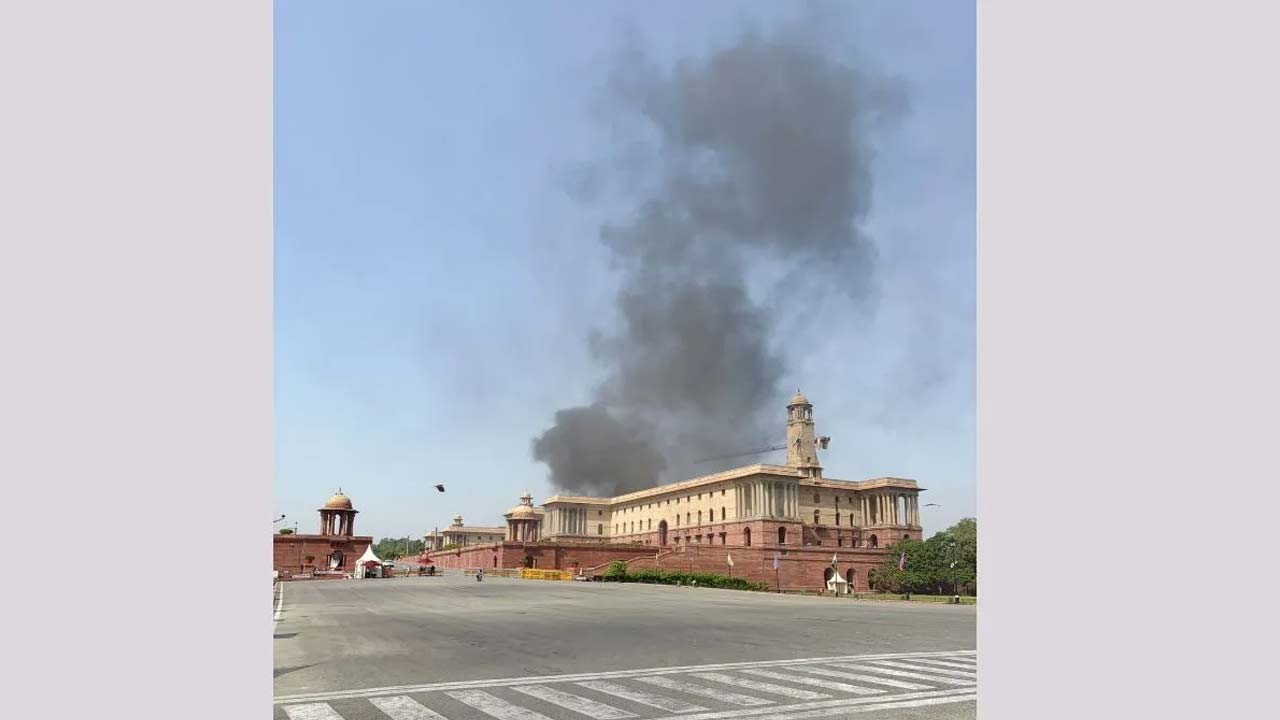
On the morning of October 26, 2026, the quiet order of New Delhi’s administrative center was interrupted by a sight that immediately commanded attention. Near the Rashtrapati Bhavan—the sprawling, iconic residence of the President of India—thick smoke began to billow from the North Block. The building, a cornerstone of the capital’s government infrastructure, is a site of immense historical and political weight. For those passing through the area, the sight of dark clouds rising from such a sensitive location served as an immediate, jarring reminder of how quickly the routine of governance can be disrupted.

Among those who witnessed the unfolding scene was Rajya Sabha MP Milind Deora. As he was traveling toward the Parliament building, he noticed the smoke rising from behind the North Block. Capturing the moment, Deora shared a photograph on social media, noting, "While going to Parliament, I saw thick smoke rising from behind the North Block. It seems like a fire has broken out there. I hope everyone is safe and emergency services are acting quickly." His reaction reflected the immediate concern felt by many, as the North Block is not merely an office building but a symbol of the state’s operational stability.
Within moments of the smoke being reported, the Delhi Fire Services mobilized. The gravity of the location necessitated an immediate and significant deployment. Six fire engines were dispatched to the scene, their sirens cutting through the morning air as they converged on the North Block. The objective was clear: to contain the situation before the fire could spread through the aging structure, which houses critical government offices and archives. The speed of the response underscored the preparedness of the city’s emergency services, who are tasked with protecting some of the most high-security zones in the country.
The North Block, like many of the historic government buildings in the area, is subject to ongoing maintenance and construction efforts.
As the smoke cleared and the fire was brought under control, investigators began to piece together the cause of the alarm. According to officials from the Delhi Fire Services, the incident was not the result of a malicious act, but rather a minor spark that had ignited during welding work taking place on the building's roof. The North Block, like many of the historic government buildings in the area, is subject to ongoing maintenance and construction efforts. In this case, the routine work of building repair had inadvertently created a hazard, turning a standard construction project into a high-stakes emergency.
While the fire at the North Block was successfully extinguished with no casualties reported, it was not the only emergency to occupy the city's fire crews recently. The incident followed a separate fire at the Karkardooma Court complex, where authorities had deployed eight fire engines to manage the situation. Much like the event at the North Block, the Karkardooma incident was resolved without loss of life. These back-to-back events have served as a stark reminder of the constant vigilance required to maintain safety within the capital's dense and aging infrastructure.
By the time the situation was fully contained, the immediate threat to the North Block had passed. The investigation into the exact circumstances surrounding the welding work remains ongoing, a standard procedure for any incident occurring within such a high-security perimeter. For now, the North Block stands as it did before—a silent, stoic witness to the workings of the Indian state. The smoke has dissipated, the fire engines have returned to their stations, and the machinery of government continues, though the day serves as a quiet testament to the fragility of even the most fortified centers of power.