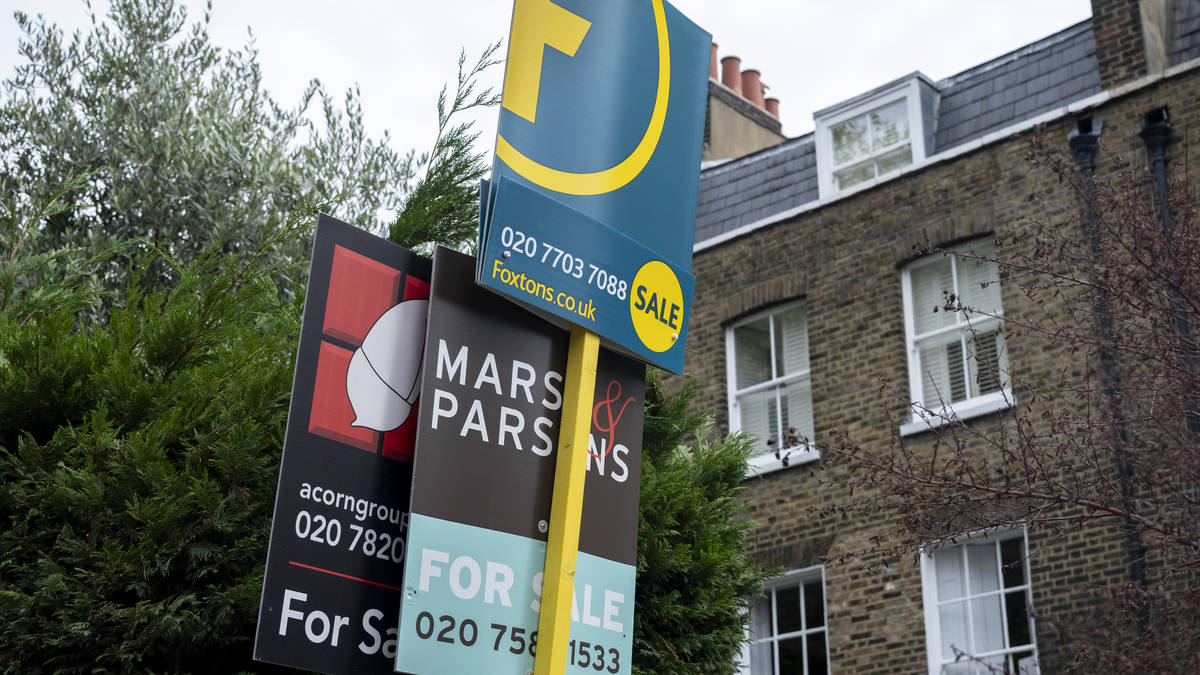
For years, the British housing market has been defined by a relentless upward trajectory, a reliable engine of wealth for homeowners and a daunting hurdle for those looking to enter. But as of October, that engine has begun to sputter. The latest data reveals that annual house price growth has slowed to just 0.5%, the weakest pace of expansion seen since January 2024. This deceleration is not merely a statistical blip; it is a reflection of a fundamental shift in the psychology of the British buyer, who is increasingly choosing caution over commitment.

To understand the current stagnation, one must look back to the late summer. In September, property values grew by 0.8%. However, the market’s underlying fragility was exposed as the broader economic environment—characterized by persistent inflationary pressures and the looming shadow of energy price hikes—began to weigh heavily on household budgets.
For the average Briton, the financial reality of the housing market has become increasingly difficult to navigate. As Robert Gardner, Nationwide’s chief economist, noted, the market’s current state is a direct reflection of an "uncertain economic backdrop" that has dampened both activity and price growth.
Jonathan Hopper, a prominent voice in the sector, observes that buyers are currently "spoilt for choice.
Perhaps the most telling indicator of the market's health is the volume of mortgage approvals. Mortgage approvals for house purchases have fallen, sitting notably below the average observed over the previous six months. When fewer people are being approved for loans, the ripple effect is immediate: demand softens, and the competitive frenzy that characterized the post-pandemic market begins to evaporate.
This shift in momentum has fundamentally altered the power dynamic between buyers and sellers. In much of southern England, the market has transitioned into what experts describe as a buyer’s surplus. Jonathan Hopper, a prominent voice in the sector, observes that buyers are currently "spoilt for choice." In this environment, those who have the flexibility to walk away from a deal have little incentive to meet a seller’s optimistic asking price, leading to a standoff that further suppresses transaction volume.
While domestic economic factors are the primary drivers of this slowdown, they are being compounded by external forces. Geopolitical tensions, particularly the conflict in the Middle East, have introduced a layer of anxiety that discourages major financial commitments. Furthermore, the persistent burden of high energy bills has left many households with less disposable income to dedicate to mortgage payments. Experts at Pantheon Macroeconomics suggest that while holding prices steady in October is a "decent result" given the circumstances, the market remains vulnerable to expectations of further interest rate hikes.
As we look toward the final months of the year, the outlook remains guarded. Robert Gardner has warned that "forward-looking indicators suggest further softness in the near term." The hope among many analysts is that the market will find its footing once the current energy price shock begins to fade. Until then, the British housing market remains in a state of watchful waiting, defined by a cautious public and a landscape that is no longer moving in a single, upward direction.